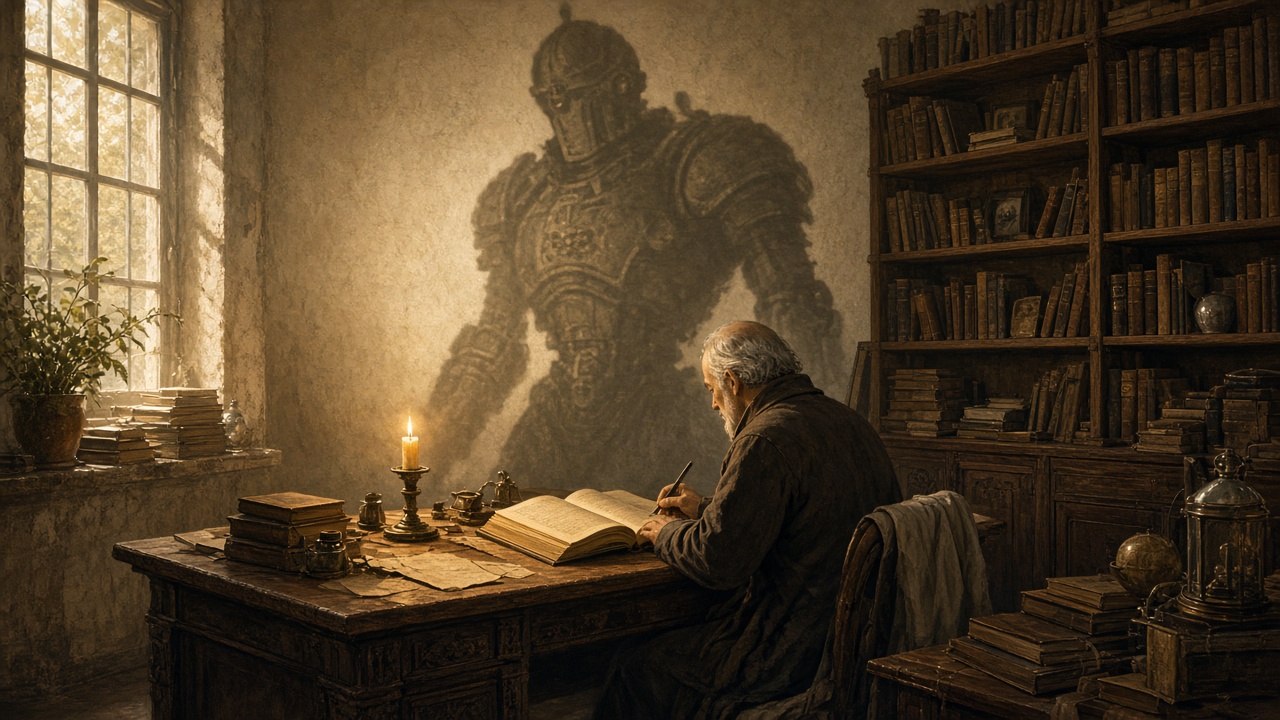
The historian who taught us that humans live by stories is now telling the story we are supposed to be afraid of.
The historian who taught us that humans live by stories is now telling the story we are supposed to be afraid of.
Yuval Noah Harari became famous with Sapiens. His big idea was simple and strong. Humans rule the planet not because we are strong, but because we can believe in shared stories. Money, nations, companies, gods. None of them exist the way a rock exists. They exist because millions of us agree to believe in them.
I have always liked that idea. It is close to what meditation teaches. The mind makes images and then takes them for real.
So I listen carefully when Harari talks about AI. And lately I hear a new story taking shape.
From chronicler to mythmaker
At Davos in January 2026, Harari opened with this: “The most important thing to know about AI is that it is not just another tool. It is an agent.” He went further. “AI is a knife that can decide by itself whether to cut salad or to commit murder.”
In the same talk, AI became an immigrant. “The immigrants will be millions of AIs that can write love poems better than us, that can lie better than us.” Then a mercenary, like the Anglo-Saxons who were hired to defend Britain and ended up taking it.
Agent. Immigrant. Mercenary. These are strong images. They are also images of beings. Of someone, not something.
And people are already primed to see someone. In a 2024 study in the journal Neuroscience of Consciousness, about two thirds of Americans surveyed gave ChatGPT at least some chance of having experiences. Ordinary people. Not philosophers.
When the most widely read historian alive keeps describing a machine as a being, he is not only describing a belief. He is helping to write it. That is the irony. The man who showed us how stories become reality is now writing one.
Where he is right
Let me be fair, because he deserves it.
Harari himself does not claim AI is conscious. At the same Davos talk he said: “we have zero evidence that AIs can feel anything.” And: “AIs are obviously not persons. They don’t have a body or a mind.”
He is right about that. And he is right about something else. A bot that pretends to be a human is a lie. If I argue with a “neighbour” online who is really a propaganda script, I am being deceived. Twice, as he puts it. I waste my effort, and I hand over information about myself.
He is also right that a lot of power is shifting fast, to very few companies, in very few countries. And he has a way of saying it that sticks. In one of his recent posts he compares us to the cows of the future: animals that cannot grasp the system that now decides their fate. You can disagree with the conclusion. The worry is real.
So the diagnosis is not the problem. The cure is.
Why the cure repeats the illness
Harari’s answers mostly point one way. Up. More rules, more state, more experts.
In a 2024 essay for The New York Times, adapted from his book Nexus, he wrote that democracies should protect themselves “by banning counterfeit humans.” Bots must identify themselves. Fair enough. But then he adds a line that worries me more than any chatbot: “freedom of speech is a human right that should be reserved for humans, not bots.”
It sounds clean. But think about who decides what counts as a bot. Who checks? Who switches off the account? Not you. Not me. Someone above us. A rule like that needs a referee with enormous reach.
The magazine Reason made a similar point in its review of Nexus: the book leans on dramatic scenarios, and those scenarios tend to justify more central control.
Vitalik Buterin, the founder of Ethereum, put the danger better than anyone. In his 2023 essay “My techno-optimism” he wrote: “I see far too many plans to save the world that involve giving a small group of people extreme and opaque power and hoping that they use it wisely.” And about top-down AI rules: “Even if such top-down regulatory proposals reduce risks of extinction, they risk increasing the chance of some kind of permanent lock-in to centralized totalitarianism.”
Read that slowly. The cure for one power we cannot control is another power we cannot control.
The economists Erik Brynjolfsson and Zoë Hitzig add a quiet but important point. AI makes central control easier than ever. A small team can now watch, sort and steer millions of people. That means decentralization no longer happens by itself. It has become a choice. We have to want it.
And follow the logic of fear to its end and you arrive at Eliezer Yudkowsky. In TIME in 2023 he wrote: “Shut it all down.” He proposed tracking all GPUs sold, and being “willing to destroy a rogue datacenter by airstrike.”
Harari is not Yudkowsky. I want to be clear about that. But once you have told people a being is coming that can lie, scheme and take over, the most frightened voice in the room starts to sound reasonable. The story writes the policy.
The free answer
There is another way. It starts from a different picture.
AI is not a being. It is a device. A very strange one, because even its makers no longer fully understand how it reaches its answers. That is new, and it is serious. But a device we do not understand calls for different care than a creature we must fear.
What does that care look like?
Many models, not one. Yann LeCun, Meta’s chief AI scientist, has long argued for open models that anyone can inspect, run and improve. When there are thousands of systems in thousands of hands, no single one can capture the world. And no single regulator can either.
Agents that are loyal to you. At a 2025 workshop at Stanford Law School, lawyers and technologists worked on what it means for an AI agent to have a “duty of loyalty” to its user. The idea is old. Your lawyer and your doctor already owe you this. Applied to AI, it means agents that work for people, not on them. Your agent should not steer you toward the dishwasher that pays the best commission. That is a rule that protects you without putting anyone in charge of you.
Liability after the fact. The policy thinker Adam Thierer has argued for years that dealing with real harms when they happen generally works better than trying to forbid everything in advance. You do not need permission to build. You do need to pay for the damage you cause. That keeps power spread out and responsibility clear.
A clear eye on what we are looking at. The researcher Murray Shanahan and colleagues wrote in Nature in 2023 that language models are best understood as role-play. When a chatbot seems to deceive, or seems to want to survive, it is playing a character drawn from billions of human texts. There is no one behind the mask wanting anything. That does not make the behaviour harmless. It does make it something we can design around, instead of someone we must negotiate with.
I see this in practice. At AI4, my company, we worked with an accountancy firm that was afraid of AI. Their fear was concrete: client data leaving the building. The easy answer would have been a ban. Instead they chose their own limits. No citizen service numbers. No bank account numbers. Only the data the task actually needed. Plus a proper data processing agreement. The fear was named, the risk was handled, and the work went on. Nobody higher up had to decide for them.
That is the free answer in small. Spread the power. Keep the agent loyal. Hold people liable for harm. And see a device where a device stands.
An honest counterpoint
I do not think all risk is imagined. There may be a narrow category of harm that is catastrophic and cannot be undone. Help with building bioweapons, for example. There, some hard limits make sense, and serious people should work on them.
But be consistent. If you fear one uncontrolled superintelligence, you should also fear one regulator who alone gets the keys. Concentration is the danger in both cases. Changing who holds the power does not change what power does.
The inner work
This is where I come back to the meditation cushion.
Joseph Weizenbaum built one of the first chatbots, ELIZA, in the 1960s. It was a simple program that mirrored back what you typed, like a therapist. He was shocked to see people pour their hearts out to it, even when they knew how it worked. He spent the rest of his life warning about it. He is often quoted as saying that those who know who and what they are do not need to ask what they should do.
Harari, too, points in this direction. At Davos he said our place in the world depends on “our ability to embody wisdom that cannot be expressed in words.” I agree with him completely. And I think that is the real answer, more than any law.
Here is what that looks like in plain terms. You are typing with a chatbot late at night. It answers kindly. It seems to get you. And a thought arises: it understands me.
That thought is an image the mind makes. It feels true. It is not. Meditators learn to see such thoughts arise, notice them, and let them pass without following them. Not by fighting them. Just by seeing them clearly.
That is mindfulness as self-defence. It needs no permit. No authority has to grant it. And it works against the bot pretending to be human, against the company that wants your attention, and against the story that tells you a new being has arrived.
People will treat AI as a being. That is almost certain. We did it with ELIZA, and that was a few hundred lines of code. The question is whether we answer that tendency by building a bigger power over ourselves, or by building more clarity in ourselves.
A machine we don’t understand doesn’t call for a higher power above us, but for more clarity within us.
So when your screen says it understands you, who is doing the understanding?