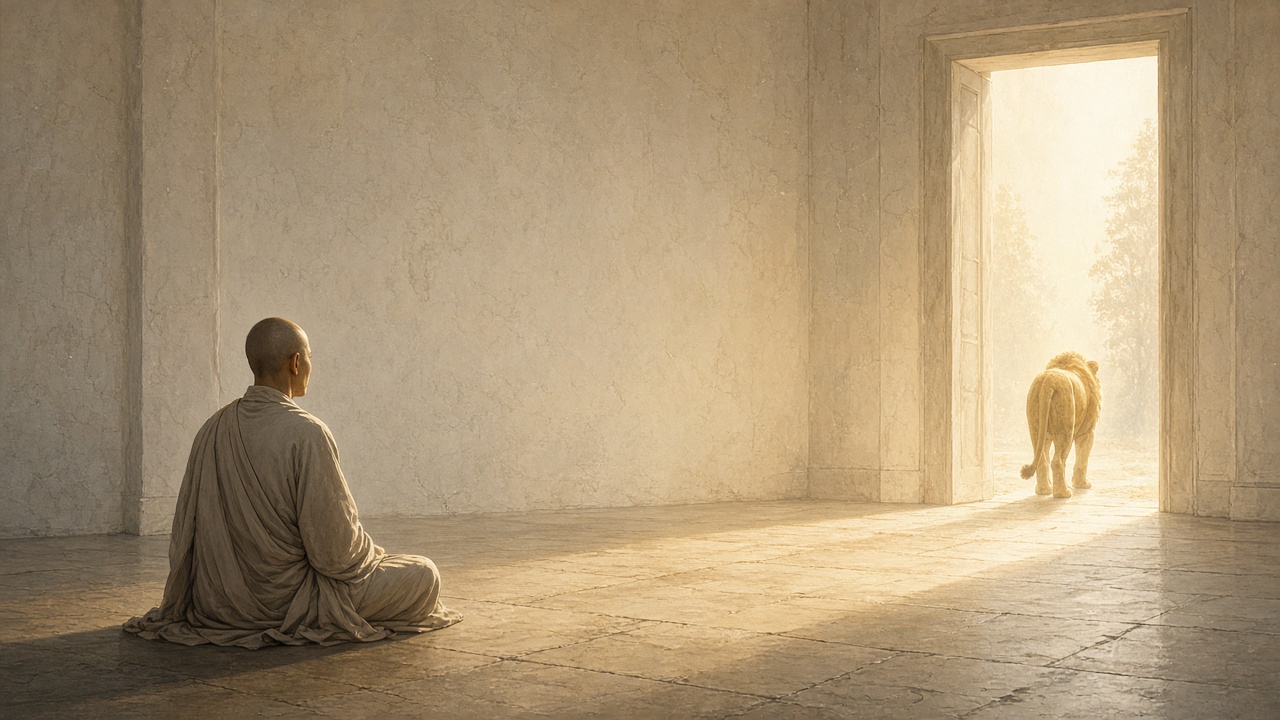
Lion Mode, Dan Koe and Joe Dispenza all put the monk to work for the hunt. But the monk isn't for anything. He is the one still standing when the hunt is over.
A young man finishes four years of criminology. They shake his hand, say “congratulations,” and give him a piece of paper.
“It was extremely underwhelming and I didn’t feel anything,” he writes. “I was happy for a day when I passed my final exam, but after that, I was back to baseline.”
That is Stijn Noorman, in an X Article called “Work Like a Lion. It’ll Change Your Life.” It’s a good article, and I’ll get to why. But that honest moment, the handshake and the nothing that followed, is the most important sentence in it. Maybe in the whole productivity genre. And almost nobody in that genre knows what to do with it.
Here is Lion Mode, fairly told.
Stijn opens with Naval: “Work like a lion. Sprint, rest, and reassess. Then attack again. You’re not a cow, grazing all day. You’re a lion, waiting, preparing, then going in for the kill.”
Three phases. Plan, hunt, rest, each at full intensity. “Average people are always 30% on,” he writes. High performers switch between 0% and 100%.
He’s right. Most of us live at 30%. Half-working with one eye on the phone, half-resting with one eye on the inbox. If you build things, you know that grey middle, and you know it wins nothing. Lion Mode is a real cure for it.
Then comes the rest. Stijn quotes the flow researcher Steven Kotler: flow is “neurochemically expensive,” and without recovery you build “allostatic load,” the wear your body takes when its stress systems never switch off. So you need active recovery. Sauna, walking, massages, journaling, breathwork, nature, cold showers. And, between the ice baths and the naps: “Meditation & mindfulness.”
There it is. The monk. Filed under recovery. A pitstop, so the lion can hunt again.
Stijn says everyone talks about Monk Mode, “which is great and has its place.” He never says what that place is. Nobody in the genre really does.
Dan Koe comes closest, and I want to be careful, because Dan is one of the most thoughtful writers in this space. He knows where the monk comes from. In a 2025 letter he traces it back to the Axial Age, to Socrates, the Buddha and Lao Tzu, and the discovery that the divine was “in here.” Then he writes: “True monk mode is just this. A period dedicated to the ascending path and self-realization.”
And then he sets it aside. “We’re not even going to follow what the original meaning of monk mode is,” he says. Contemplation alone is “only one piece of the puzzle.” Instead he proposes “a holistic monk mode”: “A period where you obsess over a problem until it’s solved.”
Read that again. A man obsessed with a problem until it is solved. That is not a monk. That is a lion in a robe.
Another letter makes it clearer still. “I often oscillate between the warrior and monk archetypes,” he writes. War mode: “You attack your goals. You simulate a hunt.” Monk mode is the quiet season in between, where you cut distractions and come back stronger. In his framework Human 3.0, the aim is to become “one who has maximized all areas of life.” His example of life near the top of that map: “a CEO who sells their company, becomes depressed, and starts another one from a more enlightened point of view.”
I don’t think that’s wrong. He ends Human 3.0 with a life “where work becomes play,” and I share that destination. But the move is the only one the magician knows. The hunt left you empty, so you design a better hunt.
Joe Dispenza gets closer than anyone. That is exactly why he slips.
Dispenza is a chiropractor and author who teaches meditation to thousands of people at a time. His instruction is to become “no body, no one, no thing, no where, in no time.” Drop the body. Drop the identity. Drop the clock. On his blog he describes the moment beautifully: you “stay open, present, and surrender by relaxing into whatever happens. This is the elegant moment where you abandon everything you know and stop trying to control or force an outcome.”
That is the monk. Word for word.
Now read one paragraph further. “Now they are in the unknown, which is the perfect place to create something new.” And: “If they’re going to create a new life, they have to get beyond the memory of their old life.”
The door opens onto nothing at all, and he walks back out with a shopping list. Surrender becomes the doorway to manifestation. The stillness serves the wanting.
I’m grateful to Dispenza. He has put more people on a cushion than almost anyone alive, and many of them will find what’s there on their own. But he describes the monk precisely, and then puts him to work.
Here is the pattern. Three serious, generous people, and each one recruits the monk into the service of the magician.
Those two words need a line of explanation. The magician is the part of you that makes things happen: he sees what isn’t there yet, and builds it. The monk is the part that watches, and needs nothing to happen. I wrote about the magician’s fall in my last essay, about Nikola Tesla dying broke in a New York hotel room while his current ran through every wall in the city.
For Stijn, the monk is recovery for the next kill. For Dan, a training camp for the next level. For Dispenza, the doorway to the next reality.
Different jobs. Same employer.
The monk is not for any of that. You can’t recruit him, because his whole quality is that he isn’t for anything.
What he is shows only when the magician falls. And the magician falls in one of two ways.
The first: the hunt fails. The lion misses. The company folds, the market turns, the tower gets sold for scrap. I’ve been there. A trading algorithm built generational wealth on Bitcoin, and then gave it all back, just as hard. Nothing in Lion Mode tells you who you are on the day the kill doesn’t come.
The second is quieter, and Stijn already described it. The hunt succeeds, and it’s empty. Handshake, piece of paper, nothing. He even gives the science: “dopamine is not about having things, it’s about getting and wanting things.” Dopamine is the chemistry of pursuit, not of arrival.
Follow that to the end. If every good feeling comes from pursuit, and arrival gives you nothing, you can never arrive. You need the next star, and the next, forever. Stijn calls it aiming higher. Dan calls it starting another game. It works. It never lets you stop.
That is what the monk is for. Not to make you a better hunter. To be the one still standing when the hunt is over, whichever way it ended. The one who was there before the plan, during the kill and after the handshake, and who didn’t need any of it to be all right.
I sat my first ten-day Vipassana retreat when I was 29. Vipassana is old insight meditation, done in silence: ten days of no phone, no talking, and no goal except to watch what happens in your body, moment by moment, without chasing it or pushing it away.
Nothing in that hall is recovery for anything. You are not resting so you can hunt better on day eleven. If you sit there to get something, you notice the wanting, and the wanting becomes what you watch. Then the next thing. And underneath all of it, the one who watches, who wasn’t trying to get anywhere.
That one isn’t a technique. It’s not a state you achieve. It’s what is left when you stop achieving.
Now a glimpse, and only a glimpse, because this is where the next chapter begins.
Eckhart Tolle, in A New Earth, names the healthy ways of acting “acceptance, enjoyment, and enthusiasm,” and makes a prediction I keep coming back to: “enjoyment will replace wanting as the motivating power behind people’s actions.”
The psychiatrist David Hawkins drew a map of consciousness from 1 to 1000. Below 200 sit shame, fear, anger and pride, energy that has to push. Above it come courage, reason, love, joy and peace. The map isn’t science, and I don’t use it as a measurement. I use it as a way of seeing. My reading is that the lion lives around courage and pride. Strong, honest, and still pushing. Higher up, the push goes. The action doesn’t.
That’s what I mean by playing. The player goes at 100%, just like the lion. He plans, he hunts, he rests. But the kill isn’t what he is for. When it comes, he enjoys it. When it doesn’t, he’s still there. And the handshake at the end isn’t empty. It’s just a handshake. He was already full when he walked in.
You don’t get there by skipping the lion. You get there by remembering what the monk was for.
So keep Lion Mode. Plan, hunt, rest. Get out of the grey 30%. Stijn is right about all of it.
Just don’t put the monk on the recovery list. He isn’t there to get you ready for the next kill. He’s the one who can stand in the room after the handshake and feel nothing missing.
When your next hunt succeeds, who will be there to receive it?