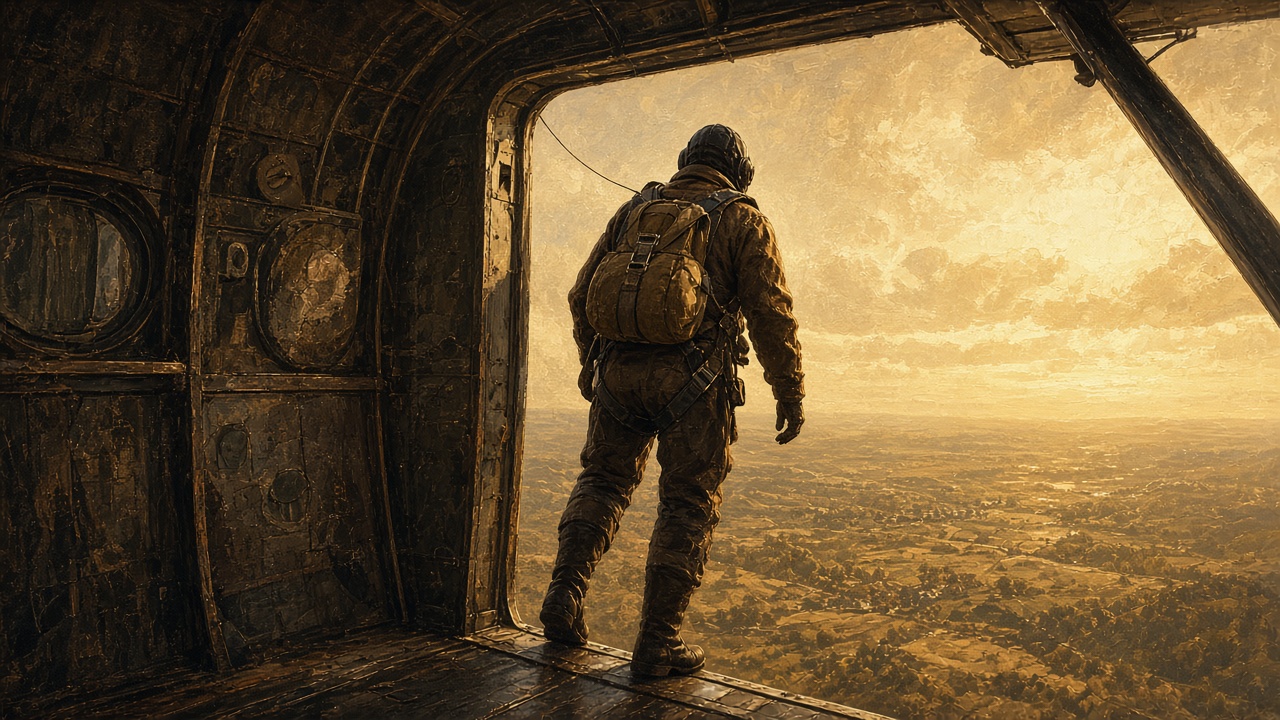
Clear the old fear, and the door still makes you dizzy. That is not a warning. It is freedom, looking down.
I was a teenager in the 1980s. A weekend night, the local disco. A small dance floor. And across it, a girl I wanted to ask to dance.
Nothing was stopping me. My feet worked. The music was playing. The worst she could say was no. I knew all of that. And still I stood there.
I had one question that always got me moving. How will I feel next Sunday morning if I don’t ask her?
I knew the answer. So I walked across the floor and asked.
I have thought about that walk many times since. Not because of what happened next. Because of what happened before. The standing still. The part where every reason said go, and something without a name said wait.
The man in the door
Picture a trained parachutist. He stands in the open door of a plane. The wind is loud. His altimeter is right. His chute has been checked twice. He has done the drills hundreds of times.
Everything checks out. And he doesn’t jump.
Nothing is wrong. That is the strange part. If something were wrong, he would know what to do. He would fix it, or he would sit down. But there is nothing to fix. There is just the door, and the sky, and him.
Most of us know that door. We have stood in it at work, in love, in our own plans.
The last layer
Eli Goldratt was an Israeli physicist who became one of the sharpest management thinkers of his time. He built a method called the Thinking Process. It uses simple logic diagrams, he called them trees, to work through a change step by step.
First you agree on the problem. Then you agree on the solution. Then you take every “yes, but” seriously. What could go wrong? You trim each of those branches. What stands in the way? You plan around each obstacle.
At the end the logic is complete. Every objection has an answer.
And very often, people still don’t move.
Goldratt saw this so often that he gave it a name: unverbalized fear. It is the last layer of resistance to change. In his buy-in process the final step reads: “Overcome unverbalized fears.” One practitioner of his method, Kelvyn Youngman, put it plainly: “And this is where we get stuck.”
Why do we get stuck there? Because logic can only answer what has been said. A fear without words has no branch to trim. You cannot argue with something that never shows up at the table.
Two kinds of fear
So let’s give it some words.
There is a fear we can name. It is old. It comes from the past. Things that hurt us once. Habits that protected us. Buddhists have a word for these deep grooves: sankharas. Think of them as conditioned reactions, patterns pressed into us so many times that they fire before we think. Someone raises their voice and we shrink. Someone says no and we hear “you are not enough.”
This kind of fear can be verbalized. You can find it, look at it, and slowly clear it. Therapy does this. Meditation does this. Honest friends do this. It takes years, but it can be done.
Some people use David Hawkins’ map of consciousness for this. Hawkins was a psychiatrist who ranked emotional states on a scale. Shame, guilt, fear and anger sit low. At 200 sits courage, the line where life stops being about survival and starts being about growth. You don’t need the scale. The point is simple. At some moment the old weight is light enough. The past no longer runs the show.
And then something surprising happens. The fear doesn’t fully go away.
You are standing in the door. The old stuff has been cleared enough. And you still feel it. Your stomach still turns. Your hands still go a little cold.
Part of that is aftershock. The body remembers before the mind updates. But mostly it is something else.
The dizziness of freedom
The Danish philosopher Søren Kierkegaard wrote about this in 1844, in a book called The Concept of Anxiety. He made a sharp split. Fear, he said, refers to “something definite.” A snake. A cliff edge that is crumbling. A real danger.
Anxiety is different. He wrote:
“Anxiety may be compared with dizziness. He whose eye happens to look down into the yawning abyss becomes dizzy. But what is the reason for this? It is just as much in his own eye as in the abyss, for suppose he had not looked down. Hence anxiety is the dizziness of freedom.”
Read that last line again. The dizziness of freedom.
The parachutist isn’t dizzy because the chute might fail. He is dizzy because he can jump. The door is open. The choice is his. Nobody will push him.
That is what I felt on the edge of that small dance floor. Not danger. Possibility.
So here are the two signals, side by side.
Fear says: something is wrong.
Dizziness says: something is possible.
They feel almost the same in the body. That is the whole trouble.
A trade between two fears
On 21 October Tim Denning published an essay on X with a title that is almost my Sunday morning question: “You need to be more afraid of wasting your life than embarrassing yourself.”
His argument is strong. Embarrassment is a lie. The consequences you imagine aren’t real. Nobody is watching as closely as you think. The real monster is a wasted life. So seek out embarrassment, admit it, and recover fast. He tells how he went to the pool with his young child, saw an old high school friend, said hi, and was completely ignored. His face went red. He survived.
I recognise that red face. I had it at the edge of that dance floor.
And it is good advice. It works. It got me across the floor too: the regret of next Sunday morning weighed more than the embarrassment of a no.
But look at what it does. It puts one fear against another and lets the bigger one win. Embarrassment is small, a wasted life is huge, so push. That is still fear doing the steering. You just hired a scarier driver.
Good advice, but still a trade between two fears. The boy at the edge of the dance floor wasn’t choosing the lesser fear. Below the line, maybe he was. But what was left after the old stuff was not fear at all. It was the door being open.
The compliance officer
In companies, you can watch this happen in slow motion.
A team has a bold plan. The numbers work. The risks are mapped. And then the dizziness arrives, and it almost always turns into not jumping. It even has a job title. The compliance officer.
To be clear, the compliance officer is a good thing. His job is to name what can go wrong. Laws, risks, rules. Every serious company needs one. Without him you jump with a broken chute.
But we all carry a compliance officer in our heads too. He sits in a small office behind the eyes. He is careful. He is loyal. He is very good at sounding reasonable.
Here is what matters. The compliance officer is not the boss.
The CEO is the boss. A good CEO listens to the officer. Takes him seriously. Thanks him. And then decides. Sometimes the CEO may ignore him and jump. Sometimes the CEO must.
A company where the officer runs the show becomes very safe and very dead. So does a life.
The test
So how do you know when to listen and when to jump?
There is one test. Ask your inner compliance officer a single question:
What, exactly, is wrong?
If he names something definite, listen. A frayed line. A real law. A real person who will get hurt. That is fear doing its job. Fix it, or sit down.
If he can’t name it, if all he has is a feeling, a “what if,” a vague sense that it might go badly, then you are not hearing fear. You are hearing dizziness. And dizziness is not a warning. It is the feeling of standing in front of a door that is actually open.
That is also why my Sunday morning question worked, and why it is more than a bigger fear. It skipped the officer entirely. It didn’t ask “what could go wrong?” It asked “who do I want to be tomorrow?”
The dizziness doesn’t leave before the jump. It leaves in the jump.
The door
Goldratt was right that the last layer has no words. Kierkegaard gave it some. It is not a fault in the plan. It is freedom, looking down.
Clear the old fear. Do the work on the past. Then expect the door to still make you dizzy. That is not a sign you are not ready. It is the sign that this time, the choice is really yours.
The fear tells you the chute is broken. The dizziness tells you the door is open.
Which one is your compliance officer reading to you right now?