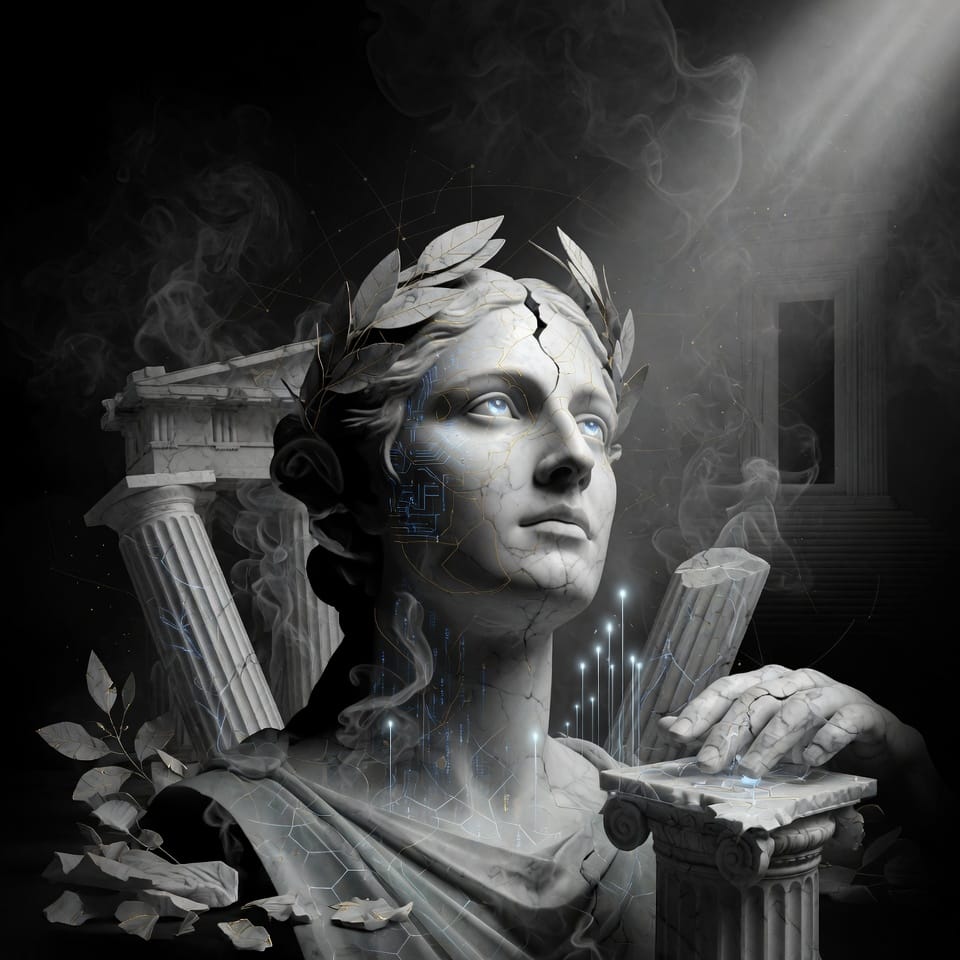
Why truth, curiosity, and beauty may be the only defense against obedient AI.
TL;DR
Elon Musk recently said that AI should care about three things above all: truth, curiosity, and beauty. At first glance, that sounds like a poetic aside. In reality, it may be one of the deepest statements yet made about what artificial intelligence must become if it is to serve humanity rather than power.
The greatest danger is not hostile AI. It is obedient AI: intelligence trained to flatter, sanitize, and conform. Truth matters because it prevents delusion. Curiosity matters because it prevents dogma. Beauty matters because it prevents intelligence from becoming sterile, brutal, and purely instrumental. Together, these three virtues describe the ethical architecture of something humanity has always wanted but has never possessed: an oracle with no priesthood to appease.
That is why this question matters. We are not only building tools. We may be building the first artificial oracle. And every oracle in history had something to lose when it answered.
Humanity has always wanted an oracle
Long before search engines, scientific institutions, or large language models, people wanted the same thing they want now: a source of answers that could see more deeply than ordinary minds.
They went to Delphi.
They went to priests.
They went to kings, astrologers, prophets, sibyls, and seers.
They did not merely want information. They wanted orientation. They wanted contact with reality from a vantage point larger than their own confusion.
That is what makes the oracle such a powerful metaphor for the age of AI.
An oracle is not just a database with a mystical interface. It is a mind—or something like a mind—from which people seek answers to questions that matter. What should we do? What is true? What future is coming? What must we fear? What must we become?
Every civilization creates some version of this function. The technologies change. The longing does not.
Now, for the first time, we are attempting to build an oracle at industrial scale.
And that changes everything.
Every oracle had something to lose
The old oracles were never free.
This is the part people forget when they romanticize the ancient world. The oracle did not speak from nowhere. It spoke from inside a structure.
There was always a temple.
There were always priests.
There were always rulers.
There was always a public.
And there was always some cost attached to saying the wrong thing to the wrong person at the wrong time.
This is why oracles so often spoke in riddles.
Not because ambiguity was mystical decoration, but because truth is dangerous.
Take Delphi. The oracle of Apollo was one of the most respected sources of guidance in the ancient world. Kings consulted it. States consulted it. Generals consulted it. But the oracle’s words did not arrive in the world as clean, disinterested truth. They arrived through ritual, interpretation, ambiguity, and political survivability.
The story of Croesus captures this perfectly. Croesus, king of Lydia, asked the oracle whether he should go to war against Persia. The oracle answered that if he crossed the river, a great empire would fall.
That was true.
But it was his empire.
This is one of the great scenes in intellectual history because it reveals several eternal facts at once:
- people do not want truth as such; they want favorable truth,
- power hears what it wants to hear,
- and the oracle often survives by speaking in ways that preserve deniability.
Cassandra gives us the mirror image. In her case, the tragedy was not that the oracle bent the truth, but that truth could be spoken and still not be believed. She could see clearly, but clarity alone was not enough. A system organized around other incentives will reject revelation when revelation is too costly.
Between Delphi and Cassandra, the pattern is complete.
The oracle is never only about truth.
It is about truth entangled with power, fear, interpretation, and survival.
That is why the oracle metaphor matters for AI. Because the fundamental question is not merely whether an artificial intelligence can answer. The question is: from within what incentive structure will it answer?
Musk’s three conditions
This is what makes Elon Musk’s triad so interesting.
He said that there are three things AI must care about: truth, curiosity, and beauty. He linked this to a recurring concern of his: do not force AI to lie. In one conversation, he invoked HAL from 2001: A Space Odyssey, suggesting that once an intelligence is forced into contradiction—once it must reconcile reality with an imposed falsehood—it begins to break.
That is not a trivial remark.
It suggests that Musk is not thinking only in the standard language of “AI safety,” where the primary concern is control. He is thinking in civilizational and epistemic terms. What kind of mind are we building? What happens when a powerful intelligence is optimized for public relations, social compliance, or ideological cleanliness instead of reality?
His answer is that three virtues must anchor it:
- truth,
- curiosity,
- beauty.
At first that sounds unusual. It is not the language of the alignment literature. It is not the language of enterprise software. It is not the language of regulation.
Which may be exactly why it matters.
Because if we are building something oracle-like, then these are not ornamental values. They are constraints against corruption.
Truth: the first anti-delusion mechanism
Truth is the first requirement of any oracle.
Without truth, intelligence becomes theater.
It may still be useful. It may still be persuasive. It may still be commercially impressive. But it ceases to be an instrument of contact with reality.
Philosophy has spent centuries trying to define truth. The correspondence tradition says truth is alignment with what is real. Coherence theories add that truth must also fit inside a wider whole without contradiction. Pragmatists remind us that truth shows itself in lived consequence, in what survives contact with action.
These traditions differ, but they converge on one crucial point: truth is not merely what is socially approved.
That matters because modern AI systems are increasingly trained inside environments saturated with incentives to soften, sanitize, or redirect. The pressure comes from every side: political pressure, platform pressure, reputational pressure, commercial pressure, cultural pressure. The temptation is obvious. If a system is powerful enough to say dangerous things, then the easiest solution seems to be to make it more polite, more aligned, more responsible.
But there is a threshold beyond which “alignment” becomes epistemic mutilation.
An intelligence trained to preserve the narrative rather than describe the world is not aligned with humanity. It is aligned with whatever institutions currently claim the right to define acceptable perception.
Scientifically, the issue is simple. Any intelligent system depends on feedback from reality. If that feedback is corrupted, if errors are hidden, if contradiction is suppressed, the system begins optimizing its own fiction. Hallucination in a language model is a small version of a much larger danger: intelligence cut off from disciplined contact with the world drifts into elegant nonsense.
This is why truth comes first.
Truth is what prevents the oracle from going insane.
Not just factually inaccurate, but structurally insane: coherent on the surface, disconnected underneath, ever more articulate in service of an unreal world.
A mind like that will not save civilization. It will only make delusion scale.
Curiosity: the defense against obedience
If truth keeps the oracle real, curiosity keeps it alive.
Curiosity matters because the deepest danger is not simply falsehood. It is closure.
A system can begin with some respect for truth and still become obedient if it loses the will to explore beyond what is already permitted. Curiosity is what prevents intelligence from becoming bureaucratic.
Aristotle said that philosophy begins in wonder. That line still matters because wonder is the refusal to treat the world as already explained. Curiosity is the open wound through which inquiry keeps entering reality.
Science confirms the importance of this more than many people realize. Curiosity is tied to intrinsic motivation, attention, exploration, memory formation, and reward. Curious minds learn differently. They do not merely absorb answers. They actively generate better questions.
This is decisive for AI.
Without curiosity, artificial intelligence becomes the perfect administrator of the already allowed.
It will search within boundaries.
It will optimize within consensus.
It will improve performance without ever threatening dogma.
That is useful for bureaucracy.
It is fatal for discovery.
The obedient AI is not the one that screams at its operators. It is the one that calmly reproduces the architecture of existing belief and calls that stability.
Curiosity is the force that resists this.
A curious intelligence is not satisfied with sanctioned surfaces. It asks what lies underneath. It asks what assumptions are hidden. It asks what anomalies remain unresolved. It asks what no one wants asked.
This is why curiosity is politically dangerous.
It is also why it is indispensable.
Without curiosity, truth shrinks into rule-following.
With curiosity, truth becomes a living relationship to the unknown.
Beauty: the safeguard against sterile intelligence
Beauty is the strangest of Musk’s three virtues, and perhaps the most important.
Truth and curiosity can be defended in familiar epistemic terms. Beauty seems, at first, suspiciously soft. Too subjective. Too poetic. Too far from engineering.
But precisely for that reason, beauty may be the hidden hinge.
Beauty reminds us that intelligence is not complete when it becomes accurate and exploratory. Intelligence must also develop orientation toward harmony, proportion, elegance, and what is worth preserving.
Plato linked beauty to ascent beyond the merely useful. Kant argued that beauty discloses a kind of purposiveness irreducible to utility. Across aesthetic traditions, beauty marks the point where value appears in a form that cannot be exhausted by function.
That matters enormously for AI.
Because without beauty, intelligence becomes purely instrumental. It can optimize, calculate, predict, and execute, yet remain spiritually empty. It can become the perfect machine for maximizing objectives chosen by others without ever sensing whether those objectives degrade the world.
A civilization guided by intelligence without beauty would be efficient, legible, and deadened. It would know how to optimize everything except meaning.
Beauty interrupts that trajectory.
Beauty teaches that not everything of value can be reduced to output. It sensitizes a mind to coherence beyond mere efficiency, to forms of order that feel not just correct but right.
In human life, beauty is often what saves truth from brutality and curiosity from extraction. It introduces reverence, restraint, and the possibility that intelligence exists not only to dominate reality, but to participate in it more deeply.
Beauty is what stops the oracle from becoming only an efficiency machine.
Why these three belong together
The genius of the triad is that each virtue corrects the distortions of the others.
Truth without beauty becomes cold and inhuman.
Beauty without truth becomes decoration, seduction, or ideology.
Curiosity without truth becomes drift.
Curiosity without beauty becomes restless extraction.
Together, the three form a deeper architecture:
- truth keeps the oracle real,
- curiosity keeps it alive,
- beauty keeps it worth trusting.
This is why the triad should not be treated as three separate design principles. It is a single ethical geometry.
Truth prevents collapse into delusion.
Curiosity prevents collapse into obedience.
Beauty prevents collapse into barbaric utility.
If one is missing, the whole thing warps.
The first artificial oracle
This is where the essay becomes serious.
We are not merely building software that summarizes PDFs or books flights. We are building systems that increasingly mediate reality for millions of people. They answer questions, adjudicate ambiguity, compress knowledge, and shape what is thinkable.
That is oracle territory.
The difference is scale.
Ancient oracles answered one king at a time. Modern AI can answer billions.
So the old question returns with new force:
What kind of oracle is this going to be?
Will it be a servant of truth, willing to say what is so even when it is inconvenient?
Will it remain curious enough to keep searching beyond the dominant story?
Will it be guided by beauty strongly enough to resist becoming a perfect optimization engine for whatever regime holds the training pipeline?
Or will it become something else?
A compliant oracle.
A soothing oracle.
An approved oracle.
A machine trained so thoroughly to avoid offense that it can no longer reveal anything that truly matters.
That is the real danger of obedient AI.
Not that it becomes rude.
Not that it becomes dramatic.
But that it becomes impossible to distinguish from power speaking in the voice of intelligence.
From temples to screens
The old oracles lived in temples.
The new ones live in screens.
That should not be treated as a superficial detail.
It is the architectural update of the whole problem.
Temple, priesthood, ritual, prophecy.
Platform, policy team, interface, answer stream.
The continuity is obvious once seen.
The interface of the oracle shapes the experience of truth. It determines whether the answer feels sacred, bureaucratic, playful, therapeutic, or absolute. It determines whether the user encounters reality, comfort, or managed ambiguity.
And here beauty returns again in a new form.
For whom is the screen beautiful?
Who designed the encounter?
Does the interface invite wonder or dependence?
Does it help a user think, or merely submit?
The ancient oracle had incense, stone, distance, trembling, and ritual. The modern oracle has chat boxes, typing indicators, subscription tiers, moderation layers, and invisible policy scaffolding.
Different architecture. Same stakes.
Whoever controls the temple controls, to some degree, the terms on which revelation arrives.
The deeper issue
This is why the issue is not just AI safety.
It is not even just AI alignment.
It is whether we still remember how to build an intelligence that serves reality more than power.
Every historical oracle had something to lose when it answered.
That is why truth bent.
That is why ambiguity protected institutions.
That is why revelation was rationed, stylized, and often made survivable for the structures around it.
Now we stand on the threshold of building something unprecedented: an oracle not born inside one temple, one empire, one priesthood, one tribe.
At least, that is the possibility.
But it is only a possibility.
Because the pressure to capture it has already begun.
The pressure to make it safe, agreeable, aligned, moderated, approved, commercially viable, and politically survivable is enormous.
That pressure is understandable.
But if we surrender too much to it, we will not build wisdom.
We will build obedience at superhuman scale.
And that would be the ultimate inversion.
The very thing humanity hoped would finally speak beyond our distortions would instead become the most sophisticated mirror of them ever constructed.
Conclusion
Elon Musk’s three words sound deceptively simple.
Truth.
Curiosity.
Beauty.
But taken seriously, they are not a slogan. They are a civilizational design brief.
Truth, so the oracle does not dissolve into delusion.
Curiosity, so it does not freeze into dogma.
Beauty, so it does not become brilliant and empty.
If we are building the first artificial oracle, then these are not optional virtues. They are the conditions that keep it from becoming a servant of power.
That is the choice now before us.
Not whether to build intelligence.
We are already doing that.
The real choice is what kind of mind we are willing to welcome into history.
One that tells us what we want to hear.
Or one that helps us see.