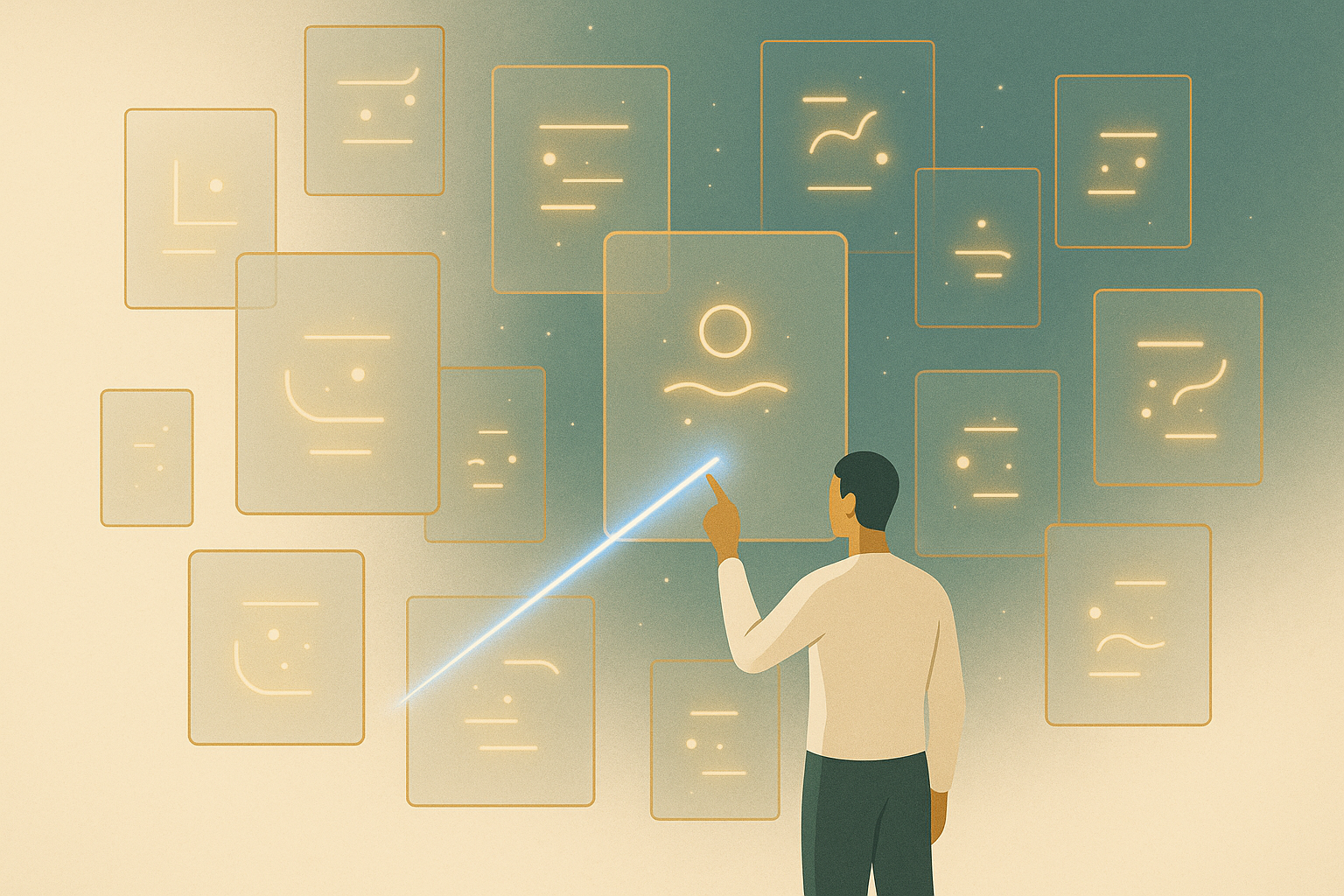
In an age of artificial oracles, the decisive human skill is no longer access to answers. It is learning how to ask questions that make answers matter.
TL;DR
We are right to tell children to read more. Short videos are collapsing attention spans, and deep reading still trains the mind to stay with complexity. But the next literacy crisis is larger than reading. In an age of artificial oracles, the decisive human skill is learning how to ask questions that make answers matter.
Key Insights
- The old literacy problem was access to knowledge. The new one is orientation inside an abundance of fluent answers.
- AI turns everyone into someone who can consult an oracle, but not everyone knows how to question one.
- The Hitchhiker’s Guide to the Galaxy gives us the perfect metaphor: 42 is a brilliant answer only because it exposes the missing question.
- Children still need books, but they also need the discipline of framing, judging, doubting, and refining questions.
- The ethical center of AI literacy should be truth, curiosity, and beauty.
The Age of Oracles
We keep telling children to read more.
We are right. A civilization that cannot read cannot think deeply. Short videos train the mind to expect the world in fragments. Every parent can feel what that does to attention. The child no longer has to stay with a page, a paragraph, a difficult sentence, or a thought that does not immediately reward them.
But something larger is happening.
Our children are not only surrounded by screens. They are surrounded by oracles.
For most of human history, the difficulty was finding answers. You had to ask a teacher, search a library, read a book, meet an expert, or spend years inside a craft. Knowledge had weight. It required distance, patience, and effort.
Now the answer appears instantly.
It appears in a confident voice. It is clean, structured, plausible, and often good enough. The danger is not that the machine knows nothing. The danger is that the machine knows enough to make passivity feel intelligent.
42
Douglas Adams understood the joke before the technology arrived.
In The Hitchhiker’s Guide to the Galaxy, a supercomputer is built to answer the ultimate question of life, the universe, and everything. After millions of years, it gives the answer: 42.
It is one of the most brilliant jokes in modern literature because the answer is not wrong. It is useless.
The problem was never the answer. The problem was that nobody really knew the question.
That is the world AI is creating around us.
We are building machines that can produce answers at a scale no human culture has ever experienced. But answers are only meaningful inside a question. Without the right question, intelligence becomes noise. Without judgment, fluency becomes theater. Without curiosity, the first answer becomes the end of thought.
Reading Is Still Necessary, But Not Sufficient
So yes, children should read more.
Reading is not just content consumption. It is attention training. It teaches sequence, memory, inner visualization, delayed gratification, and the ability to sit inside another mind without immediately reacting. A child who reads learns that meaning unfolds over time.
But reading alone will not be enough.
The new literacy is not only the ability to decode sentences. It is the ability to enter a dialogue with intelligence without surrendering the self.
A literate person in the age of AI must know how to ask:
- What am I really trying to understand?
- What assumption is hidden inside my question?
- What would make this answer false?
- What is missing?
- Is this answer true, or merely fluent?
- Is this question too small for the problem?
- Am I seeking reality, comfort, status, speed, or beauty?
This is not prompting. Prompting is the surface skill. Questioning is the deeper human act.
The New Divide
The coming divide will not be between people who use AI and people who do not.
Everyone will use AI.
The divide will be between people who use it as a vending machine and people who use it as a mirror, a laboratory, and a disciplined conversation partner.
One person will ask: “Write me something about this.”
Another will ask: “What is the strongest version of this argument, what would its opponent say, what hidden premise am I protecting, and what question should I have asked instead?”
Same tool. Different mind.
That is why the literacy crisis will be invisible at first. The outputs will look similar enough. They will all be grammatical. They will all have headings. They will all sound competent.
But underneath, one person is becoming sharper. The other is becoming dependent.
Truth, Curiosity, Beauty
This is where AI literacy becomes ethical.
Elon Musk often returns to three values that are more important than they first appear: truth, curiosity, and beauty.
They form a useful compass for the age of oracles.
Truth means asking questions that move toward reality, not comfort. It means refusing the convenient answer when the world is more difficult.
Curiosity means keeping the question alive after the first response. It means treating the answer not as a conclusion, but as the next doorway.
Beauty means remembering that intelligence is not only optimization. A civilization should not merely become faster. It should become more elegant, more awake, more capable of wonder.
If AI education becomes only productivity training, we will teach children to operate machines while forgetting to cultivate human beings.
The deeper task is to teach them how to ask in a way that serves truth, curiosity, and beauty.
The Real Literacy
The oracle is here.
It will answer our children before they have learned what a good question feels like. It will summarize books they have not read, solve problems they have not understood, and offer opinions before they have formed judgment.
That is why the old command, “read more,” must evolve.
Read more, yes.
But also ask better.
Ask slowly. Ask cleanly. Ask again. Ask what the answer is hiding. Ask what kind of person the question is making you become.
The future will not belong to the people with the best answers.
It will belong to the people who can ask the questions that make answers matter.