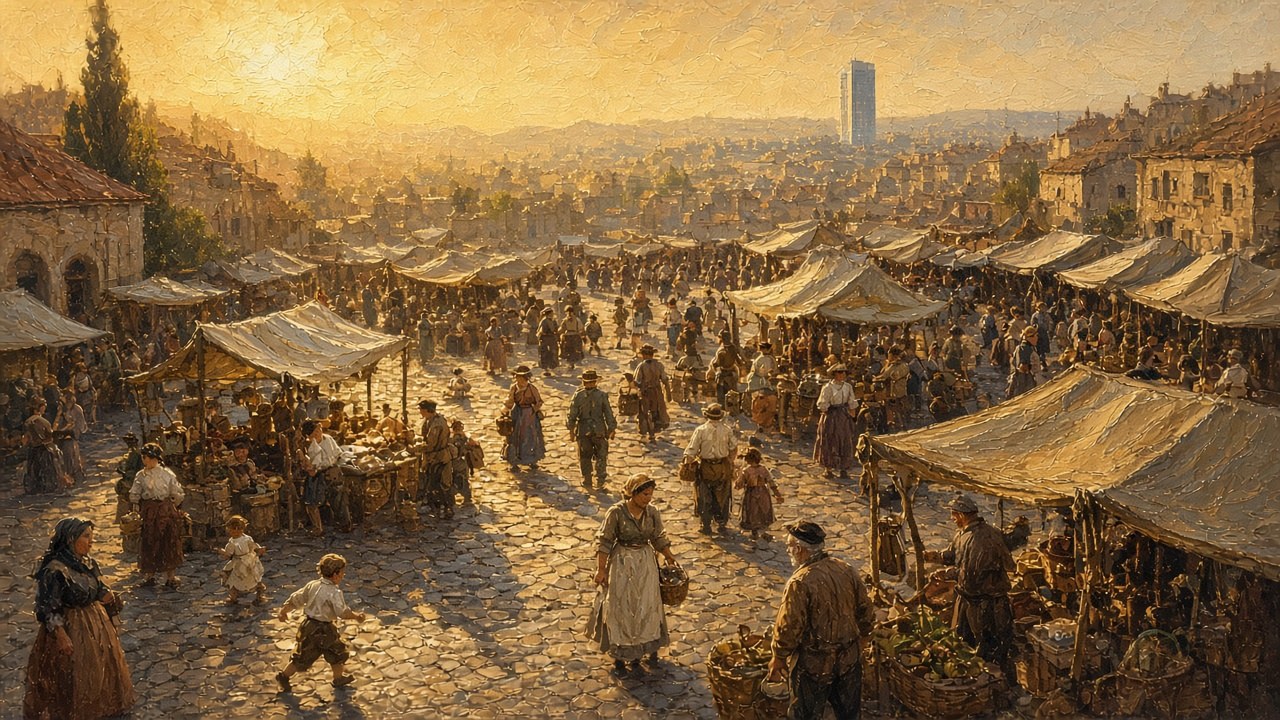
Harari fears AI as one mind we cannot see into. What I see is a market square. And the cure he reaches for is the thing I fear most.
I have moved house three times in a year without carrying a single box.
My assistant ran on OpenClaw. Then on Hermes. Eight weeks ago I moved it to Grok Bot. Each time I asked the old one to write down everything it knew about me, and each time it did. My files never moved at all. They sit in my Google Drive, my mail, my GitHub. The bot reads them. It does not own them.
Before that I had already walked out on ChatGPT for Gemini, and on Gemini for Claude. I built with Google’s Antigravity, with Devin, with Claude Code, with Cursor. Along the way I used more language models than I can name. Together they hold no part of me I cannot take back.
That is not a list of products. It is what a market square looks like from the inside.
One mind, or many hands
Last week I wrote about Yuval Noah Harari, the historian who taught us that humans live by shared stories. I admire him. I still do.
This weekend he posted a line from a podcast with Rory Stewart: “21st century empires won’t need gunboats - they’ll just need to supply the AI running your defense network.”
It is a sharp line, and the fear behind it is real. We will soon depend on systems we cannot see into. Nobody, not even their builders, can tell you exactly what they are doing.
So how do you keep control of something you no longer understand?
Harari’s picture answers the question for you. If AI is one power, one mind, one empire, then the only answer is a bigger power above it. A referee. A regulator that watches all of it and decides what may run.
But that is not what I see when I look at my own week. I see millions of people, each with a few agents, making countless small decisions. Book this. Skip that. Write to her. Let it rest until Monday. Every one of those decisions is tied to a real person who wants something and can say no.
That is not one mind. That is a market square. And a market square has its own way of staying in control: an invisible hand that moves with people, because people keep choosing.
Nobody knows, and that is the point
Friedrich Hayek saw this in 1945, long before computers. In “The Use of Knowledge in Society” he argued that the knowledge a society needs “never exists in concentrated or integrated form but solely as the dispersed bits of incomplete and frequently contradictory knowledge which all the separate individuals possess.”
Nobody understands the whole market either. No one ever did. Hayek did not see that as a flaw to be fixed from the top. He saw it as the reason the top cannot do the job. His conclusion was blunt: “We must solve it by some form of decentralization.”
Not knowing what the system does is not new. The question was always the same: do you steer it from one office, or do you let millions of people correct it, one choice at a time?
The office far away
I already depend on a system I cannot see into, run far away by people who do not know me. It is called the European Union. Its seat is in Brussels.
The EU does not know what I want. It cannot. Brivael, who writes about Europe on X, laid out how it works last week. Once every five years I vote for a European Parliament that, he writes, “cannot even initiate legislation.” Laws are proposed by the Commission, “27 commissioners nobody elected.” The real deals are struck in “trilogues”, closed-door meetings, for a law that will apply to 450 million people.
And who is in those corridors? Brivael counts “nearly 18,000 organizations on the transparency register,” more than 50 lobbyists for every member of Parliament. His sharpest point is distance. A national politician who ruins the farmers in his district runs into them at the market on Saturday. In Brussels, the decision-maker never meets the people who live with his decisions. He meets the lobbyists every day.
There is no market on Saturday. When the office gets something wrong, it has no simple way to notice. And I have no easy way to say: thank you, I will take my business elsewhere.
The economist Albert Hirschman gave this a name in 1970. In Exit, Voice, and Loyalty he described two ways to respond when an organisation fails you: you leave, or you complain. With the EU, complaining is what I get, once every five years, together with millions of others. With my bots I can leave. I have done it more times than I can count.
That exit is the invisible hand at work. Every time I walk out, a builder somewhere learns something no regulator could have told him.
Now imagine putting the agents under one office. It would have to watch everything, approve what may run and stop what it dislikes. That is exactly the unfathomable power far away that Harari warns about, only now with a stamp. Ludwig von Mises spent much of his life arguing that one intervention tends to call for the next, until the regulator becomes the economy. I trust that body least of all.
What the square can get wrong
A free market has unintended consequences. So will this one. I want to name the two that worry me.
The first is a bad actor behind the model I use every day. The empire Harari fears. My answer is still the square, not a guard: several platforms good enough that switching is real. The day there is only one, my exit door is painted on the wall.
The second is quieter. If all those millions of small decisions run on the same two or three models, they are not really independent. They can be wrong together, like a field planted with one crop. So many stalls in the square is not a nice extra. It is the safety measure itself.
And there is a test I use on my own bots. Does it help me find out what I want, or does it quietly fill it in for me? The first is a market stall. The second is a small office. I can only feel the difference because I can still walk out and compare.
The square makes mistakes in a thousand places, and a thousand people correct them. The office makes one mistake, and it applies to everyone.
Back to the boxes
Three moves in a year, and I never packed a box.
We will depend on machines we cannot see into. That is settled. We already depend on governments we cannot see into. The choice is not between control and chaos. It is between one office that decides for all of us and a square where every person can still turn around and walk to the next stall.
I choose the square.