The Nine Streets
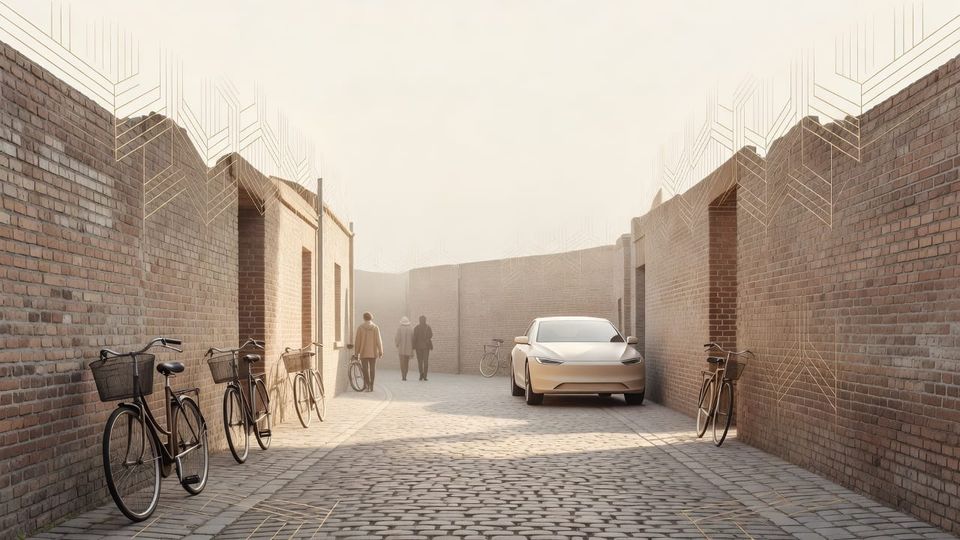
I used to think the European proof of autonomy would be a corridor. Schiphol to the Zuidas. Night runs. Ring roads. Somewhere wide, legal, and dull enough that a ministry could survive the first accident.
Then I drove the supervised system through the kind of street that looks like a dare.
Narrow brick. Cyclists from both directions. A tourist who steps off the curb because the canal is pretty. A corner you cannot see. The human instinct there is to cut, to hurry, to shave the stone. The car does the opposite. It waits. It creeps. It treats a body as something you do not negotiate with. I felt safer in the alley than I often feel with a confident person at the wheel.
That is why the Nine Streets are not the final boss. They are the demonstration.
Why it can be Amsterdam
Germany, France, Italy, Spain, and Sweden are car-making countries. Autonomy there is an attack on a national industry. The state protects factories, unions, and suppliers even when the cost curve has already left the room.
The Netherlands does not have that incumbency. No Volkswagen to betray. No Stellantis to soothe. What it has is density of Teslas, a regulator that moved first, and a city that already treats the private car as a guest.
On 10 April 2026 the RDW approved Tesla Full Self-Driving Supervised. European first. Tens of thousands of cars. Tens of millions of kilometers. Belgium, Denmark, Estonia, and Lithuania followed on a Dutch stamp. AutoWeek put a Model Y through Amsterdam and Muiden and watched the system handle crowds that American suburban training never saw. Tesla’s own Europe account posted the stress test: cyclists, works, streets that do not exist in Phoenix.
The Randstad is the breeding ground because the data is European in the harsh sense. Rain. Trams. Bikes that do not confess their intentions. Tourists. The perception does not flip because a safety agency publishes a PDF. It flips when a visitor tells a story: we went to Amsterdam and the car drove the Nine Streets.
Spain can win Super Power. Spain cannot be first to unsupervised miles without hurting SEAT. Italy has Fiat in the bloodstream. France has already flinched at monitoring and speed. Germany will want a Mercedes path that keeps Wolfsburg in the sentence.
Sun in the south. Miles in the Randstad. That is complementarity, not a copy.
The mayor who may not mean to help
I used to assume a progressive Amsterdam mayor would be the brake. Femke Halsema wants fewer cars, fewer tourist wreckers, fewer metal boxes storing nothing. Autoluw is not a slogan. Parking spaces have been coming out of the street. Another wave is planned.
Robot miles without an owner and without a parking bay can serve that appetite. Frame them as less steel at rest, not as a Tesla parade, and the coalition changes. The taxi will still fight. The cyclists’ union will still doubt. One crash will still produce an emergency room in City Hall. But the political enemy is no longer “machines on the gracht.” The enemy is the parked private car that the city has been trying to evict for years.
Unsupervised in the canal belt is still the hardest legal and social step. Supervised is already teaching the city the manners of the thing. If Amsterdam is smart, it does not claim the automobile. It claims the European proof: RDW as stamp, the Randstad as data, a fleet that no Dutch factory has to defend.
I was wrong about Schiphol being easier.
The human is the danger in the corner.
The machine is the brake.
When that becomes a postcard, the taxi is morally wounded. Not dead. Wounded. That is how disruptions begin in a street, long before they finish in a parliament.