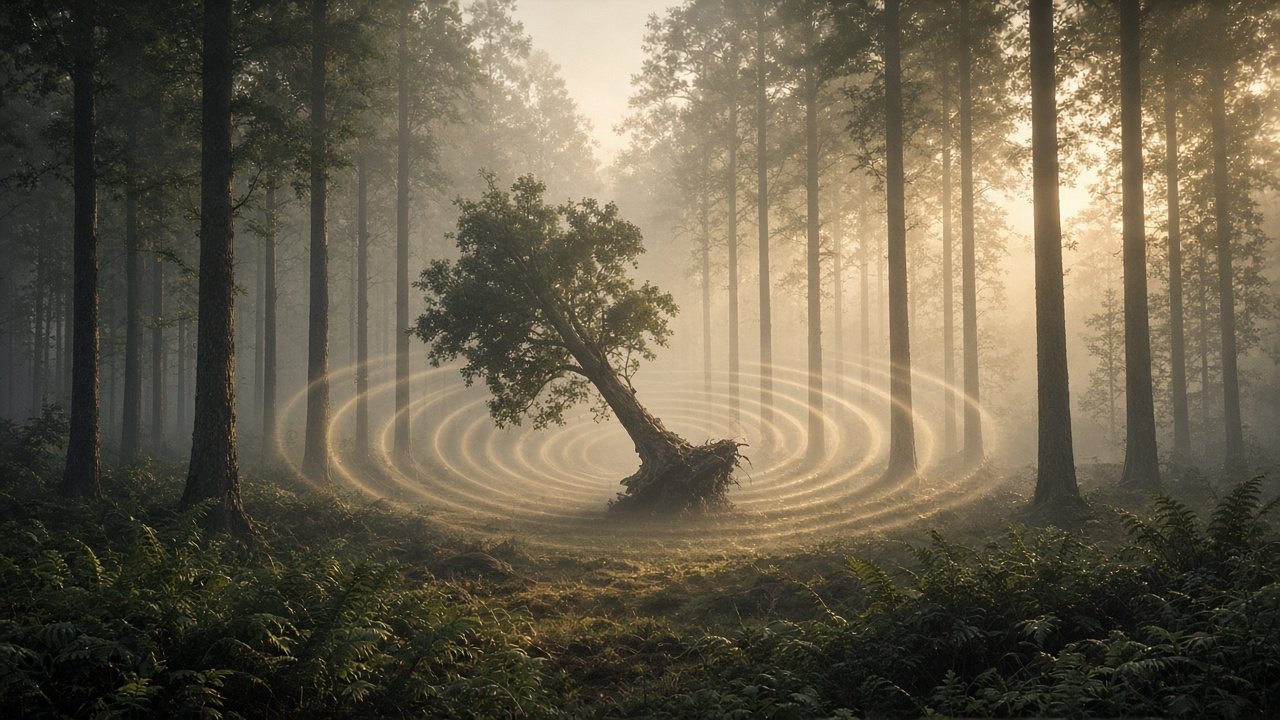
A falling tree makes waves in the air, not noise. My bots now do most of the naming in my life, and what they hand back is the moment before the word, the one only a body can feel.
A tree falls in a forest. Nobody is there.
Alan Watts took that old riddle and answered it in a way that is hard to unhear. “When a tree falls in the forest, it certainly makes vibrations in the air. But those vibrations in the air do not become noise unless they vibrate an eardrum.”
So there is no crash in the forest. There is a trembling of air, rolling out in rings through the trunks and the ferns, touching nothing that turns it into sound. The crash needs an ear. The ear makes it.
Watts kept going. “The light from the sun does not become light unless it falls on an eye.” And then he brought it all the way down to the skin: “Nothing is hard except in relation to the soft surface of the human skin. Nothing is heavy except in relation to human muscles.”
Hard, heavy, loud, bright. None of it is out there on its own. It happens where the world meets a body.
I heard this in a short reel by Paul M Vincent, with Watts’s voice laid over it. Vincent takes it one step further, into the place where most of us actually live. What triggers us, he says, is tone passing through a filter. The ear is a filter. The eye is a filter. And so is the opinion we already held before the other person opened their mouth.
Here is how that goes on an ordinary day.
Someone says something. A colleague, a stranger online, someone across the dinner table. Air moves. Words arrive. And before anything has been felt, a label is already stuck on it. Insult. Attack. The label lands before the sentence is even finished, and then we react to the label. We answer the word we put on it, not the thing that happened.
The tree falls, and we are already running from a crash we invented.
That is the whole problem, and it lives in one small gap. Between the vibration and the name there is a moment. It is short, half a breath maybe. We skip it nearly every time. So we end up living in the names, and the world underneath them goes by unfelt: the actual pressure on the eardrum, the actual heat rising in the chest.
It has never been easier to skip. A feed delivers the world pre-labelled. Breaking. For you. A notification arrives with its verdict attached: urgent, or someone mentioned you. By the time a thing reaches us, it has been named several times over, by people and systems that never felt it.
And now there is AI, the greatest labelling machine ever built.
I live with that machine every day.
Before I open anything in the morning, a bot has read my mail. It has decided what matters and what can wait, what is a bill and what is a friend. It keeps my tasks. It tidies my notes. It boils long threads down to a few lines and drafts the replies I would probably have written, often a little better than I would have written them.
Sort, summarise, judge. Every one of those is naming.
For most of my working life that was my job, and a large share of my attention went into it. Is this urgent? Is this person annoyed? Is this a good idea? Each of those questions is a label looking for something to stick to. I used to do that sticking myself, hundreds of times a day, and I called it being on top of things.
The common fear says that when machines take this over, something human goes with it. I think the opposite is happening. The bots are not taking the experience. They are taking the naming. And naming was never the deepest thing we did. It was only the busiest.
So let the machines name. They are good at it, and they get better every week. What they hand back is not an empty afternoon. It is the layer underneath, the one they cannot reach, because it only exists where the world meets a body.
A model can tell you a message sounds hostile. It cannot feel your jaw tighten as you read it.
That tightening is the vibration before the name.
This is what abundance looks like when it lands in an actual life. Not a person who consumes more because the work got easier. A person who finally has room to notice what happens in the body before the story starts. Elon wants to preserve the light of consciousness. I want to explore it. And the exploring starts much smaller than a rocket. It starts in that half a breath between a sound and its name.
Back in the forest, the air is still moving.
Nobody has called it a crash. Nobody has called it anything. It is pressure, rising and falling, rolling out through the trees. That is the world before we get to it.
The Buddha gave a teaching about exactly this place, and he gave it on the move. A seeker named Bahiya had travelled a great distance to find him, and caught up with him while he was walking through a city on his alms round. The Buddha said it was not the time. Bahiya asked again. Then a third time. So the Buddha gave him a teaching of only a few lines, right there in the street:
“In reference to the seen, there will be only the seen. In reference to the heard, only the heard. In reference to the sensed, only the sensed. In reference to the cognized, only the cognized.”
Only the heard. Not the insult. Not the attack. The heard.
Vipassana, the old practice of insight meditation, is the slow way to train what Bahiya received in a few sentences. You sit. You move your attention through the body, part by part. You notice what is there: warmth, pressure, a tingling in the hands, an itch, a pulse. You do not chase it and you do not push it away. And deeper in the practice, you stop naming it. Not pain. Not anxiety. Just the first trembling, before a word arrives to claim it.
Anyone who has tried this knows how fast the word comes. A sensation in the shoulder is “tension” before it has finished being a sensation. Tension becomes stress. Stress becomes tomorrow’s meeting. A few seconds later you are no longer in your body at all. You are in a story about Wednesday.
The practice is noticing that slide, and coming back to the vibration. Again, and again.
There is an honest objection here, and I feel it too.
If I stop naming, do I stop caring? If someone is cruel to me and I only register the heard, am I letting it slide? A person who refuses to label can look passive, or cold, or a little above it all. And there is real wrong in the world. Somebody has to call it what it is.
But not naming is not the same as not acting. It is the end of acting from a script. When the label comes first, I answer the story. I hit back, or I write the reply I regret an hour later. When the vibration comes first, I can see what is actually in front of me. A tired colleague. A clumsy sentence. Or a real wrong that needs a real response. What I do next is usually smaller, and usually better aimed.
The American philosopher Charles Sanders Peirce placed truth where I think it belongs: in what holds up when you act on it. Labels fail that test all the time. “He despises me” falls apart the moment you actually ask him. The tightness in your chest does not fall apart. It was there. You can work with what was there.
So why is this so hard, when the practice costs nothing and a body is always at hand?
Because the label feels like who we are.
Take away “this is unfair,” take away “I was disrespected,” take away “I’m not someone who puts up with that,” and something in us panics. If I am not the one who names this, then who am I? Without the label, it seems, nobody would be left.
That is exactly where Watts was pointing. His whole riff hangs on one question: “Does what we know depend on there being a knower?”
The tree needs an ear to become a crash. Fine. But look closely at the ear. There is no little person inside it, waiting with a dictionary. It is a membrane that moves when the air moves. The hearing happens first. The naming comes after. And the one who names comes after that, put together in a hurry, just like the crash.
The Buddha told Bahiya the same thing in the very next lines. When there is only the seen in reference to the seen, “there is no you in connection with that.”
That sounds frightening until you try it for ten seconds. What remains is not nobody. It is a body, alive, trembling with whatever just arrived. Quieter than the self that names. More awake.
My bots will keep sorting my mail. They will name things faster than I ever could, and I am grateful for it. Every label they take off my hands is a few seconds given back to the one thing no model has.
A tree falls. Air moves through the forest in slow rings. Somewhere a thin membrane catches it and begins to tremble.
Stay there a moment longer, before the word.