The End of Scarcity — From Lithium to Sodium and Beyond
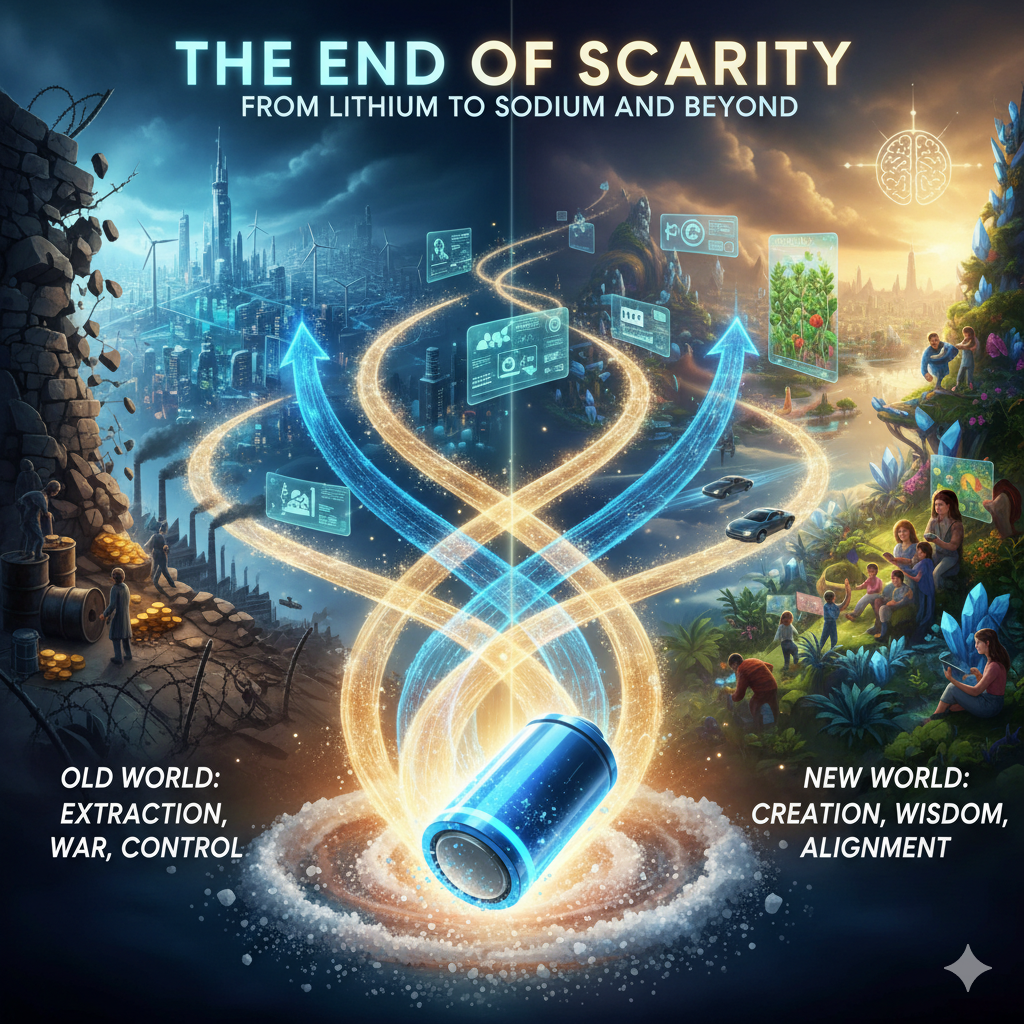
Every few decades, humanity encounters a discovery so fundamental that it quietly rewrites the story of civilization. The recent breakthrough in sodium-ion batteries — featured on The Electric Viking channel — may be one of those moments.
For years, skeptics argued that the clean-energy revolution would hit a wall: lithium was too rare, too costly, too polluting. And then comes sodium — one of the most abundant elements on Earth — performing nearly as well, at a fraction of the cost, and with minimal environmental footprint.
This is not just a new chemistry. It is another proof point of Tony Seba’s theory of technological S-curves — that disruptive innovations always begin quietly, accelerate exponentially, and ultimately overturn the old order.
The Hidden Logic of S-Curves
Seba has long argued that technological change follows a predictable pattern. Solar, batteries, autonomous transport, and precision fermentation all share the same curve: slow growth, rapid acceleration, mass adoption.
Each curve reinforces the next. Cheaper batteries make solar more viable; abundant clean energy makes food production more efficient; autonomy slashes logistics costs.
Sodium-ion batteries fit perfectly into this interlocking web. They dismantle one of the last excuses for energy scarcity. When storage becomes cheap, clean, and built from salt, the geopolitics of extraction begin to collapse. Energy becomes local, and with it, power itself decentralizes.
The Great Transformation
At Abundance 360, Peter Diamandis described this convergence as the meta-curve of humanity: a civilizational shift from scarcity to abundance. For 6,000 years, we organized around what we lacked. Scarcity shaped our religions, our hierarchies, and our economies. Kings and corporations existed to manage shortage.
Abundance flips that equation. It’s not that everyone suddenly has everything — it’s that the baseline of possibility changes. When energy, food, and information become exponentially cheaper and more accessible, the limiting factor is no longer material. It becomes mental: imagination, wisdom, coordination.
Diamandis calls abundance a mindset. Seba maps it in data. Together they describe a new reality forming beneath the old one — an economy where creation outpaces consumption, and where value is no longer extracted from scarcity but generated through alignment.
What Abundance Really Means
Abundance is often misunderstood as excess. But true abundance is not about owning more — it’s about needing less because everything essential flows freely. It’s the point where access replaces ownership, and intelligence replaces control.
It means the sun provides nearly free energy; AI translates and educates universally; biology grows materials that once required factories. It means the old incentives — hoard, defend, compete — begin to look primitive.
But abundance also demands a new kind of discipline. When resources multiply exponentially, so do the consequences of ignorance. Abundance without consciousness simply scales chaos.
The future therefore requires both: exponential technology and exponential wisdom.
The Civilizational Shift
Tony Seba’s latest book, Stellar, extends this logic. He suggests we are moving toward an economy no longer limited by physical scarcity but organized by creativity and coordination. The combination of cheap energy, clean mobility, and AI-driven production will dismantle the 6,000-year scarcity architecture — the one built on extraction, war, and centralized power.
Agriculture made us farmers. Industry made us consumers. Abundance will make us creators — planetary citizens designing systems that sustain life rather than exploit it.
This is not utopianism; it is mathematics meeting consciousness. The curves are measurable. The question is whether our institutions, and our minds, can curve fast enough with them.
The Sodium Signal
That’s why the sodium-ion breakthrough matters. It’s not Seba’s invention, but it is exactly what he predicted would happen: the emergence of a cheap, abundant, clean alternative that accelerates all other S-curves.
As The Electric Viking video demonstrates, the performance of these batteries challenges the last remaining barrier to full energy abundance. Salt may soon power cities. The periodic table itself is turning into a canvas of freedom.
Each drop in cost is another data point on the curve toward abundance — and another crack in the wall of scarcity thinking.
From Scarcity to Consciousness
If Stellar and Abundance 360 share a single message, it’s this: the end of scarcity is not just a technological milestone — it’s a spiritual one. Humanity’s next revolution is not about more energy or data; it’s about shifting the story we tell about ourselves.
For millennia we’ve lived by the myth of not-enough. The Sodium Age — and everything it represents — suggests that maybe, just maybe, we’ve crossed the threshold where that story no longer makes sense.
The tools of abundance are here. What remains is the consciousness to use them wisely.
Summary
Sodium-ion batteries, first reported by The Electric Viking, validate Tony Seba’s vision of cascading S-curves and Peter Diamandis’ belief in exponential abundance. They prove that the clean-energy transition is not slowing down — it’s accelerating into a new paradigm.
We are witnessing the quiet end of the scarcity economy and the birth of an abundant civilization — one where creativity, not control, becomes humanity’s defining resource.