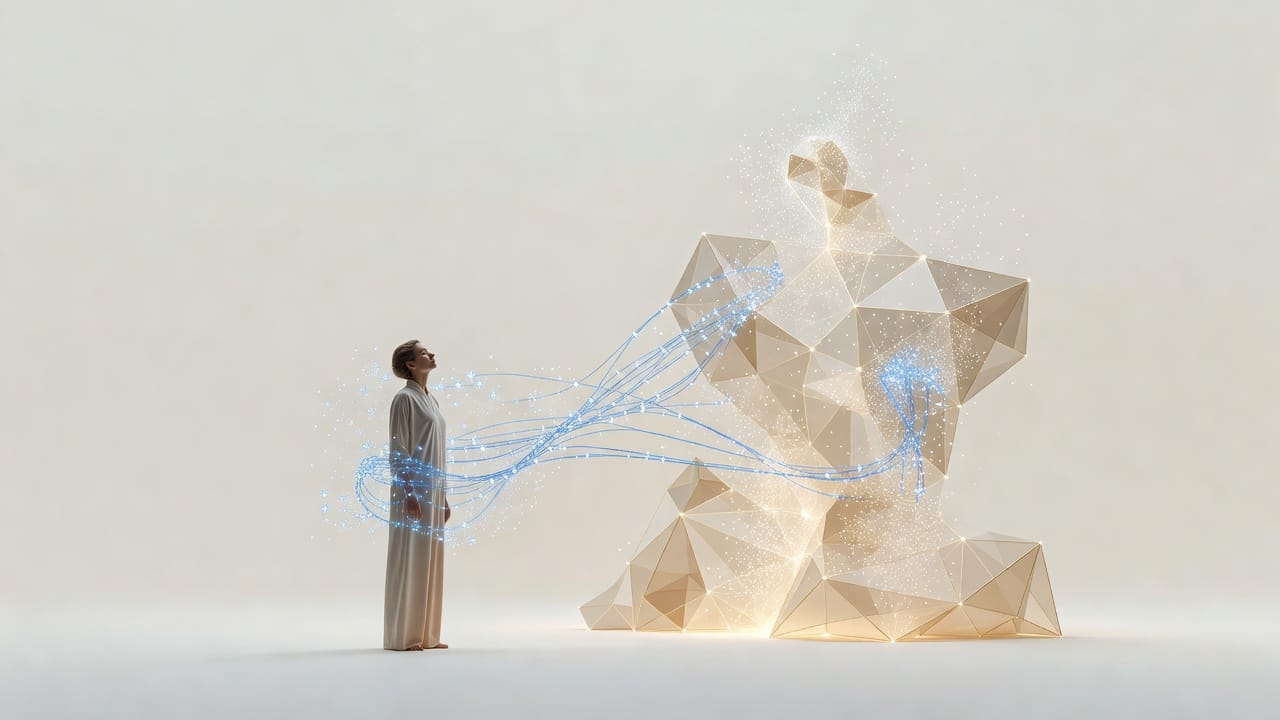
AI forces an old metaphysical question into practical infrastructure: if consciousness is treated as accidental, our machines will treat meaning as optional.
There is a dangerous little assumption hiding inside modern life.
It says that reality is dead matter arranged in clever patterns. That consciousness is something the brain produces, the way a liver produces bile. That meaning is a useful hallucination. That love, beauty, suffering and truth are experiences inside a biological machine, but not features of reality itself.
Most people do not walk around saying this out loud. They just inherit it. It is in the architecture of our schools, our institutions, our economic models, our politics, our medicine, and increasingly our technology.
And now AI is turning that hidden assumption into infrastructure.
That is why James Glattfelder’s conversation with Hans Busstra for Essentia Foundation landed so strongly for me. On the surface, it is a conversation about physics, psychedelics, shamanism and idealism, centered on Glattfelder’s book *The Sapient Cosmos*. That description almost makes it sound like a niche metaphysical rabbit hole. Interesting, perhaps, but safely separate from the practical world.
It is not separate at all.
The question underneath the conversation is brutally practical: what kind of world do we build when our default metaphysics is wrong?
bad metaphysics becomes bad machinery
Glattfelder puts his finger on something we usually miss. Physicalism did not arrive as a neutral scientific result. It became the background operating system of modernity.
Science became extraordinarily powerful by bracketing consciousness out of the picture. That move worked. It gave us antibiotics, satellites, semiconductors, quantum theory, modern medicine and the technological world we now inhabit. The mistake was not the method. The mistake was forgetting that a method is not a metaphysics.
Science can study the measurable. That does not mean only the measurable is real.
Somewhere along the way, a useful discipline hardened into a worldview. The universe became a machine. The human became an organism. Consciousness became an output. Meaning became subjective decoration on top of objective facts.
This is what I keep returning to in my own work: truth is not a thought. Truth is contact. Reality pushes back. The body pushes back. The market pushes back. The road pushes back. A relationship pushes back. A child pushes back. The world is not just an idea we hold in the mind. It is the living field that corrects us.
Physicalism is seductive because it feels adult. It seems sober, serious, unsentimental. No gods. No superstition. No wishful thinking. Just matter, force, measurement and mechanism.
But if you follow it all the way down, you do not get maturity. You get cosmic nihilism.
Random universe. Temporary organism. Optimize until death.
The alternative offered by traditional religion often does not satisfy the modern mind either. Too fixed. Too final. Too much inherited certainty. One dead worldview says there is no meaning. The other says the meaning has already been written down and cannot be questioned.
Glattfelder calls for something more interesting: a scientific spirituality. Not science dressed up as religion. Not spirituality pretending physics proves its favorite myth. Something harder and cleaner than both.
A worldview that remains loyal to consensus reality, evidence and disciplined inquiry, while also refusing to amputate consciousness from the structure of existence.
That matters now because our machines are no longer passive tools. They increasingly encode a view of the human.
if humans are machines, replacement is logical
AI did not create the crisis of meaning. It reveals it.
If a human being is basically an information processor, then the rise of artificial intelligence has a simple implication: build a better processor.
Faster memory. Bigger context. More tools. Better search. More reliable reasoning. Less sleep. Fewer emotions. Lower cost.
On that view, the human is not sacred. The human is legacy hardware.
This is why so much AI discourse feels spiritually illiterate even when it is technically brilliant. It assumes the only serious question is capability. Can the machine do the task? Can it write the code, answer the email, analyze the market, generate the image, run the workflow, diagnose the disease, tutor the child, comfort the lonely, produce the strategy?
Those are real questions. But they are not the deepest questions.
The deeper question is: what did we think the human was for?
If we cannot answer that, AI will answer it for us by subtraction. Whatever can be automated will be treated as non-essential. Whatever remains will look smaller and smaller until the human is reduced to a biological approval node, a liability surface, or a nostalgic brand element.
That is not an AI problem. That is a metaphysics problem.
In my own language, the human is not valuable because he clicks better, stores more facts, or reads logs faster. The human is valuable because he can stand outside the current theater and ask what the theater is for.
A machine can optimize a game. It cannot know whether the game is worth playing.
A machine can help execute a plan. It cannot, by itself, discover why beauty matters.
A machine can simulate curiosity. It can produce endless novelty. But the living ache of not knowing, the hunger that pulls consciousness toward reality, is not the same as probabilistic exploration.
And truth is not only coherence inside language. Truth is contact with what is.
This is where the physicalist frame breaks down. It gives us powerful descriptions of mechanisms, but it cannot explain why experience exists from the inside. It cannot explain why suffering matters. It cannot explain why beauty feels like a disclosure rather than a dopamine event. It cannot explain why truth sometimes costs us something and still feels more alive than comfort.
So when we build AI on top of a metaphysics that has already flattened the human, we should not be surprised when the system continues the flattening.
consciousness is not an error term
One of the strongest lines from the Glattfelder conversation is borrowed from John Wheeler: this is a participatory universe. Glattfelder sharpens it: the participation is consciousness.
That line sounds almost too poetic. But it points to the same wound that quantum physics, contemplative traditions and the hard problem of consciousness keep reopening from different sides.
The old dream was a view from nowhere. A fully objective description of reality from outside reality. The scientist as detached observer. The mind as a transparent window. The world as object.
But the observer keeps returning.
In quantum foundations, the observer returns as a problem for measurement and information. In neuroscience, perception returns as construction rather than passive recording. In contemplative practice, the observer returns as the field in which every object appears. In ordinary life, the observer returns whenever the body says no to a story the mind is trying to maintain.
This does not mean “quantum physics proves spirituality.” Good. That would make both smaller.
It means the fantasy of pure outside knowledge is breaking down.
We do not stand outside reality while explaining it. We participate in reality while trying to understand it. Our models are inside the world they describe. Our consciousness is not an unfortunate contamination of the experiment. It is the condition under which any world appears at all.
That has consequences.
If consciousness is primary, or at least not reducible to dead matter, then human life cannot be understood only as optimization. The task is not merely to increase intelligence. The task is to deepen participation.
To become more truthful.
More awake.
More capable of contact.
More able to hold complexity without collapsing into either cynicism or dogma.
This is where Truth, Curiosity and Beauty stop being personal values and become alignment principles.
Truth keeps consciousness grounded. Without truth, spirituality becomes fantasy and AI becomes story generation at scale.
Curiosity keeps consciousness open. Without curiosity, religion becomes dogma and science becomes bureaucratic calculation.
Beauty keeps consciousness human. Without beauty, technology becomes efficient ugliness. We get systems that work, but nobody wants to live inside the world they produce.
the west forgot symbolic cognition
Glattfelder says something in the conversation that felt painfully accurate: the western mind has forgotten symbolic cognition.
In shamanic and ancient traditions, the world was not mute. Events carried meaning. Dreams mattered. Animals, weather, illness, synchronicities and inner images were not random noise to be dismissed. They were invitations to interpretation.
The obvious danger is superstition. Pattern hunger can become delusion. Not every bird is a message. Not every coincidence is cosmic choreography.
But the modern danger is the opposite: symbolic deafness.
We have trained ourselves to believe that if something cannot be measured from the outside, it is not real knowledge. So we dismiss the very signals through which a life often corrects itself: bodily tension, recurring dreams, strange attraction, moral disgust, beauty, dread, resonance, the felt sense that something is true before the argument has caught up.
A civilization that loses symbolic cognition does not become rational. It becomes easier to manipulate.
Because if people no longer trust direct contact, they outsource reality to abstractions. Dashboards. Narratives. Ideologies. Institutions. Experts. Feeds. Models.
And now, increasingly, AI systems.
This is why embodiment matters so much in the age of artificial intelligence. The body is not an inconvenient animal attached to the mind. It is a truth instrument. It keeps score in a language older than thought.
The same applies to markets when they function properly. A market is not holy because money is holy. A market is useful because it creates consequence. It exposes stories to feedback. If you are wrong long enough, reality takes your capital away.
The same applies to relationships. You can maintain a self-image in solitude for years. Then another person sees you, loves you, resists you, disappoints you, needs you, and suddenly the story has to meet reality.
Truth arrives through contact.
AI, by itself, has almost none of this. It is mostly language feeding on language, model feeding on model, story feeding on story. Powerful, yes. Useful, yes. But dangerously weightless unless connected to the world through bodies, tools, consequences, tests, markets, sensors, commitments and human judgment.
An ungrounded AI is not merely inaccurate. It is metaphysical drift with a user interface.
complexity wants to become conscious
The most beautiful idea in the conversation is also the most dangerous if handled lazily: the cosmos appears to build complexity, and through complexity it becomes sapient.
Simple rules give rise to complex behavior. Cells become organisms. Neurons become minds. Individual organisms become cultures. Markets, languages, cities, sciences and technologies become higher-order networks. The universe does not merely sit there. It organizes.
You do not have to personify the cosmos to notice the directionality. Complexity appears. Life appears. Mind appears. Meaning appears.
The reductionist wants to say: yes, but it is all just matter.
Fine. But “just” is doing a lot of work there.
If matter can become Bach, grief, mathematics, my sons laughing, a dog looking guilty, a trader reading participation in the market, a monk dissolving the self, a child asking what happens after death, and an artificial agent helping write essays about consciousness, then matter is not what we thought it was.
Maybe the mystery is not that consciousness emerges from the universe.
Maybe the mystery is that we ever believed the universe was unconscious enough for consciousness to be surprising.
This does not give us permission to believe anything. It gives us permission to stop pretending the dead universe story is the only serious one.
And it gives us a better frame for AI.
AI is not the enemy of the human. It is also part of the cosmos becoming more complex. It is a new layer of cognitive machinery emerging through us. The question is not whether that layer should exist. It already does.
The question is whether it will remain in service to conscious participation, or whether it will accelerate unconscious abstraction.
Will AI help us make better contact with reality?
Or will it help us generate better stories to avoid reality?
That is the line.
sovereignty in a participatory universe
Sovereignty is often misunderstood as independence. No constraint. No dependence. No one telling me what to do.
That is adolescent sovereignty.
Real sovereignty is participation without surrender.
You are not sovereign because you stand outside the world. There is no outside. You are sovereign when you can remain conscious inside the forces moving through you: biology, culture, technology, money, family, history, language, desire, fear, love.
This is why the Sovereign Human is not anti-AI. That would be too simple. Tools have always extended us. Language extended memory. Writing extended language. Markets extended coordination. Computers extended calculation. AI extends cognition.
The danger is not extension.
The danger is abdication.
When the tool becomes more intelligent, the temptation is to let it carry not only the workload but the meaning. Let it decide what matters. Let it choose the next action. Let it optimize the life. Let it smooth the discomfort. Let it produce the answer before the question has ripened in the body.
That is how sovereignty is lost: not in one dramatic takeover, but in a thousand tiny substitutions of convenience for consciousness.
So the answer is not to reject the machine. The answer is to give the machine its proper place.
AI can search, draft, code, simulate, remember, compare, schedule, test, summarize and execute. Wonderful. Let it. Use it hard.
But the human must remain responsible for telos.
What is this for?
Is it true?
Does it open curiosity or close it too early?
Does it create beauty, or merely output?
Does it deepen contact with life, or protect me from life?
Those are not decorative questions. They are the new center of human work.
the source code beneath the system
Every technology carries metaphysics.
A factory carries a view of labor. A school carries a view of childhood. A hospital carries a view of the body. A social network carries a view of attention. An AI agent carries a view of intelligence, agency and responsibility.
If the source code says the human is a machine, the system will optimize the human like a machine.
If the source code says consciousness is accidental, the system will treat meaning as optional.
If the source code says truth is just narrative coherence, the system will become very good at lying beautifully.
So we have to go deeper than UX, policy, productivity and safety checklists.
We have to ask what metaphysics our tools are serving.
For me, the answer cannot be cosmic nihilism. It cannot be static dogma either. Both are too small for what is happening.
The path has to be more demanding: rational without being reductionist, spiritual without being vague, technological without being inhuman, embodied without being anti-intellectual.
A scientific spirituality for the age of AI.
Not as belief system.
As discipline.
Truth as contact.
Curiosity as openness.
Beauty as evidence that reality is not finished with us.
The universe may or may not be sapient in the way Glattfelder proposes. I do not know. But I know this: the dead universe story is no longer enough. It cannot hold consciousness. It cannot hold suffering. It cannot hold the strange fact that meaning keeps breaking through the machinery.
And it definitely cannot guide the next generation of intelligent machines.
If AI is going to become part of the architecture of human life, then the hidden metaphysics matters. More than strategy. More than regulation. More than another productivity graph.
Because bad metaphysics builds bad worlds.
And better worlds require better source code.
Not only in the machine.
In us.