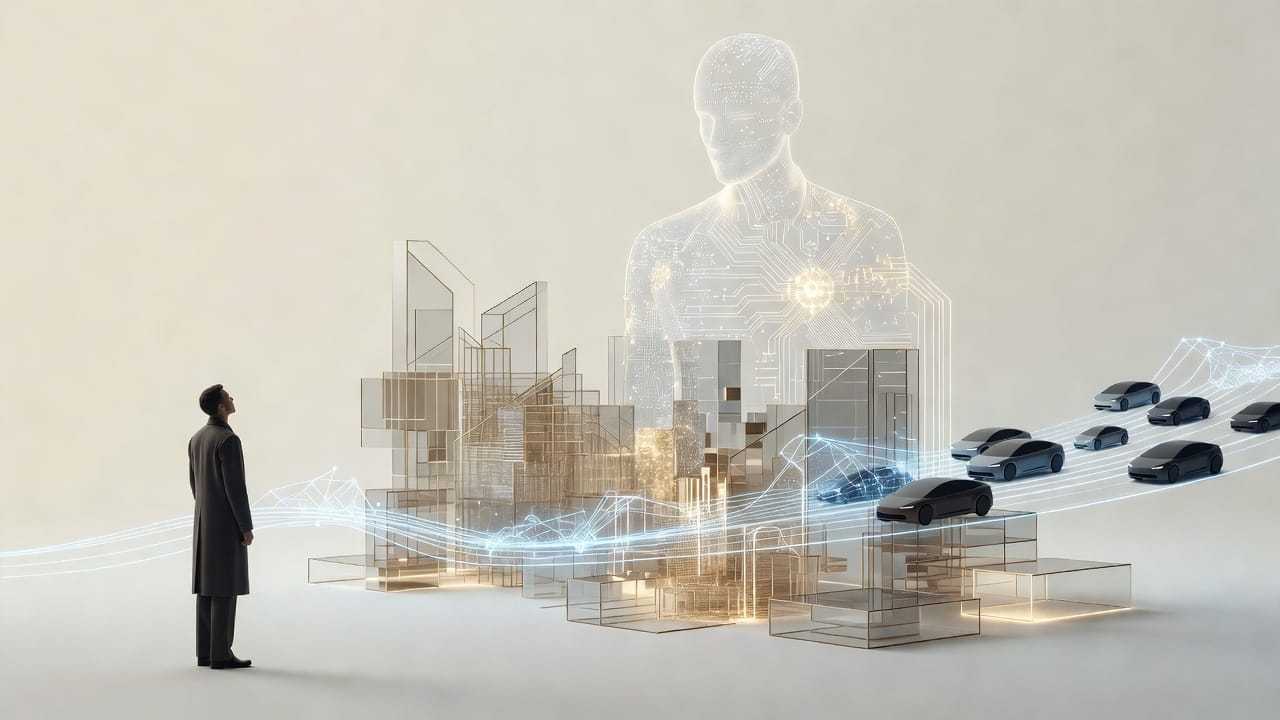
On Hannah Arendt, Tesla, AI, and Europe’s habit of waking up after the future has already left.
On Hannah Arendt, Tesla, AI, and Europe’s habit of waking up after the future has already left.
Hannah Arendt became famous for her reporting on the Eichmann trial in Jerusalem. People expected a monster. A demon. Someone who embodied the full depth of his evil.
What she saw was more disturbing.
Eichmann spoke in clichés. He hid behind procedures. He did not look like someone who woke up every morning with a demonic self-image. He looked like someone who had learned to play his role, then stopped thinking.
That is what Arendt called the banality of evil.
The phrase is often misunderstood. She did not mean that evil was small, harmless, or excusable. She meant that evil does not always need a grand inner darkness. Sometimes it needs obedience, career incentives, departmental meetings, forms, targets, procedures, and people who simply show up again on Monday morning.
I thought about that while looking at Europe.
Not because Volkswagen is Eichmann. Not because BMW is committing evil by being late to software. That would be a cheap and morally lazy comparison.
But Arendt’s deeper insight touches something in our time: large historical failures do not always begin with someone deciding to do the wrong thing. Sometimes they begin because nobody truly decides to do anything else.
Nobody at Volkswagen walks into the office on Monday morning and says: let’s fall behind on purpose. Nobody at BMW says: let’s give Tesla the market. Nobody at Mercedes says: let’s ignore software until it is too late.
That is not how it works.
What happens is far more banal.
There is a meeting. There is a budget cycle. There is a supplier presentation. Procurement looks at which sensor, which chip, which dashboard, which “AI feature” can be bought. There is a roadmap. A compliance process. A mobility conference. Someone says self-driving is interesting and “we should look at it strategically.”
Three months later, there is an inventory.
NVIDIA can supply something. Bosch maybe. Mobileye has a package. There will be a pilot. Then an evaluation. Then a next phase.
And meanwhile Tesla keeps moving.
That is the unsettling part. Not the evil. The absence of urgency.
The choice has often already been made
There is a moment in every disruption when people still think there is a choice, while in reality the choice has already been made.
Tony Seba has been saying this for years about technology. A disruption does not begin when everybody sees it. By then it is already underway. It begins when cost, performance, and scale shift far enough that the old world no longer has an economic future. After that, it simply takes a while before institutions, journalists, executives, and consumers are willing to admit it.
The electric car did not win on the day every car became electric. It won when battery prices, software, drivetrains, and manufacturing curves started pointing in one unavoidable direction.
Precision fermentation does not win when the last cow disappears from the landscape. It wins the moment microorganisms can produce proteins more cheaply, cleanly, and precisely than an animal body that needs grass, water, land, antibiotics, transport, and slaughter.
AI did not make Europe dependent only once every company started using OpenAI, Microsoft, Google, or Amazon. That dependency was already there when compute, models, cloud infrastructure, chips, capital markets, and product distribution concentrated outside Europe.
And self-driving electric cars do not win only when every taxi has no steering wheel. They win when the car stops being mainly a mechanical product and becomes a software platform on wheels.
That moment has passed.
Europe still talks as if it has to choose. The world has already chosen.
That is the painful sentence nobody in Brussels likes to say: it has already happened.
Not completely. Not perfectly. Not without delays, accidents, resistance, and temporary failures. But direction is not the same as completion. Markets move on direction.
That is the European mistake.
Europe sees an unfinished disruption and thinks: then we can still steer it. But a disruption does not need to be complete to become irreversible. Once the economic logic has shifted, policy mostly becomes an attempt to soften the landing. Not to determine the direction.
Sovereignty as theater
This is why Europe’s sovereignty rhetoric has started to sound so hollow.
We say we want digital sovereignty, but our cloud runs on American platforms.
We say we want military sovereignty, but NATO still leans on American power.
We say we want AI sovereignty, but infrastructure, models, chips, and capital markets mostly sit elsewhere.
We say we want to lead mobility, but Tesla and China set the pace.
Europe wants to speak sovereignly without acting sovereignly.
That is not strategy. It is a pipe dream with policy documents.
Mistral CEO Arthur Mensch warned French lawmakers that Europe has roughly two years to build serious AI infrastructure or become structurally dependent on American and Chinese suppliers. His point was not only technical. It was about power. If AI is the new cloud, the question is not who has the most beautiful principles. The question is who converts energy, compute, and models into tokens the world uses every day.
ASML CEO Christophe Fouquet signed a similar warning with other European technology leaders: Europe has talent, ecosystems, and technology, but too often fails to convert them into scale. That may be the best summary of the European problem. The ingredients exist. The meal does not reach the table.
And still, it is too easy to simply mock Europe.
Europe regulates because regulation is Europe’s invention for not going to war with itself again and again. That is not a small achievement. The continent that tore itself apart for centuries learned to slow power down, divide it, and tame it legally.
That is noble. Maybe even civilization.
But the same trait that brought Europe peace makes it bad at technological wars.
Regulation is useful when you want to avoid conflict.
Regulation is weak when you need to conquer a market.
Regulation is beautiful when power must be limited.
Regulation is not enough when speed itself becomes power.
A customer with a flag
This is the difference between Rutte at NATO and the sovereignty fantasy in Brussels.
Rutte seems to understand where Europe actually stands. Not where it would like to stand. Not where the speeches say it stands. Where it stands in reality. Dependent on American military power. Too little capacity of its own. Too little urgency. Too many countries that want protection without paying the full price.
You can work with that. Not because it is beautiful, but because it is true.
The mistake begins when Europe acts as if a market is the same thing as power.
A large market is leverage. Of course. But it is not automatically sovereignty. You are not in charge when you only write rules for systems other people build.
You are not sovereign because you have a market. You are sovereign when you own the critical layers: energy, defense, compute, chips, models, software, manufacturing, capital, talent, and speed.
Europe owns some layers. ASML is a miracle. European engineers are excellent. The industrial base is not nothing. But as a whole, Europe does not behave like an actor that wants to win. It behaves like an actor that wants to prevent others from winning too hard.
That is different.
A continent cannot simulate sovereignty through rules forever. At some point an American company, a Chinese manufacturer, or an American president simply says: enough, you are frustrating the system, this stops now.
And then the truth appears.
You are not the boss of systems you cannot replace.
You are a customer with a flag.
The banality of stagnation
This is where the argument returns to Arendt.
Not to the crime. Not to Eichmann himself. But to her deeper warning about thoughtlessness. About systems in which people play their roles without asking what reality demands from them.
The European policy class is not evil. The CEO of Volkswagen is not stupid. BMW’s procurement department is not consciously sabotaging the future. Nobody wakes up wanting to make a continent irrelevant.
That is exactly the problem.
Everyone is doing reasonable things.
They write strategies. They organize hearings. They protect jobs. They make rules. They commission studies. They demand European values. They speak about sovereignty.
And meanwhile the future moves outside the meeting room.
The banality of stagnation is that nobody feels guilty. Everybody did their job. Everybody had good reasons. Everybody could explain why it was careful, democratic, responsible, and European.
Until the bill arrives.
Then it becomes clear that we did not fall behind because we wanted something bad.
We fell behind because we pretended for too long that words were the same as capacity.
Maybe this is the mature posture Europe now needs: not more sovereignty rhetoric, but honest position-taking.
Where are we truly strong?
Where are we already dependent?
Where has the fight been lost?
Where can we still build?
Where should we buy honestly, form alliances, and stop pretending?
The greatest humiliation is not dependency.
The greatest humiliation is dependency while pretending to be autonomous.
That is where Europe stands now.
And the writing is already on the wall.
Not: be careful, this could happen.
Look closely.
It already has.
Sources woven into this essay include Hannah Arendt’s New Yorker reporting on Eichmann in Jerusalem, Arthur Mensch’s 2026 testimony on European AI sovereignty, ASML’s 2026 European technology leadership statement, European Commission material on corporate fleet electrification, and RethinkX/Tony Seba’s work on technology disruption and precision fermentation.