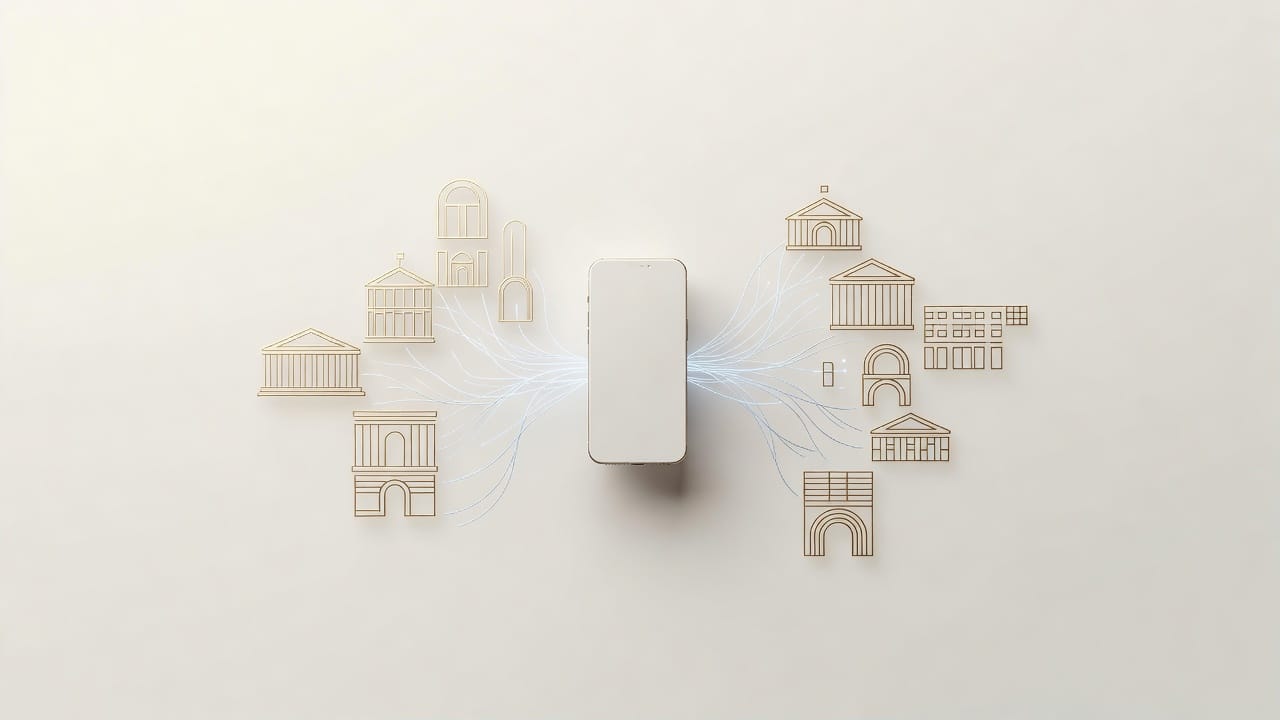
After Apple’s keynote, the real question is not whether Apple can make Siri better. It is whether Apple is bold enough to turn the iPhone into the trusted personal AI interface.
The next great institution may not look like a bank, a university, a hospital, a government office, or even a software company. It may look like a voice. Or a sentence box. Or a quiet presence on the device you already carry in your hand.
The interface we talk to every day — the thing that knows our calendar, our health, our work, our family, our location, our habits, our messages, our documents, our priorities, and our unfinished thoughts — is becoming much more than a tool. It is becoming the place where decisions are prepared, memory is kept, actions are taken, and reality is mediated. In other words: the interface becomes the institution.
That is why Apple’s next move matters so much.
The question after Apple’s keynote is not simply whether Apple can make Siri better. That is too small. We have seen years of “better Siri” promises, and nobody is really waiting for a slightly more fluent weather report. The real question is whether Apple understands that the personal AI interface is the next operating layer of human life.
If it does, Apple may be the best-positioned company in the world. If it does not, the future will be built around it, outside it, and eventually against it.
Personal AI Needs a Home
The last two years have made one thing obvious: people want agents. Not just chatbots. Not just search. Not just autocomplete. Agents.
We want systems that can understand us, remember us, help us think, help us act, and move across the messy boundaries of real life: email, calendar, notes, tasks, health, documents, money, travel, family, work, writing, planning, learning, and creating.
Today, the pioneers are building this with whatever pieces they can find. A Mac mini under a desk. A VPS server somewhere in Europe. A Telegram bot. A memory database. A sync layer. A calendar integration. A personal knowledge base. A cronjob. A language model. Another language model. A custom router. A half-broken automation that works just well enough to be magical and just badly enough to remind you that we are still early.
This is exciting. It is also absurd.
Nobody normal should need to assemble a private agentic operating system by stitching together servers, APIs, notes apps, bots, memory stores, and cloud providers. The demand is real, but the current form is transitional. Personal AI needs a home.
And the obvious home is not a server. It is not a desktop computer. It is not a standalone chatbot app. It is the phone.
The phone is always with us. It knows where we are. It connects to our messages, calls, photos, health, payments, maps, documents, and calendar. It is already the object through which modern life is coordinated. It is intimate in a way no browser tab or SaaS dashboard can be.
This is why the iPhone matters. The iPhone should not merely run AI apps. The iPhone should become the sovereign personal agent.
Apple Has the Trust Layer
Apple has something almost no other company has: trust at the level of the personal device.
That trust is not perfect. Apple is still a corporation, still an ecosystem, still a company with strategic incentives. But compared with the rest of Big Tech, Apple has the cleanest position. Its business is not primarily advertising. Its deepest product is not behavioral targeting. Its strongest story is not “give us your data and we will monetize it more efficiently.”
Apple’s strongest story is different. Your device is yours. Your private life should remain private. The system should work for you without turning you into the product.
That matters because personal AI is not normal software.
A real personal AI would need to see things we barely let other humans see. It would see our email. It would see our calendar. It would see our health. It would see our purchases. It would see our photos. It would see our work. It would see our family logistics. It would see our intentions before they are polished into public language. It would see the difference between what we say we value and how we actually spend our days.
That level of context is incredibly powerful. It is also incredibly dangerous. So the first question is not who has the smartest model. The first question is who can be trusted to place intelligence this close to the human being.
Apple has spent years building the answer: on-device processing, secure hardware, privacy-preserving architecture, and Private Cloud Compute for requests that need more power than the device can provide locally. Its direction is clear: keep as much intelligence as possible on the device, and when the cloud is needed, design the cloud so even Apple cannot simply inspect the user’s private life.
That is exactly the right philosophical foundation.
Apple does not need to win AI by having the biggest model. Apple can win by becoming the trusted place where models are allowed to touch your life.
Google Has Context, But Not the Contract
Google is brilliant. Google has extraordinary AI talent, enormous infrastructure, Android, Gmail, Search, Maps, YouTube, Gemini, and one of the richest context graphs in the world. But Google has a problem.
The advertising business model sits in the room like a loaded gun.
A truly personal AI must know too much. It must understand what we want, fear, avoid, delay, desire, buy, eat, write, plan, regret, and hide. If that system is connected to an advertising machine, the trust contract becomes unstable.
Even if the technology is excellent, the human question remains: does this system know me in order to serve me, or does it know me in order to shape me?
That distinction is everything.
For search, advertising was tolerable. Annoying sometimes, manipulative sometimes, but workable. For personal AI, it becomes existential. The interface that helps me decide what to do next cannot also be quietly optimized around someone else’s commercial incentive.
That is why Apple’s privacy position is not a marketing detail. It is a strategic advantage. Privacy is not a feature. Privacy is the condition that allows the personal interface to become trusted enough to matter.
Intelligence Is Not the Institution
OpenAI, Anthropic, Microsoft, Google, and others may provide extraordinary intelligence. Their models will reason, write, code, explain, summarize, plan, and act. They will become more multimodal, more agentic, more useful, and more deeply integrated into daily work.
But intelligence alone is not enough.
The personal AI institution needs intelligence, context, and trusted permission to act. The model companies have intelligence. Microsoft has a powerful work context. Google has enormous consumer context. But Apple has the personal device layer.
That is different.
A model can answer a question. A work assistant can help inside the enterprise. A search engine can retrieve information. But the personal operating layer must sit across life itself. It must know the apps. It must understand the screen. It must use the calendar. It must read the email. It must check the health data. It must know the location. It must remember preferences. It must help with family logistics. It must write, speak, schedule, search, summarize, remind, prepare, decide, and execute.
And it must do all of that without making the user feel exposed.
That is the Apple-shaped opportunity.
OpenAI, Anthropic, Microsoft, and others can become engines inside the system. Perhaps we should be able to choose them. Perhaps Siri should route between Apple’s own models, ChatGPT, Claude, Gemini, or other specialized models depending on the task. But the institution is not the model. The institution is the trusted interface that decides when a model may touch your life.
Siri Must Stop Being Siri
This is where Apple’s challenge becomes uncomfortable. Siri cannot remain Siri. Not in the old sense.
The old assistant model was built around commands. Set a timer. Play this song. Call my wife. What is the weather? Turn on the lights. Useful, sometimes, but not transformational.
The new interface must be built around context and agency. It should prepare you for a meeting before you ask in the perfect words. It should know which email thread matters because it understands the project. It should notice how your sleep affects your training and how your calendar affects your patience. It should help move an appointment, tell the people involved, and protect your evening. It should remember why a project matters, not just where the document is stored. It should draft the message, but know when not to send it. It should watch for patterns and warn you when they return.
That is not a chatbot. That is a personal operating layer.
It should be available through voice. It should be available through text. It should live across the device. It should understand what is on screen. It should know which app has the relevant information. It should have memory. It should ask permission for sensitive actions. It should route to stronger external models when needed. It should act locally when possible. It should remain private by default.
Most importantly, it should not feel like opening an AI app. That would miss the point.
The future interface is not another destination. It is the layer between intention and action.
Apple’s Strength Is Also Its Risk
Apple’s strength is control. Apple’s weakness is control.
The company is brilliant at integration, polish, privacy, hardware, ecosystem coherence, and waiting until technology is ready for normal people. That patience made sense for many previous shifts.
But AI is different.
AI improves through use. Agents improve through context. Memory improves through continuity. Interfaces improve through daily friction. The product becomes real by living with the user.
If Apple waits until everything is perfectly controlled, it risks missing the living version of the category.
That is already happening. People are carrying ChatGPT, Claude, Gemini, Perplexity, and other tools in their pockets. Developers are building personal agent systems. New devices are emerging: small handhelds, AI-native note-takers, Android-based experiments, voice-first tools, ambient companions, and strange little objects trying to become the thing Siri should have become.
Some of these products will fail. Many deserve to fail. Some are gimmicks. But the impulse is correct. People want a personal interface that knows them, helps them, and acts with them.
If Apple does not provide that layer, someone else will. And if someone else builds the daily interface, Apple’s beautiful ecosystem becomes less central. The iPhone remains the hardware, but the relationship moves elsewhere.
That is the real risk. Not that Apple loses the model race. That Apple loses the human interface.
The Ternus Test
This is why the leadership question matters.
Whether under Tim Cook’s final chapter or the coming John Ternus era, Apple faces a rare strategic test: can it move from protecting the old interface to inventing the next one?
The iPhone changed the world because it collapsed many tools into one personal object. The next shift collapses many apps into one trusted intelligence layer.
That requires boldness.
Not reckless boldness. Apple should not become an AI chaos machine. It should not throw privacy away. It should not copy the loudest parts of Silicon Valley’s agent hype. It should not turn the iPhone into a surveillance interface with better typography.
But it must be bold enough to understand the category. A better Siri is not enough. A Siri app is not enough. A few integrations with external models are not enough.
The real question is whether Apple can make the interface itself intelligent, personal, private, and agentic. Can it make the iPhone feel less like a grid of apps and more like a trusted extension of intention? Can it make AI useful without making human life feel harvested?
That would be worthy of Apple.
The Pioneer Path
For those of us already building personal agent systems, the direction is obvious.
We are not doing it because we enjoy complexity for its own sake. We are doing it because the need is real and the official tools are not yet sufficient.
A personal agent with memory, tools, voice, calendar access, health context, publishing workflows, task systems, private infrastructure, and daily operational awareness is not science fiction. It already exists in rough form.
But it exists as pioneer infrastructure.
Too many moving parts. Too much maintenance. Too many APIs. Too much glue. Too many servers. Too many moments where the human has to become the system administrator of his own intelligence layer.
That cannot be the final form.
The final form should feel inevitable. You pick up your phone. You speak or type. It knows enough to help. It knows enough to act. It knows enough to protect you. It knows enough to ask before crossing a line. It remembers what matters. It forgets what should be forgotten. It uses the right model for the task. It keeps your private life private.
That is not a fantasy. That is the logical endpoint of the iPhone.
The Real Test
So after Apple’s keynote, the question is simple.
Will Apple move quickly enough to make the interface the institution?
It has the hardware. It has the privacy architecture. It has the operating system. It has the developer ecosystem. It has the user trust. It has the intimate device. It has the strategic need.
But does it have the urgency?
If Apple gets this right, personal AI becomes something profoundly different from today’s cloud chatbot race. It becomes private, embodied, contextual, and humane. It becomes a tool for agency rather than another mechanism for extraction.
If Apple gets this wrong, the pioneers will keep building the missing institution outside the system.
That may be exciting. But it would also be a strange failure.
Because the answer has been in our hands all along.