Why We Need Heroes Who Build Impossible Things
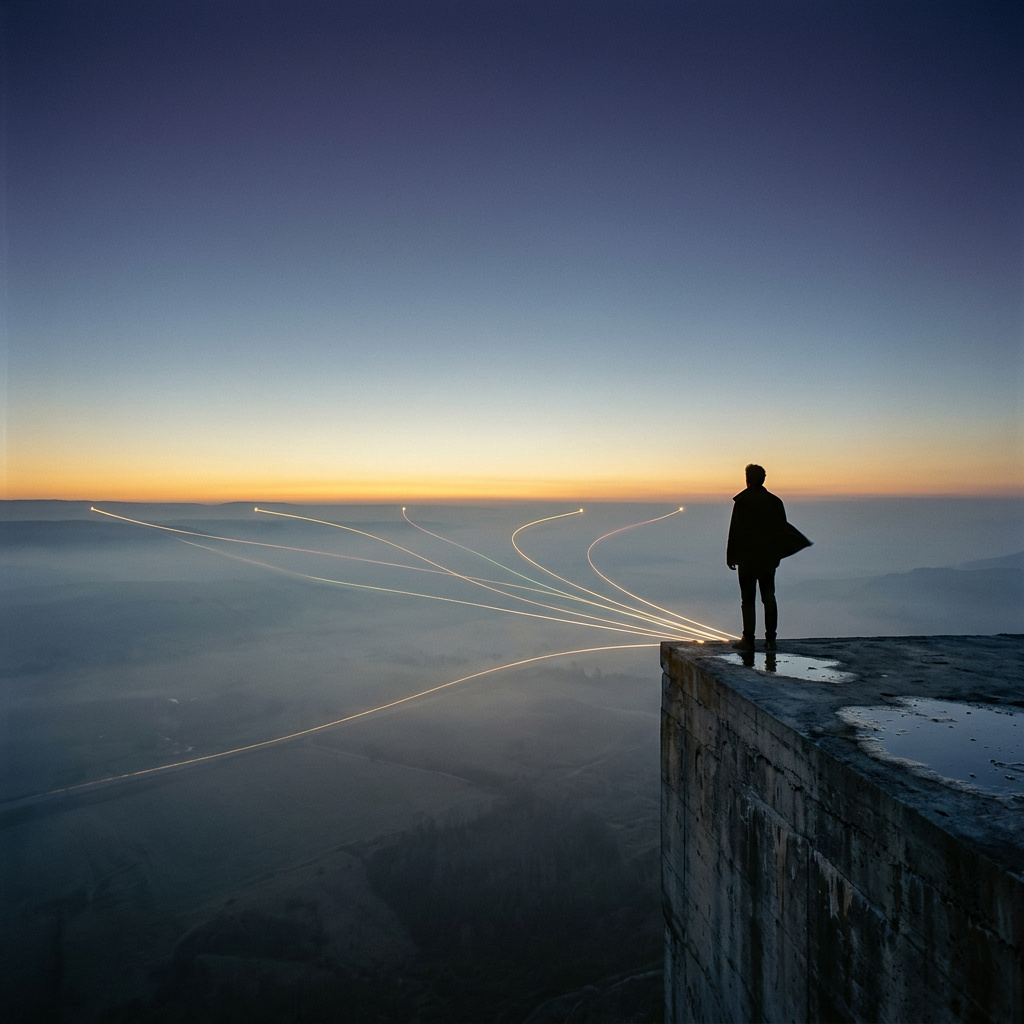
I want to tell you a fairytale.
Not the kind with dragons and castles, but something better. Something real.
Cern Basher wrote it on X, and when I read it, I recognized something most people miss when they talk about Elon Musk. They see the rough edges, the controversies, the tweets that make them uncomfortable. They slap "I chose the car, not the CEO" stickers on their Teslas and feel morally superior.
But zoom out. Look at the actual pattern.
What Musk is doing exceeds most fairytales we've inherited. The question isn't whether you like him. The question is whether he sees something the rest of us can't yet perceive.
The Prison Guard Problem
Here's a metaphor I keep returning to: imagine you're in prison, and you're significantly smarter than your guard. You escape in a way the guard cannot comprehend. The guard doesn't even understand what happened.
This is the problem with insight asymmetry.
When someone operates from a level of perception you don't possess, you judge them using your own framework. You apply your standards, your limits, your understanding of what's possible. You can't see what they're seeing because you lack the cognitive architecture to perceive it.
The enlightened person recognizes this. If you have lower insight and believe there's no higher insight than yours, you will evaluate the person with greater vision using your limited perspective. You'll call their boldness recklessness. You'll mistake their pattern recognition for ego.
This is what's happening with Musk.
Boldness vs. Recklessness
People conflate these constantly.
Recklessness is impulsive. It disregards consequences. Boldness is different. Boldness operates in what decision theorists call the innovation sweet spot: the 5-7 zone on a 0-10 certainty scale.
If your certainty is 9 or 10, you're not innovating. You're optimizing.
If your certainty is 0 to 2, you're gambling.
But that middle zone—where you've done enough due diligence to make an informed bet but there's still meaningful unknown—that's where transformation lives.
When SpaceX and Tesla were both on the verge of bankruptcy and Musk had $75 million left, he didn't protect his fortune. He invested all of it into his companies. SpaceX succeeded on its fourth launch. Tesla secured funding just in time.
That wasn't reckless. That was calculated belief in structural necessity.
The Seven Doers Framework
Cern Basher's fairytale frames Musk's companies as seven companions on a quest. It's not just poetic—it reveals something structurally true.
Each company attacks a specific cost barrier that defines the transition from scarcity to abundance:
Tesla lowers the cost of energy and transport. The company shifted its mission from "sustainable energy" to "sustainable abundance"—driving down costs across mobility, energy, and labor with one shared AI and manufacturing stack.
SpaceX lowers the cost of reaching orbit. Full reusability could reduce space access costs by a factor of 100. With Starship achieving 100 reuses, costs could fall to under $30 per kilogram. That's a 99.61% reduction compared to 1961.
Starlink lowers the cost of intelligence distribution. From mountaintops to war zones, it brings knowledge where silence once lived.
xAI lowers the cost of intelligence itself. Musk predicts AI smarter than any human by the end of this year, and within five years, AI could surpass humanity's collective intelligence.
Neuralink lowers the cost of healing and human-machine integration. It offers hope where darkness has fallen in injured minds.
The Boring Company lowers the cost of movement. It carves swift tunnels through stubborn earth, freeing cities from suffocating congestion.
Ad Astra lowers the cost of imagination itself. Hidden near SpaceX launch towers, it gathers curious children who don't fit ordinary classrooms. No bells. No rigid rows. Just building, solving, questioning.
This isn't seven separate ventures. It's simultaneous pressure across multiple domains creating systemic transformation.
The Trust Problem
Here's the uncomfortable truth: when someone operates from higher insight, you can't verify their vision from your level. You're forced to trust.
The only thing you can evaluate is whether they have humanity's interests at heart.
Musk explicitly states this commitment. He warns that AI could turn ugly for humanity. He first tried to slow it down, then realized he needed to be on the bandwagon to embed high morals into it. His moral compass: truth-seeking.
What does that mean? For Musk, a man of physics, it means verifiable in the real world. Tangible. Testable.
Compare that to other tech leaders. I haven't heard Mark Zuckerberg articulate a similar commitment. Sam Altman doesn't advocate for high morals in the same way. The judges are out there. It's always in the action.
Creating Truth vs. Discovering It
But here's where it gets philosophically complex.
Musk operates like a physicist who believes truth exists independently, waiting to be discovered. Yet he also entertains simulation theory with his brother in the tub. That's a fundamental contradiction.
My thesis: consciousness is prior to time and space. If that's true, then Musk isn't just discovering truth—he's creating it. When you're building the future that will define what's true, "truth-seeking" takes on a different meaning.
It means applying physics-based first principles to realities that don't yet exist. Not discovering truth, but ensuring what you create is verifiable in the physical world once it manifests.
When Musk announced The Boring Company via tweet in December 2016, he started excavating the first test trench only a month later. That's not how traditional industries work. That's someone who sees the inevitable and moves before permission arrives.
The Civilizational Scale
Musk stated that across all his companies, "the overall goal is to maximize the probability that civilization has a great future."
SpaceX's mission assumes "that life and consciousness may be extraordinarily rare and we need to do everything possible to ensure that the light of consciousness is not extinguished."
When asked about his motivation in electric vehicles, Musk said his original interest "was not based on environmental concern, it was based on sustainability, in the sense of ensuring that civilization can continue to progress."
This frames boldness not as ego but as species-level necessity.
Musk revealed that "roughly 100 miles by 100 miles of solar is enough to power the entire United States." His plans for Starlink aim for a million tons of payload to orbit per year, enabling solar-powered AI satellites capable of generating 100 gigawatts annually.
But he also identifies the constraint most people miss: "We're very soon going to be producing more chips than we can turn on." The limiting factor isn't compute—it's the electricity needed to power data centers, factories, and AI systems at scale.
This is civilizational-scale thinking. Identifying bottlenecks before the crisis becomes visible to conventional wisdom, then building companies to solve them.
Jobs vs. Musk
In 100 years, we'll barely remember Steve Jobs. We'll definitely remember Musk.
Jobs transformed consumer experience. He made technology beautiful and intuitive. That matters.
But Musk is building civilizational infrastructure. Energy systems. Space access. Neural interfaces. The foundations that determine whether humanity stagnates or expands.
Consumer experience versus species trajectory. Both are valuable. Only one is existential.
The Abundance Question
Musk believes that "if you have ubiquitous AI that is essentially free or close to it and ubiquitous robotics, you will have an explosion in the global economy that is truly beyond all precedent."
Humanoid robots could redefine productivity. Economic output calculated from the average productivity of a robot multiplied by the number of robots deployed. Performing industrial tasks, caring for aging populations, addressing labor shortages while lowering costs.
Tesla's Master Plan Part IV declares that "growth is infinite—growth in one area does not require decline in another."
This is the endpoint: when machines solve scarcity, what becomes of human purpose?
Musk's answer appears to be that abundance itself becomes the infrastructure for a different kind of civilization. One where the limiting factor isn't survival but imagination.
Ad Astra represents this meta-layer. Lowering the cost of imagination to ensure future builders who think beyond current constraints.
What the Fairytale Reveals
Cern Basher's fairytale structure isn't just charming. It reveals something true about transformative innovation: it requires a relationship to reality that society instinctively rejects before it accepts.
The villagers always mock the hero. They call the vision impossible. They point to the failures, the rough edges, the personality flaws.
But fairytales survive because they encode patterns that repeat across time.
The pattern here: civilizational-scale problems require people willing to operate beyond conventional limits. Not because they're special, but because the problems demand it.
Boldness isn't optional for abundance-era challenges. It's the cognitive requirement for solutions that don't yet have permission to exist.
The Real Lesson
This isn't about worshiping one builder.
It's about recognizing what humanity must become willing to attempt when machines solve survival and purpose becomes the frontier.
The question isn't whether Musk is likable. The question is whether he sees what's structurally inevitable and has the audacity to build toward it before consensus arrives.
The judges are out there. It's always in the action.
And the action suggests something most people don't want to admit: we need heroes who build impossible things because impossible things are what the next phase of civilization requires.
The fairytale isn't finished. You have a role to play.
Read the full article and more at roelsmelt.com.
Disrupt Consciousness explores the collision between exponential technologies and human awakening. I write about what happens when machines solve scarcity and purpose becomes the frontier—bridging technological disruption with the consciousness work most technologists ignore and most spiritual teachers can't code.