When Machines Think: Seven Principles for Raising Humans in the Age of AGI
I've been watching the AGI timeline compress in real-time.
Leopold Aschenbrenner says 2027 is increasingly reasonable. Eric Schmidt gives it three to five years. Elon Musk predicts 2026. The Metaculus forecast has collapsed from 50 years to five years in just four years.
This isn't distant speculation. This is immediate transformation.
And if you have children, you're facing a question that no previous generation has confronted: how do you prepare a human for a world where machines handle 99% of cognitive work?
The Economic Singularity Arrives Faster Than Expected
The data tells a stark story.
In 2019, GPT-2 could perform tasks taking a human three seconds. By late 2025, Claude Opus 4.5 handles tasks requiring nearly five hours of expert human time. The doubling rate itself is accelerating—from every seven months to every four months.
By the end of 2026, AI will likely perform tasks that take a human 39 hours—more than a full work week.
This is the Economic Singularity: the point where artificial intelligence outperforms humans in most economically valuable tasks. Data analysis, report writing, customer service, scheduling, financial modeling, diagnostic support—all of it.
The irony cuts deep. Those who believed cognitive work was safer than manual labor were exactly wrong. Musk pointed out that almost all keyboard-and-mouse-based jobs will lose competitiveness first. White-collar work goes before blue-collar work.
The numbers confirm it. In the first half of 2025, 77,999 tech workers lost their jobs to AI—491 people every single day. Job postings for early-career workers aged 22 to 25 in AI-exposed fields have decreased by 13% since 2022.
This isn't just automation. This is the elimination of the traditional apprenticeship pathway.
The Collapse of the Entry-Level Economy
I've spent three decades in business leadership. I've seen technological shifts before. This one operates differently.
The percentage of young staffers aged 21 to 25 at large public tech firms has been cut in half between early 2023 and July 2025. They once accounted for 15% of the workforce. Now they account for 6.8%.
The ladder has lost its bottom rungs.
By 2030, 30% of current U.S. jobs could be fully automated. Another 60% will see significant task-level changes. And here's the acceleration that matters: skills demanded by employers are changing 66% faster in AI-exposed occupations than in the least exposed roles.
The study-a-technology-and-apply-it cycle has collapsed. The relevance window is now shorter than the learning curve.
Traditional career advice—pick a stable profession, develop expertise, climb the ladder—assumes a world that no longer exists.
The Inversion: What Becomes Valuable When Intelligence Is Abundant
I practice Vipassana meditation. I code with AI. I lead organizations. I've seen both the void of ego death and the void of algorithmic optimization.
They teach the same lesson: when something becomes abundant, its opposite becomes scarce.
When intelligence floods the market, authentic human experience becomes the premium asset.
The World Economic Forum found that while analytical thinking remains coveted, several emotional intelligence skills—motivation, self-awareness, empathy, active listening—now rank among the top 10 core competencies. Salaries for traditional information analysis will likely dip, while interpersonal skills and emotional intelligence will earn more.
This represents a profound reversal. The premodern, embodied human capabilities become premium skills.
Drama. Emotional attunement. Community building. Physical presence. The ability to hold space for another human's experience.
These cannot be automated because they require the one thing AI lacks access to: the present moment, the texture of being, the irreducible fact of consciousness.
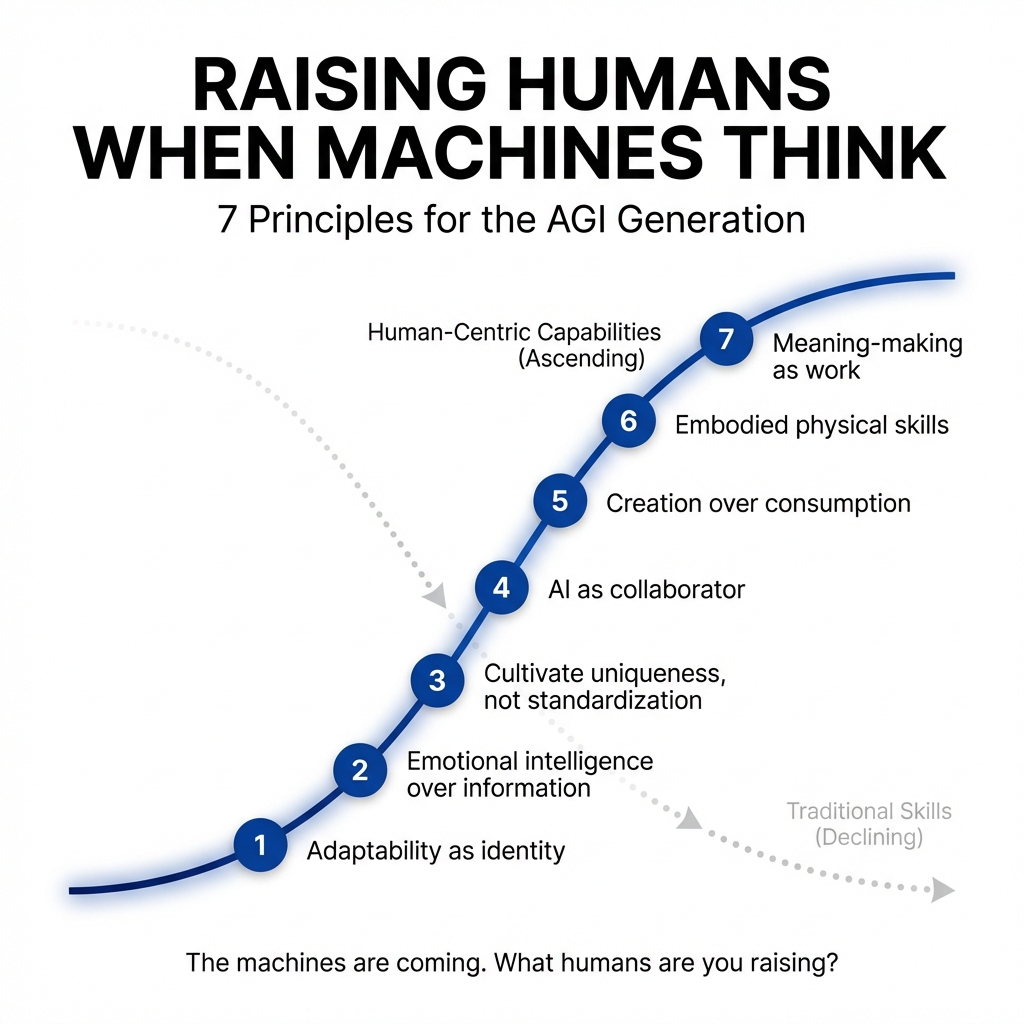
Seven Principles for the Next Generation
I'm not offering a curriculum. I'm offering a frame.
These principles emerge from watching the collision between exponential technology and human consciousness. They're designed for a world where machines solve scarcity but humans must still answer the question of purpose.
1. Teach Adaptability as Core Identity
Your child will not have a career. They will have a series of rapid pivots.
39% of skills will become outdated by 2030. The half-life of professional knowledge is collapsing. What matters is not what they know but how quickly they can learn, unlearn, and relearn.
This means cultivating comfort with discomfort. It means treating change as the baseline, not the exception. It means building an identity around flexibility rather than fixed expertise.
In my knowledge graph, I track how Vibecoding—the practice of building software through natural language and AI collaboration—shifts responsibility to non-traditional developers. The skill isn't coding. The skill is knowing what to build and how to communicate intent.
That's the pattern: technical execution becomes commoditized, strategic vision becomes valuable.
2. Prioritize Emotional Intelligence Over Information Mastery
AI can scale information. It cannot scale genuine human connection.
The more we automate with artificial intelligence, the more we must lead with emotional intelligence. This isn't soft skills. This is survival architecture.
Teach your children to read a room. To sense what's unsaid. To hold tension without collapsing into resolution. To be present with another person's pain without trying to fix it.
These capabilities operate on dimensions that logic cannot colonize.
I've noticed in my own work that Flow state—that zone of exceptional productivity in short time—emerges not from grinding harder but from alignment with forces larger than individual will. Non-attachment to results combined with committed action creates the conditions for breakthrough.
This is emotional intelligence at the existential level: knowing when to push and when to surrender.
3. Cultivate Uniqueness, Not Standardization
The industrial education model optimized for standardization. It produced interchangeable workers for interchangeable roles.
That model is now worthless.
When AI can replicate any standardized output, the only defensible position is irreplicable uniqueness. Your child's weird obsessions, their strange combination of interests, their particular way of seeing the world—these become assets, not liabilities.
I operate at the intersection of three decades of business leadership, deep Vipassana practice, philosophy of technology credentials, and active AI-native creation. That combination doesn't exist elsewhere. It can't be automated because it emerged from a specific life trajectory.
Help your children find their own rare intersections. The value is in the synthesis, not the components.
4. Build Comfort with AI as Collaborator, Not Competitor
The future belongs to humans who can work with AI, not against it.
This means early exposure. Let them see AI as a tool that amplifies intent rather than a threat that replaces agency. Teach them to prompt, to iterate, to use machines as thought partners.
But also teach them where the boundary lives.
AI processes data. It cannot experience being. It lacks access to the present moment. It embodies pure logic but cannot touch the texture of consciousness.
Your children need to understand both what AI can do and what it fundamentally cannot do. The gap between those two things is where human value persists.
5. Emphasize Creation Over Consumption
The shift from scarce to abundant intelligence redefines economic value.
When machines can generate infinite content, the ability to discern, curate, and create with genuine human perspective becomes the scarce resource.
Teach your children to make things. To build, to write, to compose, to design. Not for perfection, but for the practice of bringing something into existence that didn't exist before.
I've been experimenting with AI-enabled workflows. What I've learned: AI handles communication and execution brilliantly. But it cannot originate vision. It cannot decide what matters. It cannot choose what deserves to exist.
Those remain human responsibilities.
6. Develop Physical and Embodied Skills
When everything cognitive can be outsourced, the body becomes the last frontier of authentic human experience.
Sports. Dance. Martial arts. Cooking. Gardening. Carpentry. Any practice that requires physical presence and embodied learning.
These skills cannot be downloaded. They must be lived through. They anchor consciousness in the material world in ways that purely cognitive work cannot.
I've spent 30 days in silent Vipassana meditation. The insight that emerges from that practice cannot be transmitted through language. It must be experienced directly, in the body, through sustained attention to the present moment.
That's the kind of knowing that remains irreducibly human.
7. Teach Meaning-Making as Primary Work
When machines solve scarcity, the question shifts from "how do we survive" to "why do we exist."
This is the spiritual dimension of the Economic Singularity.
Your children will need to answer questions that previous generations could defer: What gives life meaning when labor is optional? What constitutes a good life when material needs are met? How do we maintain purpose when productivity is automated?
These aren't abstract philosophical questions. They're practical survival questions for a post-scarcity world.
In my knowledge graph, I track how Humans seek meaning-generating activities. This isn't a luxury. This is the core human drive that persists when everything else is automated.
Teach your children to ask big questions. To sit with uncertainty. To build their own frameworks for what matters. To find purpose in connection, in beauty, in the simple fact of being alive.
The Threshold We're Crossing
I'm not offering optimism or pessimism. I'm offering pattern recognition.
The collision between exponential technology and human consciousness is happening now. The timeline has compressed beyond what most people realize. The Economic Singularity isn't a distant possibility. It's an immediate transformation.
And the question facing every parent is simple: are you preparing your children for the world that was, or the world that's coming?
The old playbook—stable career, specialized expertise, linear progression—assumes a world where human cognitive labor remains scarce. That world is ending.
The new playbook requires something harder: raising humans who can thrive when machines think, who can find meaning when productivity is automated, who can remain irreducibly themselves when everything standardized becomes worthless.
This isn't about teaching them to compete with AI. It's about teaching them to be more human in a world where humanity becomes the rarest resource.
The machines are coming. The question is: what kind of humans are we raising to meet them?
Read more of my explorations at the intersection of technology and consciousness at roelsmelt.com.
Disrupt Consciousness explores the collision between exponential technologies and human awakening. I write from the rare intersection of business leadership, Vipassana practice, philosophy of technology, and AI-native creation—investigating what it means to be human when machines solve scarcity.