When Friction Became the Product Instead of the Problem
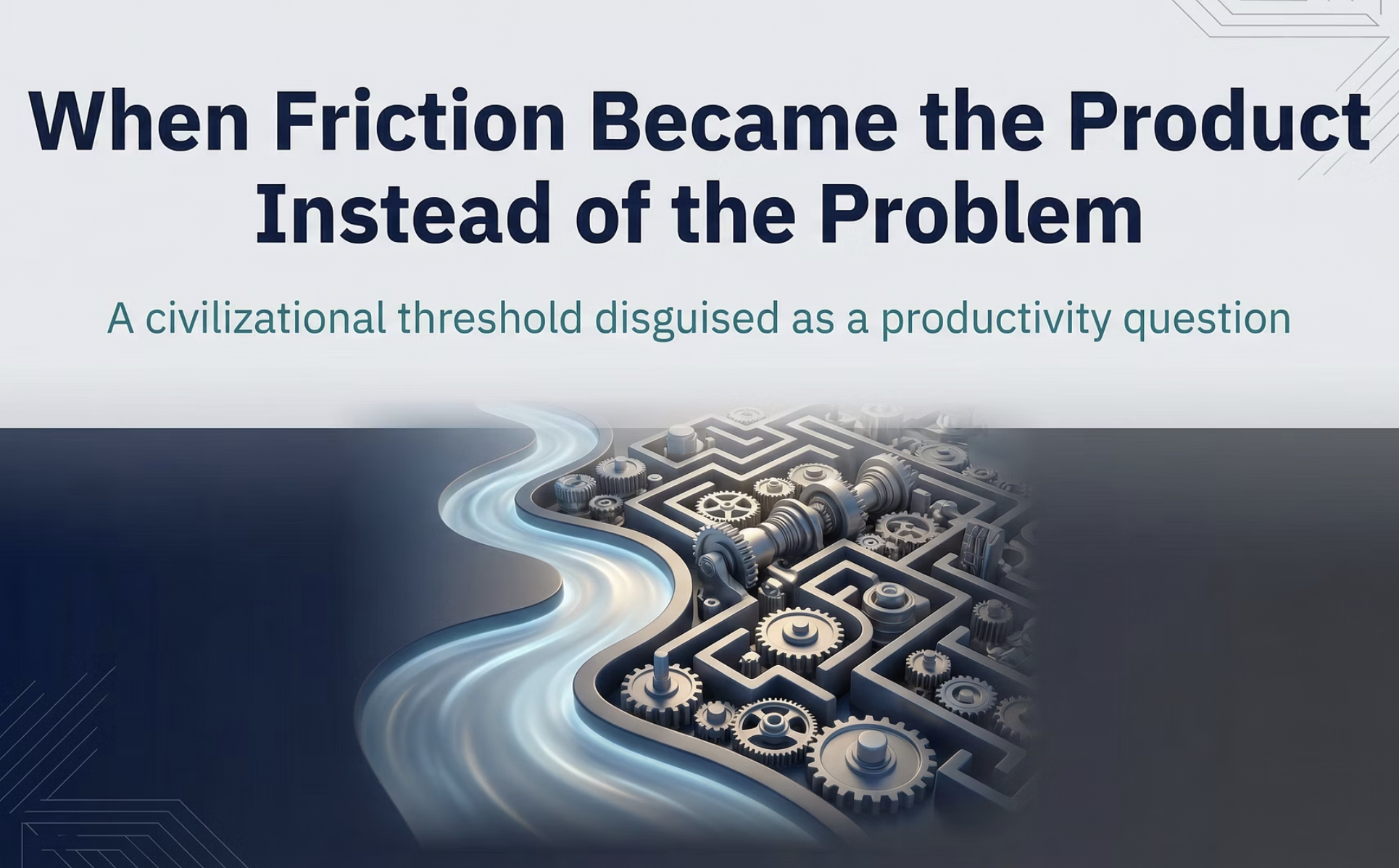
I spent months searching for the AI system that would eliminate friction between my ideas and their distribution.
I thought I was solving a production problem.
I was actually documenting a civilizational threshold.
The Developer's Monday Morning
Picture the standard workflow: Monday morning meeting. Long task list review. Priority discussion. Team coordination. Proper handover. Then finally, headphones on, the actual work begins.
This feels normal. Necessary even.
The average developer spends 10 hours per week in meetings and 15 hours on context switching. After an interruption, it takes 23 minutes and 15 seconds to return to the original task.
We built an entire professional culture around this friction. We call it "process."
But something stranger happened. When developers started using AI tools, they felt 20% faster while actually taking 19% longer to complete tasks.
The perception gap reveals what we've been measuring wrong all along.
The Content Creator's Sleep Cycle
In marketing, the same pattern plays out differently.
You write something. Sleep on it for a couple of nights. Revise. Produce the social material. Schedule distribution. Wait for engagement.
Time equals quality. Or so we tell ourselves.
I wanted something else entirely: spontaneous idea to instant distribution. Speak to AI, message gets across, human spark preserved, audience receives it.
No waiting. No process. No friction.
The resistance I encountered wasn't technical. It was philosophical.
What We Mistake for Necessary Friction
The developer believes software takes time to mature. The architect knows buildings require process. The writer trusts that ideas need to ferment.
These aren't wrong. They're incomplete.
Creativity is a human process. Thinking things through requires time and cognitive friction. But we've confused two completely different types of friction:
Cognitive friction keeps you engaged with the idea itself. This is where value lives.
Mechanical friction is everything between the formed idea and its existence in the world. This is where time dies.
AI doesn't threaten the first. It eliminates the second.
Yet 75% of engineers use AI tools while most organizations see no measurable performance gains. Meanwhile, positive sentiment for AI tools dropped from 70%+ in 2023-2024 to just 60% in 2025.
We're using future tools inside past workflows.
The Architecture of Instant Creation
When AI can build software, generate architect plans, and create content at the speed of articulation, something fundamental shifts.
You focus on ideas and vision. AI handles execution.
This isn't about making the old process faster. It's about recognizing that the old process has become the problem.
A music technology founder understood this: "Music creation should remain frictionful and tactile." He recognized that when creative effort disappears, value disappears with it.
The distinction matters.
Remove mechanical friction. Protect cognitive friction.
Most people are doing the opposite.
What the Week Revealed
I kept returning to this friction question across multiple pieces last week because it's not really about productivity tools or content systems.
It's about what happens to human purpose when machines compress execution time to near zero.
The developer's Monday morning ritual. The writer's sleep cycle. The architect's review process. These aren't just workflows. They're identity structures.
When you can speak an idea and watch it materialize instantly, you face a different question: what ideas are actually worth materializing?
We've been hiding behind process. The friction gave us time to avoid confronting whether our ideas had substance.
AI removes that hiding place.
The Pattern Beneath the Search
My months-long search for the perfect AI system wasn't about finding better tools.
I was testing whether I could trust my raw ideas without the protective buffer of "process" to refine them.
Developers feel faster with AI even when they're slower because the tools give them confidence. The friction reduction happens psychologically before it happens practically.
This is the threshold.
When execution becomes effortless, creation becomes entirely about vision. About the quality of what you're trying to bring into existence.
No more blaming the process for why the idea didn't land.
No more hiding behind "it takes time" when what you really mean is "I'm not sure this is worth saying."
What Becomes Visible
The civilizational moment we're inhabiting isn't about AI getting smarter.
It's about humans being forced to get clearer.
When I finally speak an idea to AI and it produces content instantly, nothing gets lost in translation. The friction we normalized was actually corrupting the original spark.
The developer who codes with AI. The writer who distributes instantly. The architect who materializes vision at the speed of articulation.
They're not eliminating craft. They're eliminating the performance of craft that was really just stalling.
This is what the week kept revealing: we're not discussing separate topics about AI tools, productivity systems, or content creation.
We're documenting a single threshold from multiple angles.
The threshold where execution ceases to be an excuse for unclear thinking.
Where friction stops protecting mediocre ideas.
Where the gap between vision and reality collapses, and you finally see what you're actually made of.
I'm still searching for that perfect AI system.
But I'm no longer searching for a production solution.
I'm searching for a mirror that shows me which ideas can survive the journey from mind to world without process to dress them up.
That's the pattern. That's what the year conceals but the week reveals.
When machines eliminate friction, humans face themselves.
---
Read the full article and explore more at roelsmelt.com
Disrupt Consciousness investigates the collision between exponential technology and human awakening. I write from the intersection of three decades in business leadership, deep Vipassana practice, and active AI-native creation. This isn't theory. It's pattern recognition across what's actually happening when abundance replaces scarcity and machines force humans to answer what we're actually for.