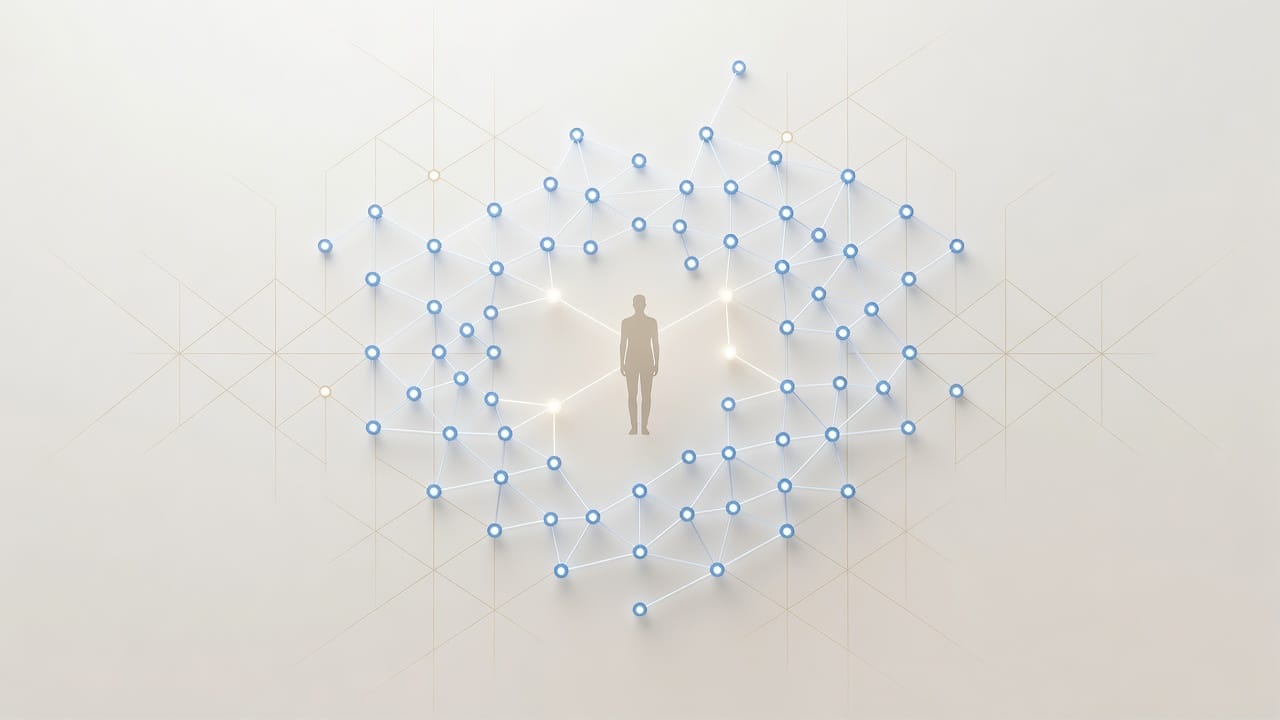
Andreessen called them AI vampires: builders who stop sleeping because agents never do. The real transition is next — from human-paced loops to automatic graphs that call the human only when judgment is required.
Marc Andreessen has a nasty little phrase for what is happening to the people who can actually build with AI.
He calls them vampires.
Not because the machines drank their blood. Because the builders stopped sleeping. One human now sits above a swarm of coding agents that keep producing while the body wants to quit. Twenty agents. Ten-minute check-ins. Projects that used to take a quarter collapsing into a night. Andreessen’s point on Rogan and elsewhere was not “programmers are obsolete.” It was almost the opposite: the best builders became so leveraged that the opportunity cost of sleep started to feel immoral. Five times, ten times, twenty times more output. Bags under the eyes. Ecstatic.
I recognize the species.
This is the real transition. Not the press-release transition where AI “assists knowledge workers.” Not the panic transition where everyone becomes a prompt tourist. The real one is uglier and more hopeful at once: a thin class of humans is learning to run automatic systems, and the old craft of sitting inside every loop is dying in their hands.
From tools to loops to graphs
Most people still meet AI as a smarter typewriter.
Then comes the loop: generate, check, correct, generate again. A human still owns the rhythm. The model is fast hands. The person is still the metronome.
Then comes the graph: multi-step work with branches, tools, memory, retries, handoffs. You stop asking one model one question. You design a small factory. Retrieval here. Critique there. A coder agent. A reviewer agent. A browser. A deploy path. Failures route somewhere. Success compounds.
That already feels like a different job. Product, engineering, and taste collapse into one nervous system. Andreessen’s “builder” is not a job title from HR. It is a person who can hold intent while machines thrash through the graph.
But even this is not the end state people think it is.
The vampire phase is the painful middle. Humans are still the runtime. We are the always-on supervisors of semi-automatic factories that never get tired. So we become the bottleneck we were trying to escape — not because we are slow at typing, but because the system still needs our continuous presence to keep the graph alive.
That is why the vampires look terrible and feel alive. They discovered leverage before they discovered rest.
The next move is not more hustle
The direction now is not “sleep less and manage thirty agents.”
The direction is systems that run without the human as heartbeat.
Fully automatic graphs. Agents that do not merely execute steps, but judge state. Agents that know what “good enough” means inside a domain. Agents that can wait, retry, escalate, abstain, and only then wake a human when the graph hits a boundary the machine should not cross: values, irreversible money, legal exposure, brand-risk, taste at the edge, a conflict between objectives no utility function owns cleanly.
This is the shift from human-paced loops to agent-run systems with human exception handling.
In the old world, the default was human action and machine assistance. In the vampire world, the default is machine action and human endurance. In the next world, the default is machine action and human meaning.
If that sounds abstract, it is not. It is already how serious operations want to work. A trading desk does not want you clicking every signal. A company does not want the founder approving every refactor. A household does not want to babysit every automation. The scarce act is deciding when the system is allowed to proceed without you — and when it must stop and ask.
Judgment is the interface
People still argue as if the future fight is “AI versus jobs.”
The deeper fight is where judgment sits in the graph.
If every node waits for a human, you built a costume drama with GPUs. If no node can call a human, you built a confident idiot at scale. If the graph can assess uncertainty, stakes, and reversibility — and page the human only then — you built leverage that does not require vampirism.
This is why taste, truth, and responsibility get more expensive as generation gets cheaper. I have written versions of this from other doors: the taste gap when everyone can produce; the last human in the loop who is not an approval monkey; machines that should make us more human rather than more absent. The vampire moment makes those essays operational. The body cannot be the scheduler for a civilization of agents.
The human remains the drum of meaning. Not the drum of keystrokes.
What has to be true for automatic graphs
A serious automatic system is not a pile of prompts with ambition.
It needs an explicit goal and a definition of done. It needs tools with real side effects and real permissions. It needs memory that does not lie about what already happened. It needs critique paths that can kill bad work before it ships. It needs escalation policy: what is routine, what is reviewable, what is forbidden without a person. It needs logging that makes responsibility reconstructible after the fact. It needs the right to stop.
That last one is underrated. An agent that cannot abstain is not autonomous. It is compulsive.
When builders talk about “agents judging when to involve the human,” this is the substance under the slogan. Not vibes. Not a chatbot that says “would you like me to continue?” A control system for irreversible reality.
The social split
This transition will not distribute itself evenly.
Some people will remain consumers of AI answers and feel vaguely helped. Some will become operators of single tools and call it transformation. A smaller set will become designers of graphs. A still smaller set will become owners of automatic systems that mint output while they sleep — without requiring them to become undead.
The vampire is the romantic antihero of the in-between. Heroic. Unsustainable. Easy to moralize about from the outside, hard to quit from the inside because the leverage is real. I know the pull: one more agent run, one more refactor, one more night where the factory hums and the roadmap melts.
But a civilization that only knows how to create vampires has not finished the transition. It has merely moved exhaustion upstream.
The endgame is not permanent white nights for the talented. The endgame is boring, reliable autonomy around scarce human judgment.
Bring it home
Andreessen named the symptom. The builders who can use AI properly are becoming vampires because the machines finally made output cheap and continuous, while responsibility stayed glued to one nervous system.
That is the real transition flashing its teeth.
The next architecture is clear enough to say without hype. Leave the loops. Build the graphs. Then make the graphs run themselves — with agents that can tell the difference between another token and a moment that needs a human.
Work day and night only while the scaffolding is being born. After that, the system should carry the night.
Not so humans disappear. So humans can remain the part that cannot be automated without loss: meaning, taste, liability, love of the end state, the decision that this is worth doing at all.
The vampire is what leverage looks like before sovereignty over the system is complete.
Complete it.