The Skills That Got You Hired Are Becoming Obsolete Faster Than You Think
An MIT study found that 11.7% of jobs could be automated right now using current AI technology.
Entry-level job postings dropped 15% year over year. In the first six months of 2025 alone, 77,999 tech workers lost their jobs to AI. That's 427 layoffs per day.
The disruption is real. But the deeper problem is something nobody taught you in school.
The Obsolescence Curve Just Accelerated
Workers expect 39% of their current skill sets to become outdated or transformed between 2025 and 2030.
Skills demanded by employers are changing 66% faster in AI-exposed occupations than in the least exposed roles. We've crossed a threshold where the time for skills obsolescence is shorter than a single career.
The concept of a degree carrying you from entry-level to retirement is as antiquated as the rotary phone.
I learned BASIC programming on a ZX Spectrum when I was fifteen. I spent two to three months building a Mastermind game. The focus required was tremendous. You had to dive in, stay in, and grind through the learning curve.
Now I throw an idea into AI and master something in a fraction of that time. My learning curve compressed. My mind can move while I learn.
This is the shift: from sequential mastery to parallel exploration.
What Companies Actually Discourage
Research reveals that rigid hierarchies, short-term deadline pressures, and fear of failure create what researchers call "creativity killers" in organizations.
When workplaces are rigidly hierarchical, focused on short-term deadlines, or filled with hostility, innovation is actively discouraged.
Workplace stress from short-term goals causes employees to prioritize quick fixes and traditional ways of doing business rather than looking ahead to the future.
Bureaucracy and needless red tape stifle new thinking. Fear of criticism causes people to play it safe and settle for far less than they are capable of earning.
Here's what this means in practice:
Companies reward execution over vision. They want you to follow the process, hit the deadline, and stay in your lane. The system is designed for predictable output.
They discourage cross-domain thinking. Marketing people do marketing. Developers code. Strategists strategize. Pattern recognition across domains is seen as distraction.
They punish experimentation. Failure is documented, not celebrated. Risk is minimized. The incentive structure favors safe mediocrity over bold exploration.
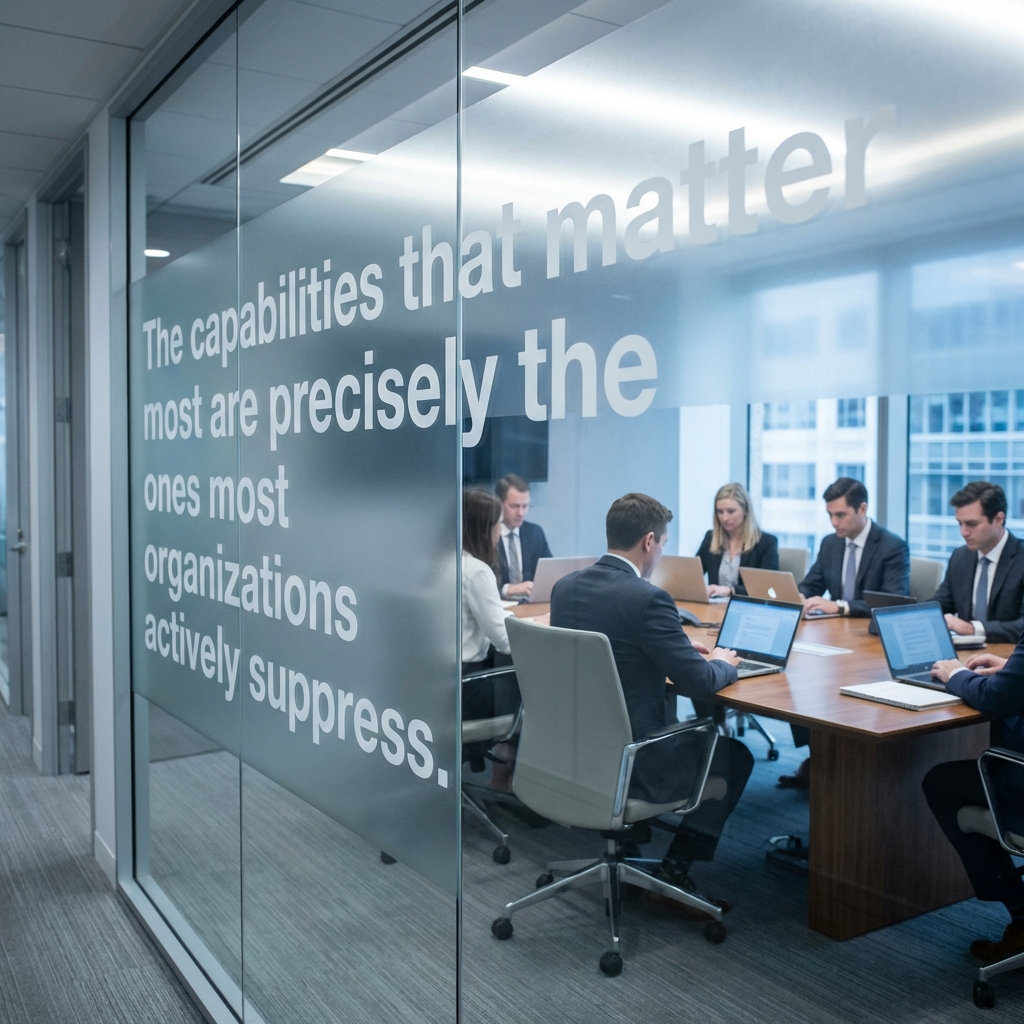
The capabilities that matter most in an AI-augmented world are precisely the ones most organizations actively suppress.
The Human Capabilities AI Cannot Colonize
Most workers in major economies fear their skills will become obsolete within five years due to technology. The anxiety is real.
But research identifies cognitive skills like critical thinking and problem-solving, socio-emotional skills like empathy and communication, and management capabilities as the least susceptible to automation.
The World Economic Forum confirms creative thinking ranks in the top five core skills growing in importance through 2030.
AI can optimize for goals, but it cannot create meaningful purpose. It cannot replicate the deep knowing that comes from being human. Experienced leaders can often sense problems or opportunities before they're visible in the data.
I've spent years in Vipassana meditation. Thirty-day silent retreats where you observe the mechanical nature of thought itself. You see how consciousness operates beyond the logic layer.
AI processes data. It excels at repetitive tasks, pattern matching within known parameters, and executing predefined logic.
But AI cannot experience being. It lacks access to the present moment. It cannot think things through in the way humans do—where intuition, embodied knowledge, and consciousness itself inform the process.
Creativity remains a human process. Not the surface-level "generate ten ideas" kind, but the deep synthesis that comes from living, experiencing, and integrating across domains.
Thinking things through remains human. AI can simulate reasoning, but it cannot inhabit the question the way consciousness can.
Flow state remains human. That absorption in present activity where exceptional productivity emerges in short time—AI cannot enter that state. It can only execute within it.
The Perception Gap and What It Reveals
Yale's Budget Lab research found no clear, economy-wide relationship so far between AI exposure and changes in employment.
Yet public perception was massively inflated. Those not affected believed 29% had lost jobs to automation. Those displaced estimated 47%. The actual rate was approximately 14%.
This reveals deep anxiety about AI's impact, even when real-world job loss rates remain lower than often assumed.
The disruption is psychological as much as practical.
VCs spontaneously identified 2026 as the inflection point when AI moves from augmentation to replacement. Battery Ventures predicts 2026 will be the year of agents as software expands from making humans more productive to automating work itself.
78% of executives say they'll have to reinvent their operating models to capture agentic AI's full value. Yet 40% of employers expect to reduce their workforce where AI can automate tasks.
One VC warned that executives will use AI as a scapegoat whether or not they're actually implementing automation. AI will become the scapegoat for executives looking to cover for past mistakes.
The narrative is being weaponized.
What Schools Never Taught You
Critical thinking is now deemed a must-have workplace skill. Yet employers perceive new hires to be underprepared to apply critical thinking skills in the workplace.
The Future of Jobs Report highlights critical thinking, problem solving, active listening, and resilience as prominent skill needs. Yet many organizations hyper focus on technical skills when looking at professional development at the expense of these durable capabilities.
Workers believe it's primarily their responsibility (44%) to keep skills relevant. They trust businesses over governments to support upskilling efforts.
The system is broken at the source.
Schools taught you to memorize, regurgitate, and follow instructions. They optimized you for an industrial economy that no longer exists.
They never taught you how to think across domains. How to synthesize Eastern and Western perspectives. How to hold tension between contemplation and action. How to commit fully without attachment to outcome.
They never taught you that consciousness is the foundation, not the byproduct.
The Real Shift: From Execution to Vision
AI handles communication and execution. It takes over the complete creation process. Software building without manual coding. Architectural planning without manual drafting.
The shift is from execution mastery to vision clarity.
I've experienced this directly. I spent months searching for an AI solution that would eliminate friction in content creation. Ideas were trapped in my head. The traditional production steps created barriers between thought and expression.
Now I work with AI in flow state. The execution happens nearly instantaneously. What matters is the quality of the vision, the depth of the thinking, the clarity of the intention.
This is what Vibecoding represents: the blurring of lines between roles. Business understanding becomes more critical than technical execution. Non-traditional developers can build because the barrier is no longer syntax mastery.
The question becomes: what do you want to create?
When machines handle logic, humans must operate from the dimensions logic cannot reach.
Commitment Without Attachment
There's a one-liner that captures the shift: be totally committed in the thing you do, but not attached to the outcome.
This is the synthesis of the monk and the magician. The contemplative and the active life. Detachment and manifestation united.
AI enables materialization. Logic mastery becomes accessible. But without the inner work, without the consciousness practice, you're just automating anxiety.
The role you were hired for is being automated. The skills that got you here won't keep you employed.
What matters now is what nobody taught you in school and most companies actively discourage: the ability to think across domains, to synthesize rather than specialize, to create from vision rather than execute from instruction, to remain present and conscious while machines handle the logic layer.
This is the threshold. The question is whether you'll cross it.
---
Read more about the collision between technological disruption and human consciousness at roelsmelt.com.
Disrupt Consciousness explores how technology enhances consciousness rather than replacing it. When machines solve scarcity, the question becomes spiritual, not technical. Join the investigation into what it means to be human when machines think.