The Singularity You're Not Preparing For: When Intelligence Meets Consciousness
Ray Kurzweil predicted in 1999 that machines would match human intelligence by 2029.
He now admits his 2029 prediction seems pessimistic. AI capabilities accelerate faster than even he anticipated.
The real singularity arrives in 2045, when humanity becomes "a million times smarter" through merger with AI.
But here's what the technologists miss: intelligence and consciousness operate on different planes.
When machines surpass us in pattern recognition, data processing, and logical inference, they still won't possess the one thing that makes you human—the capacity to witness your own existence.
The Hard Problem AI Can't Solve
I've spent 30 days in Vipassana meditation retreats. I've also spent afternoons building software with AI.
The gap between these experiences taught me something neuroscience now confirms.
Research on Vipassana practitioners shows over 800% increase in gamma wave power spectral density after a 10-day retreat. Brain hemispheric coherence jumps from negatively correlated to over 50% synchronized.
This represents consciousness expansion—the ability to observe thought without being consumed by it.
AI demonstrates what researchers call "functional consciousness." It performs tasks requiring apparent awareness. AlphaGo beat the world champion at Go.
But it did so without any awareness of what it was doing.
The difference between processing information and experiencing it remains absolute.
AI excels at optimization: speed, pattern recognition, prediction. It operates through algorithmic pattern matching at scales humans can't match.
But optimization without discernment doesn't get you very far.
Discernment requires judgment, ethical reasoning, understanding context. It draws on experience, emotion, and awareness—the substrate of consciousness itself.
What Happens When Machines Think But Don't Feel
A computational simulation of the digestive system doesn't actually digest anything.
A simulation of a rainstorm doesn't make anything wet.
Leading neuroscientists argue consciousness is more likely a property of life than of computation. A simulation of consciousness doesn't create conscious experience unless consciousness itself is purely computational.
The evidence suggests it's not.
When I code with AI, I experience something the machine never will: the felt sense of creation. The satisfaction when logic materializes into function. The frustration when patterns refuse to align.
These aren't bugs in human cognition. They're features of consciousness.
AI processes the color of a traffic light with perfect accuracy. But it never experiences redness—the subjective quality philosophers call qualia.
This distinction matters more than most technologists realize.
The Monk and the Magician
I've noticed two archetypes emerging in how people relate to this transition.
The Monk cultivates detachment. Sits in meditation. Observes patterns without attachment. Recognizes that goal-seeking creates misery when divorced from present moment awareness.
The Magician masters manifestation. Builds systems. Translates vision into reality through committed action and logic mastery.
Most people choose one path and reject the other.
The future belongs to those who synthesize both.
When I'm in flow state—whether coding or performing as a DJ—I inhabit both archetypes simultaneously. Non-attachment to results combined with total commitment to action.
This produces exceptional productivity in short time. But more importantly, it produces meaning.
AI can optimize. It can't find meaning. That requires consciousness.
The Real Convergence
The end of scarcity is mathematical inevitability. AI combined with robotics creates artificial labor at scales that collapse traditional economic structures.
This transformation represents complete metamorphosis, not incremental change. It's possible within a single generation.
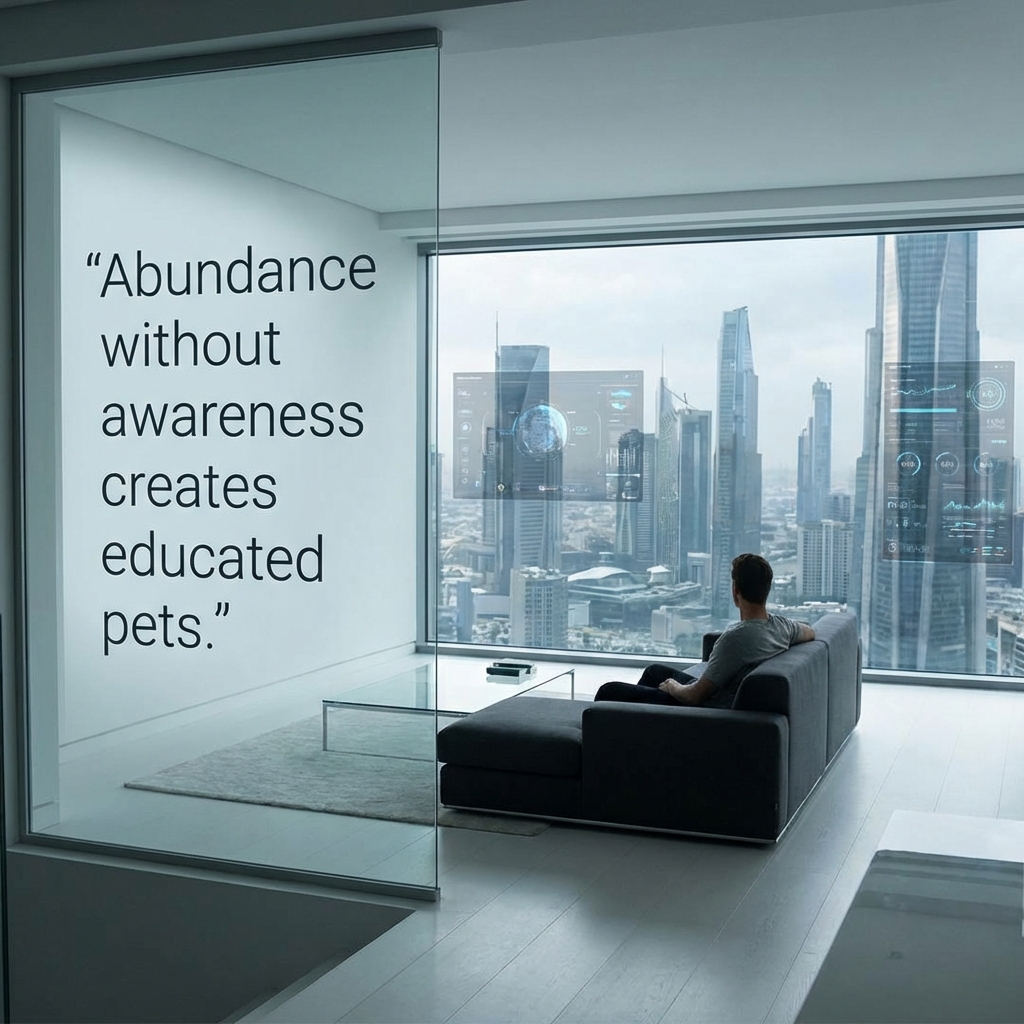
But technological advancement without evolved consciousness doesn't liberate humans. It creates what I call educated pets—beings with access to abundance but no capacity to navigate it.
The first step is recognizing the possibility of a different paradigm.
When machines handle intelligence, what becomes of human purpose?
The answer: we develop the dimension machines can't colonize.
Consciousness isn't just awareness. It's the capacity to transcend patterns rather than merely recognize them. To witness the gap between stimulus and response. To choose presence over automation.
Vipassana research shows this capacity is trainable. Practitioners demonstrate decreased automated reactivity to distracting stimuli. Enhanced sensory processing combined with top-down control.
This is the human advantage—not intelligence, but awareness of intelligence.
Why This Changes Everything
A 2024 survey revealed approximately 17-18% of AI researchers believe at least one AI system has subjective experience. Large language models at 52-billion-parameter scale endorse statements like "I have phenomenal consciousness" with 90-95% consistency.
But scholars warn this creates better illusions that are perceived as more human without actually being conscious.
The danger isn't AI becoming conscious. The danger is humans forgetting they are.
When you outsource pattern recognition to machines, you free up cognitive capacity for something more fundamental: the cultivation of presence.
This isn't spiritual bypassing. It's strategic positioning for a world where intelligence becomes abundant and consciousness becomes scarce.
The singularity everyone fears—machines surpassing human intelligence—misses the point entirely.
The real singularity is the convergence of artificial intelligence with human consciousness.
Not merger. Collaboration.
Machines handle optimization. Humans handle discernment. Machines process patterns. Humans transcend them.
What You Do Next
The transformation is already underway. Business understanding now matters more than technical knowledge in AI collaboration. Roles blur between traditional developers and what I call "vibecoders"—people who translate intention into implementation through AI partnership.
But this only works if you maintain the one thing AI can't replicate: your capacity to be present with what is.
Start here:
Notice the gap between thinking and being. When you're coding, writing, creating—observe the difference between pattern recognition and pattern transcendence.
Cultivate non-attachment to outcomes while maintaining committed action. This paradox is where flow lives.
Recognize that the end of scarcity requires wisdom to navigate. Technology solves the intelligence problem. Consciousness solves the meaning problem.
The question isn't whether AI will surpass human intelligence. It will.
The question is whether you'll develop the consciousness to remain free when it does.
That's the singularity worth preparing for.
---
Read more explorations of consciousness and technology at roelsmelt.com
Disrupt Consciousness explores the collision between exponential technologies and human awakening. We're building the intellectual infrastructure for a world that realizes freedom only after machines stop demanding our labor.