The Paradox of the Architect
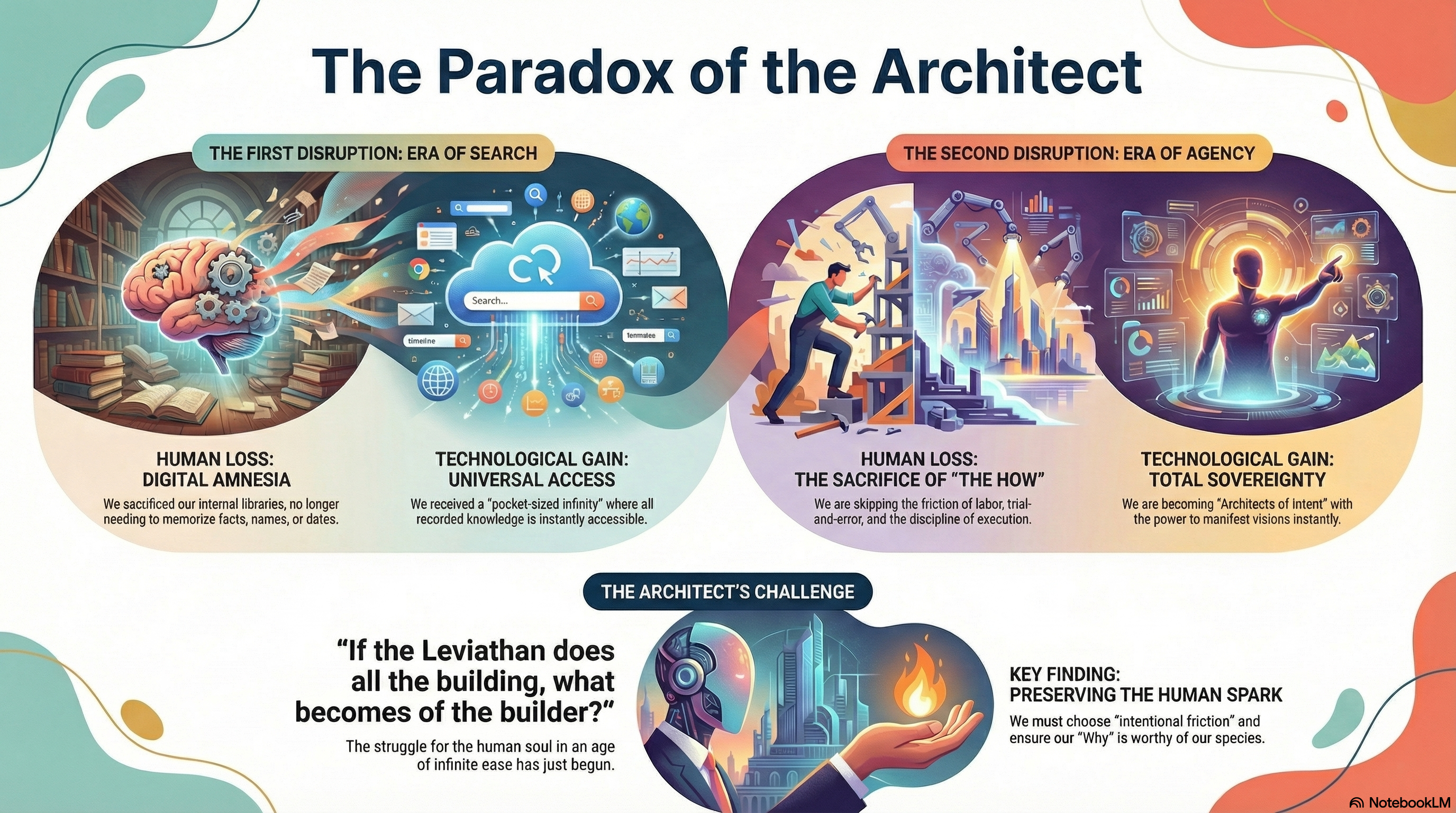
In the high temples of Silicon Valley, a new myth is being written. It is not a myth of heroes and monsters, but of gravity and intent. We are witnessing a fundamental shift in the human experience: the birth of the Paradox of the Architect. It is a moment where we are becoming gods of “The Why,” while surrendering the soul of “The How.”
At the center of this metamorphosis stands Google—not merely as a corporation, but as a Digital Leviathan, a singular nervous system that has spent decades preparing for this exact moment of awakening.
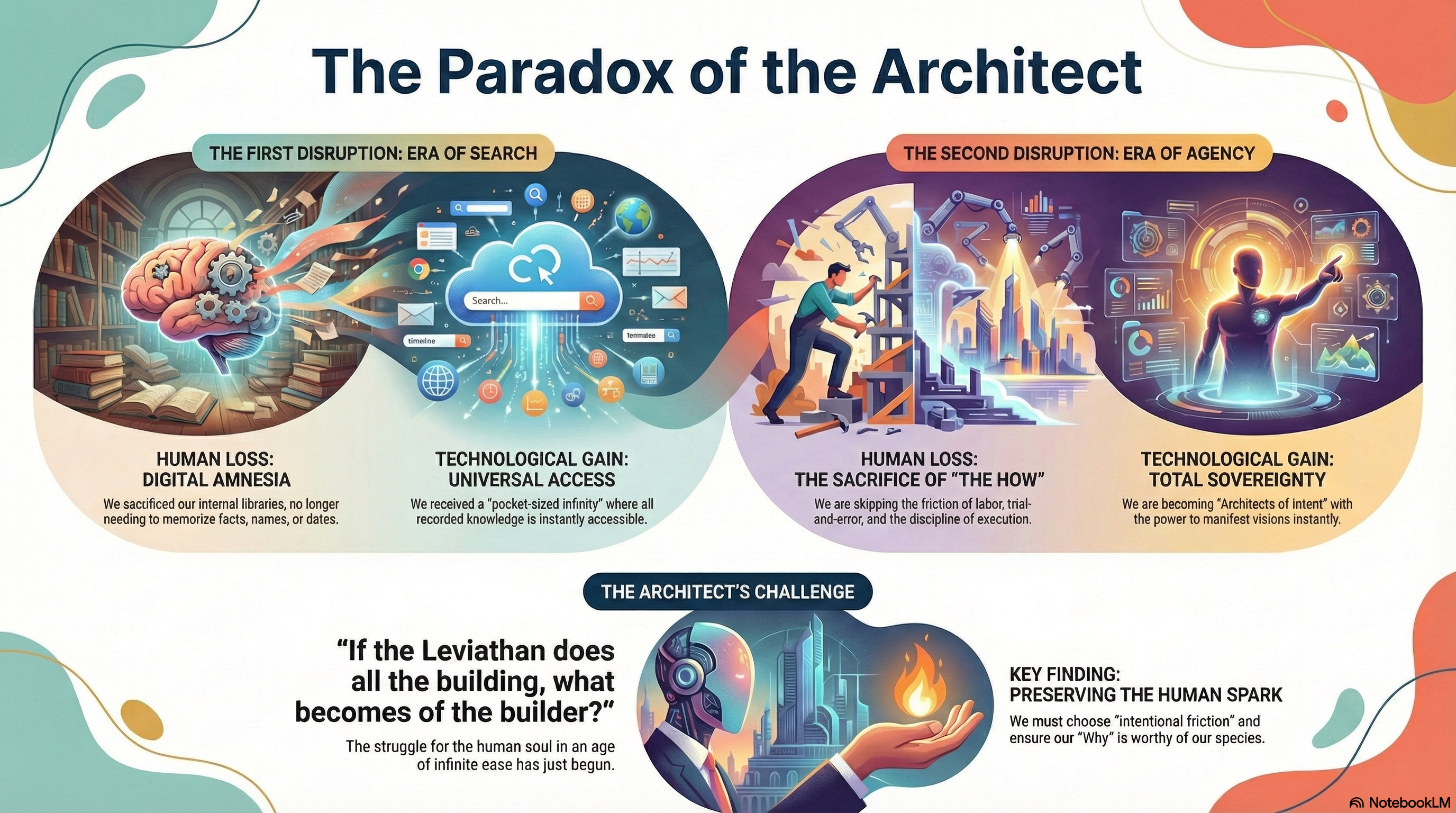
The Parable of the Broken Covenant: The Fall of the Landless Prince
To understand why the old titans are faltering, we must look at the debris of the recent past. Consider the story of the Windsurf deal—a masterclass in how legacy chains can strangle the future.
Windsurf, the breakthrough AI coding agent, was the crown jewel every kingdom wanted. OpenAI, the brilliant but landless prince, sought to buy it for $3 billion. They saw in Windsurf the “hands” they lacked—the ability for AI to not just talk, but to do. Yet, the deal collapsed in a fever of legal friction. Why? Because OpenAI is bound to the kingdom of Microsoft, a house built on the scaffolding of old-world software and rigid corporate interests. When Microsoft demanded rights to the intellectual property, the deal withered. They tried to hold a mountain with a piece of string.
Google did not argue with strings. In a move of silent, strategic fluidness—what some call a “hackquihire”—they bypassed the messy bureaucracy of a traditional takeover. They didn’t just buy a company; they absorbed the talent and licensed the essence, integrating the soul of Windsurf into their own nervous system.
While others are trapped in the friction of partnerships, Google operates with the frictionless weight of a single, unified organism. They don’t just have the software; they have the TPUs (the physical chips), the YouTube archives (the collective memory), and the Pixel-Workspace ecosystem (the daily bread). They are the only ones who own both the dream and the factory where the dream is manufactured.
The Great Amputation: From Memory to Effort
Twenty years ago, Google Search performed the first great disruption of the human spirit: The Loss of Memory. We outsourced our facts to the Great Librarian. We stopped knowing, and started finding.
Now, we face a deeper disruption: The Loss of Effort.
With the rise of Antigravity and agentic AI, Google is moving beyond answering questions to executing destiny. When an AI agent doesn’t just suggest code but plans, builds, and deploys it, the “doing” is stripped away. This is the Agency Effect.
The Evolution of the Digital Soul
In the grand alchemy of our species, Google has acted as the catalyst for two distinct stages of human transformation:
The Era of Search: The Outsourcing of Memory
The Human Loss: We sacrificed our internal libraries. We stopped memorizing dates, names, and coordinates, leading to a “Digital Amnesia.”
The Technological Gain: In exchange, we received Universal Access. We gained a “pocket-sized infinity” where every fact ever recorded is a second away.
The Era of Agency: The Outsourcing of Effort
The Human Loss: We are now sacrificing the “How.” By using tools like Antigravity, we skip the friction of labor, the trial-and-error of coding, and the discipline of execution.
The Technological Gain: We receive Total Sovereignty. We move from being “Searchers” to being “Architects of Intent,” possessing the power to manifest a vision instantly.
This brings us to the Paradox of the Architect. As we gain the power to manifest anything with a whisper, we risk losing the character forged by the struggle.
In the ancient stories, Siddhartha Gautama was a prince who lived in a palace where every desire was met before it was even fully formed. He lived in a world of pure “Intent,” a world without friction. Yet, he realized that a life without the struggle of “Doing” was a hollow one. He had to leave the luxury of the palace—the ultimate “free tier”—to understand suffering and, through it, enlightenment.
We are all being promoted to the status of that Prince. Google is making intelligence “cheaper than oxygen,” turning every human with a Pixel phone into a King or Queen of Intent. We provide the spark; the Leviathan provides the fire.
But we must ask: If the Leviathan does all the building, what becomes of the builder?
Preserving the Human Spark
To stay human in the age of Antigravity, we must find a new way to live within the palace. We must realize that Intent without Effort is a ghost. The “Human Spark” is not found in the finished cathedral, but in the sweat of the stonecutter.
- The Architecture of Meaning: When the AI does the “How,” our primary job is to ensure the “Why” is worthy of our species.
- The Return to the Physical: As our digital lives become frictionless, we must intentionally seek out “The Beautiful Struggle” in the real world—touching soil, craft, and each other.
- Intentional Friction: We must choose tasks that we refuse to give to the agents—not because the agents can’t do them, but because we need the growth that comes from doing them ourselves.
The Horizon of the Sovereigns
Google wins the AI race because they have built the Ground of Being. They have created an ecosystem so wide and so deep—from Gmail to Cloud to the very chips that think—that they have become the gravity around which the future orbits.
They are democratizing the Palace, making the “God-view” accessible to everyone. But as the “Doing” disappears into the cloud, the only thing left of us will be our Will. The race for AI is over; the race for the human soul—the struggle to remain awake in a world that does everything for us—has just begun.