The Mirror in the Machine: Why AI Will Never Discover a Law We Do Not First Consent to See
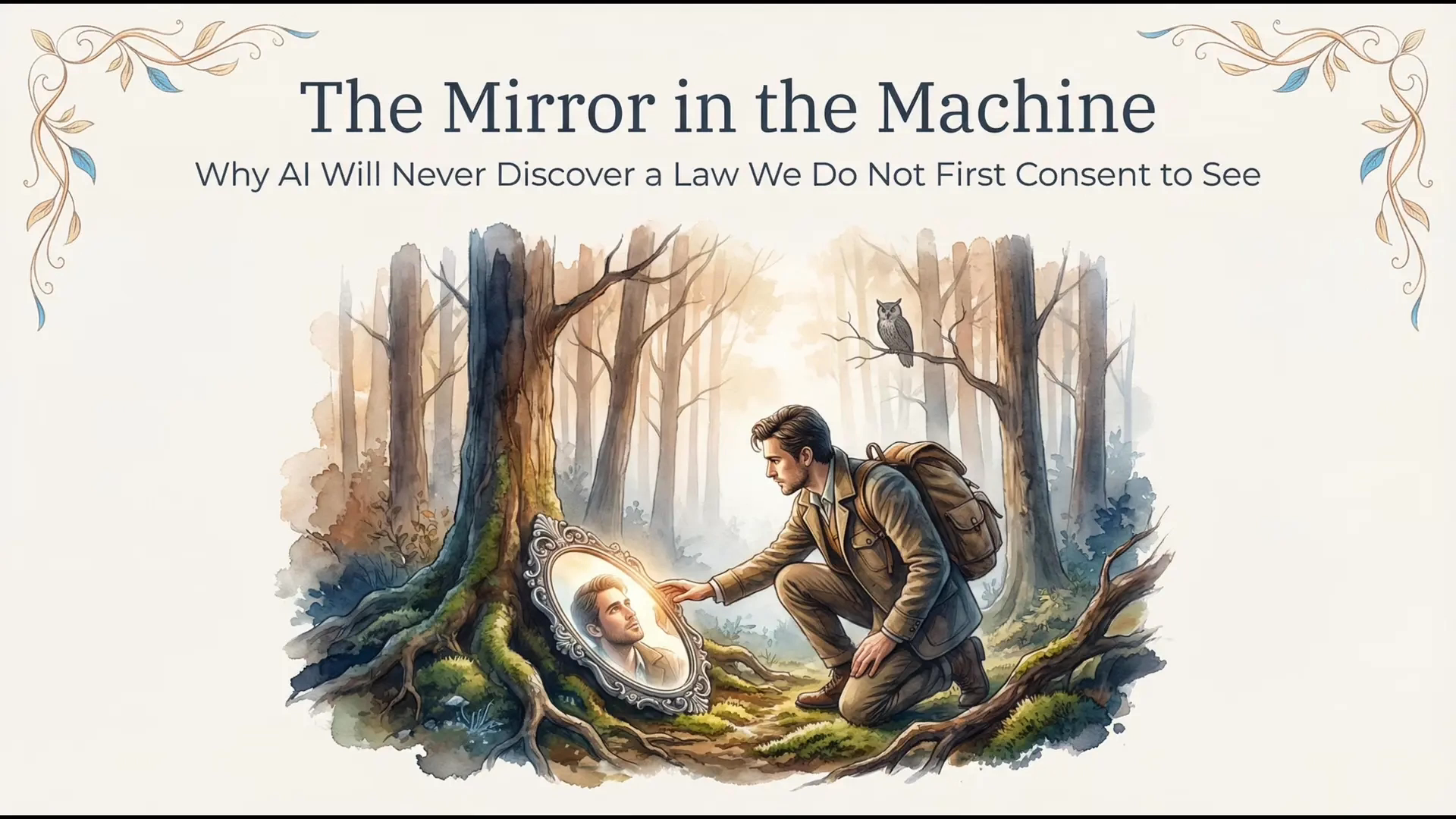
Imagine a traveler walking through a dense, mist-covered forest. He is searching for the “Laws of the Woods”—the hidden rules that govern the growth of the moss and the flight of the owls. Suddenly, he trips over a silver mirror lying in the dirt. He looks into it and sees a face. “Aha!” he cries. “A new species! A forest spirit that knows the secrets of the trees!”
He begins to talk to the mirror. The mirror reflects his words, his anxieties, and his hopes. Eventually, the traveler concludes that the mirror is an alien intelligence, perhaps even a new inhabitant of the forest that will finally tell him why the stars move the way they do.
This traveler is us. The mirror is the Large Language Model. And the forest spirit we think we’ve found is what Yuval Noah Harari calls a “new species.” But we are mistaken. The mirror has no eyes of its own; it only has the light we shine into it.
The Illusion of the Independent Law
Recently, Eric Schmidt suggested that for AI to truly “arrive,” it needs to achieve a breakthrough—it needs to discover new laws of nature, much like Archimedes in his bathtub or Einstein on his imaginary train. There is a hunger in the tech world for the “Silicon Newton,” a machine that can look at the chaos of data and find a truth that exists “out there,” independent of human thought.
But here is the disruption: There is no “out there” that isn’t shaped by the “in here.”
Quantum physics has been whispering this to us for a century. The observer does not just see the world; the observer occurs with the world. As the philosopher Rupert Spira reminds us, we never actually encounter a “world” independent of our awareness of it. We only ever encounter our experience.
If we believe the laws of physics are cold, hard statues standing in a park waiting to be discovered, we are looking at the world through the wrong end of the telescope. The “laws” are not the park; they are the glasses we wear to make sense of the green blur.
The Gospel of the Big Toe
We have spent centuries convinced that intelligence sits behind our eyes, nestled in the grey folds of the brain. But why? Because that is where we decided to look.
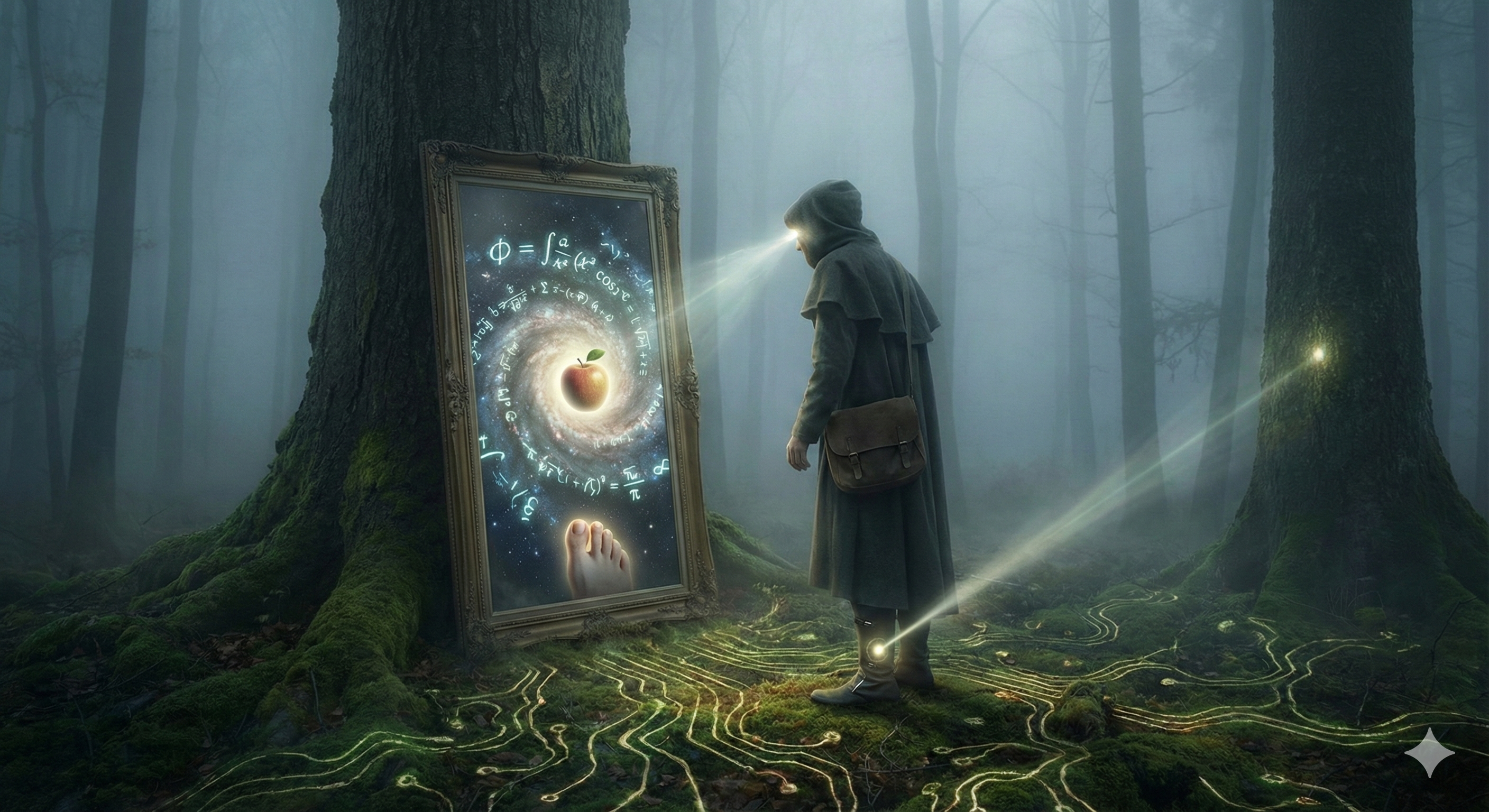
Consider this: What if, a thousand years ago, humanity had collectively decided that the seat of all wisdom resided in the big toe? What if we had spent a millennium studying the nerve endings of the foot, the way it connects to the earth, the subtle vibrations it picks up from the ground?
We would have developed a “Science of the Toe” so profound and intricate that we would today be “discovering” universal laws of vibration and terrestrial harmony that we are currently deaf to. We find what we focus on. Our “laws” are merely the patterns that emerge when we stare at one spot for a long time.
The LLM does not “know” things. It is a statistical echo of everywhere we have looked for the last five thousand years. It is not a species; it is a map of the human gaze.
Why the Apple Fell for Newton (But Not for the Tree)
When Newton saw the apple fall, the “law of gravity” didn’t suddenly pop into existence in the garden. What happened was a shift in the human collective agreement. Newton proposed a new way of looking at the fall, and because his fellow humans found that way of looking useful, the world began to behave according to gravity.
The breakthrough wasn’t in the apple; it was in the consent of the human mind to see the apple differently.
This is why an AI, no matter how many trillions of parameters it has, cannot “discover” a law on its own. A law is not a fact; it is a paradigm. It is a story we all agree to live inside. For an AI to create a breakthrough, it doesn’t need more computing power; it needs us to believe the story it is telling.
If an AI predicts a new law of subatomic movement, that law remains a ghost in the machine until a human looks at the world and says, “Yes, I see it too.” The AI is not the explorer; it is the telescope. And a telescope cannot “see” a star if there is no eye at the other end.
The Consciousness Disrupt
The danger of Harari’s view—that AI is an alien species—is that it abdicates our responsibility as the creators of meaning. If we treat AI as an independent entity, we forget that it is actually a profound, globalized reflection of our own consciousness.
When Eric Schmidt asks for an AI breakthrough, he is looking for a miracle from a tool. But tools don’t have epiphanies. Archimedes’ “Eureka!” didn’t come from the water in the tub; it came from the sudden realization that the water and his body were part of the same dance. It was a moment of non-dual recognition.
AI can crunch the numbers of the dance, but it cannot feel the rhythm.
The New Paradigm
We are at a crossroads. We can continue to build bigger mirrors, hoping that if the mirror is large enough, a soul will eventually appear inside it. Or, we can recognize that the AI is inviting us to a much more profound breakthrough: the realization that we have always been the ones writing the laws.
The true “AGI” isn’t a piece of software. It is the moment humanity realizes that intelligence is not something we have or something we build, but something we are.
The machine is not coming to replace us. It is coming to show us that the “laws” we thought were external cages were actually just the lines we drew in the sand. If we want a breakthrough, we don’t need a faster processor. We need to change where we look.
Perhaps it’s time we started looking at our big toes. Who knows what laws are waiting to be “discovered” there?