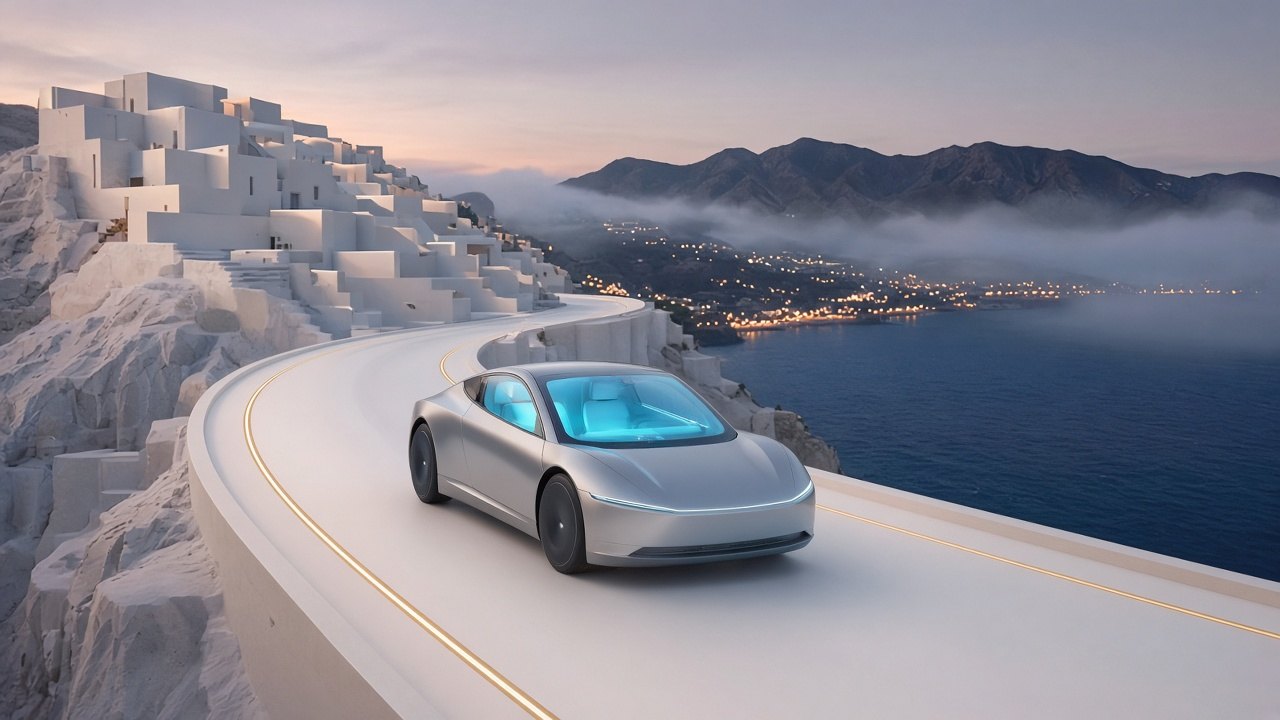
Tourism on a small island wants A-to-B at every hour. The Consell capped the rental cars that used to answer that demand. Queues, surges, drunk mountain drives, and scraped walls followed. The way through is local rental owners and entrepreneurs buying and running self-driving cars — first supervised Model Ys, then Cybercabs — with the municipality taking a thin fee and helping with loans, while taxi drivers later fold licence capital into those same local companies.
It is 03:40 in Sant Antoni.
A couple leaves a club. Their bed is in Santa Eulària. The last bus is gone. The taxi rank is empty, or it is a rumour with a queue. Uber wants €120 to €180 for a run a taxi would do near €30. They do what thousands do. They already rented a car for the week, so they drive. Tired. Music still in the ears. A mountain road they have never seen. Somewhere a neighbour wakes because another rental scraped a wall hunting a parking space that is not there.
That night is not a vibe problem. It is a mobility problem with a clock. Beach to bed. Club to finca. Airport to cove. Thin trips, all hours, all over the map.
Dear Ibiza: you already know this hour. You argue about taxis, rentals, buses, and apps as if they were separate wars. They are one mismatch.
One problem, not five
Tourism grew on a unique, finite island. In 2025 you took about 3.39 million visitors. The airport moved about 9.14 million passengers. People who live here year-round are roughly 161,000. In August the island can hold more than 300,000 on the same day. That growth does not only fill beaches. It creates fine-grain demand: A to B, not only thick corridors.
For years the scalable answer was private rental cars. Parked steel. Tourist drivers. Cars that sit most of the week, then move at the worst hours on roads the driver does not know.
The Consell put a hard stop on that supply: on the order of 14,000 summer rentals under the tourist-car ceiling. Demand did not stop. It spilled.
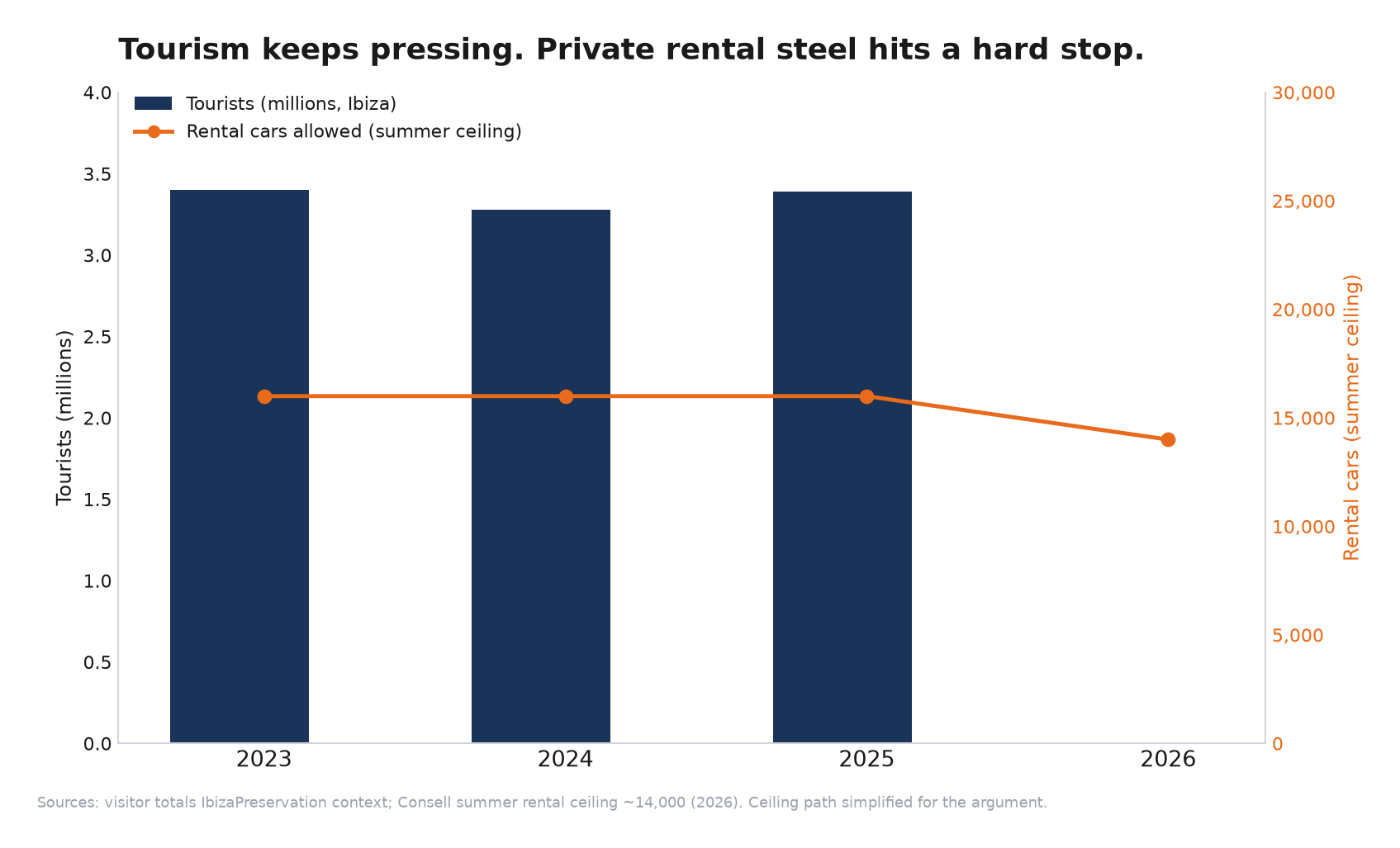
Everything you fight about is downstream of that mismatch. Taxi queues. Night surges that feel like a fine. Drunk mountain passes. Scraped walls. Drivers defending licences near €180,000 because paper is their family balance sheet. Buses that do real work on thick routes - airport to Vila, Sant Antoni to the port - and still cannot wait outside every hillside bed at 03:40.
Squeeze rentals, defend taxis, add buses, live with expensive apps: that is anger management. It does not close the gap between fine-grain demand and capped parked supply.
The pipe dream, said as a product
What if the car does not need to park for a week. What if there is no tired tourist behind the wheel. What if a clean car is in front of you in five to ten minutes, at about a quarter of a scarce taxi or Uber night price. No drunk mountain pass. No parking hunt at the hotel. Streets that breathe because steel works instead of sleeping on every kerb.
That is not a slogan. It is a product shape: shared cars that move.
In September 2026 Tesla Cybercab is taking public riders in Austin. Fares are dynamic. Early samples often land short trips in a rough $5 to $15 band; sometimes under Uber, sometimes above when demand spikes. The point is not an Ibiza price list. The point is that unsupervised shared rides already exist as a real service somewhere people can hail them.
If the machine works there, the machine can work on an island with shorter hops and clearer destinations.
Spain still needs law. The Dutch RDW approved Tesla FSD Supervised in April 2026: the driver still watches; it is not an empty Cybercab. Spain is testing. Product is not regulation. Say that cleanly and move.
Not a foreign dump. Local owners.
Here is the heart, and it is not a Tesla press release.
The municipality amplifies vision. Local car-rental owners and entrepreneurs are the enablers. Not a foreign fleet dumping empty cars on the island. Local capital buying the steel that works.
Start with what you can buy now. Local rentals buy a few Model Y cars with FSD enabled. They push supervised FSD test driving on Ibiza roads. They push Spain to follow the Dutch path. When supervised FSD is allowed here, they rent cars with an FSD option. Tourists still get a car. The car starts learning the island under a responsible frame.
Then push publicly for unsupervised Cybercab. Tell the night story. Tell the rental-cap story. Seek the attention of Elon and Tesla with a clear ask: local entrepreneurs buy the Cybercabs. Ownership stays on the island. The narrative is first-mover Europe on a finite, famous map - not a corporate experiment parked in someone else’s town.
A simple money picture, as scenario, not forecast.
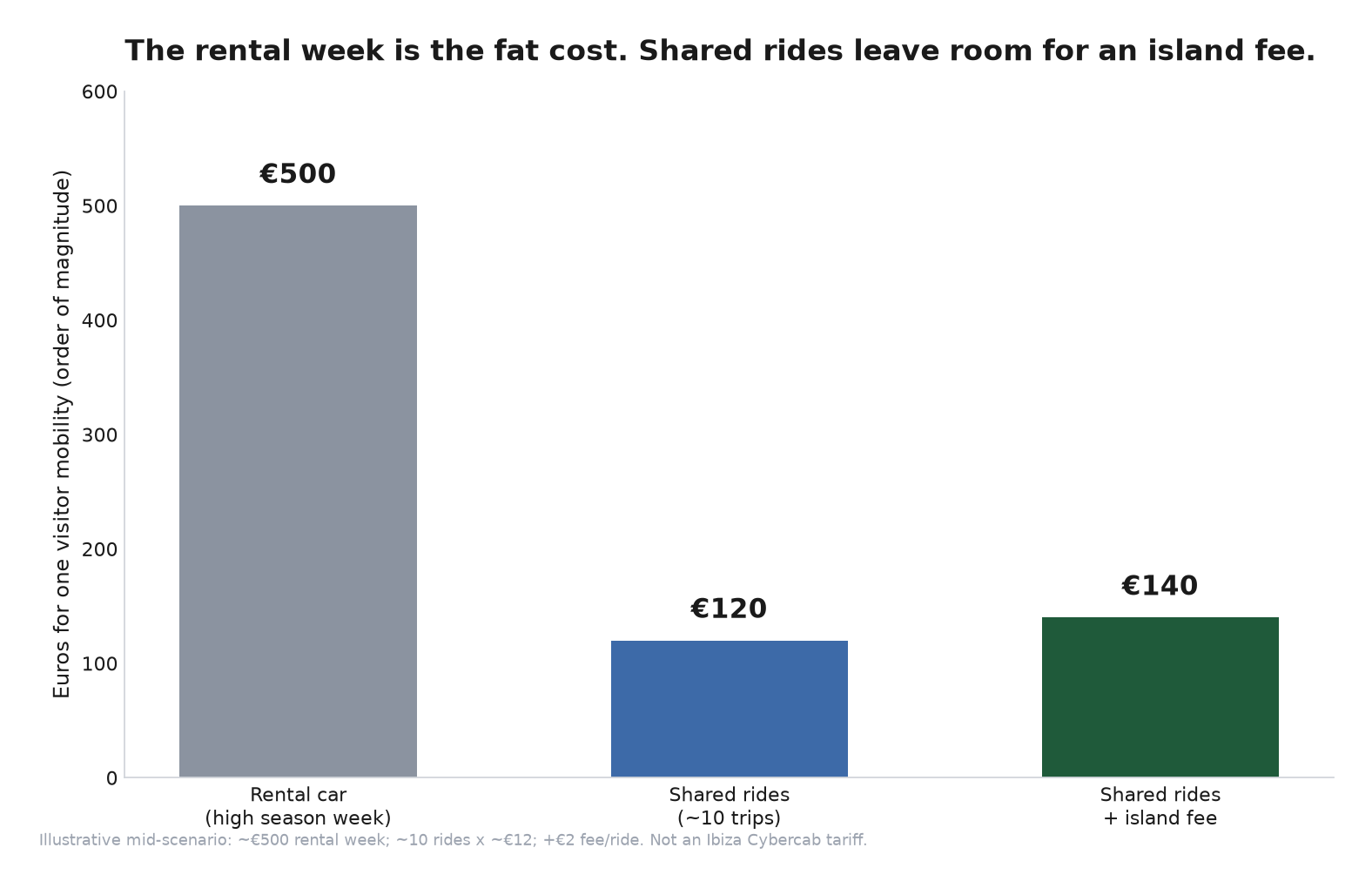
For the visitor, a high-season rental week often sits around €500 in order of magnitude. Early books can be lower; scarcity can push higher. A sketch of ten shared rides near €12, plus a small island fee, lands near €140. Same week of movement. Far less parked steel. Safer nights.
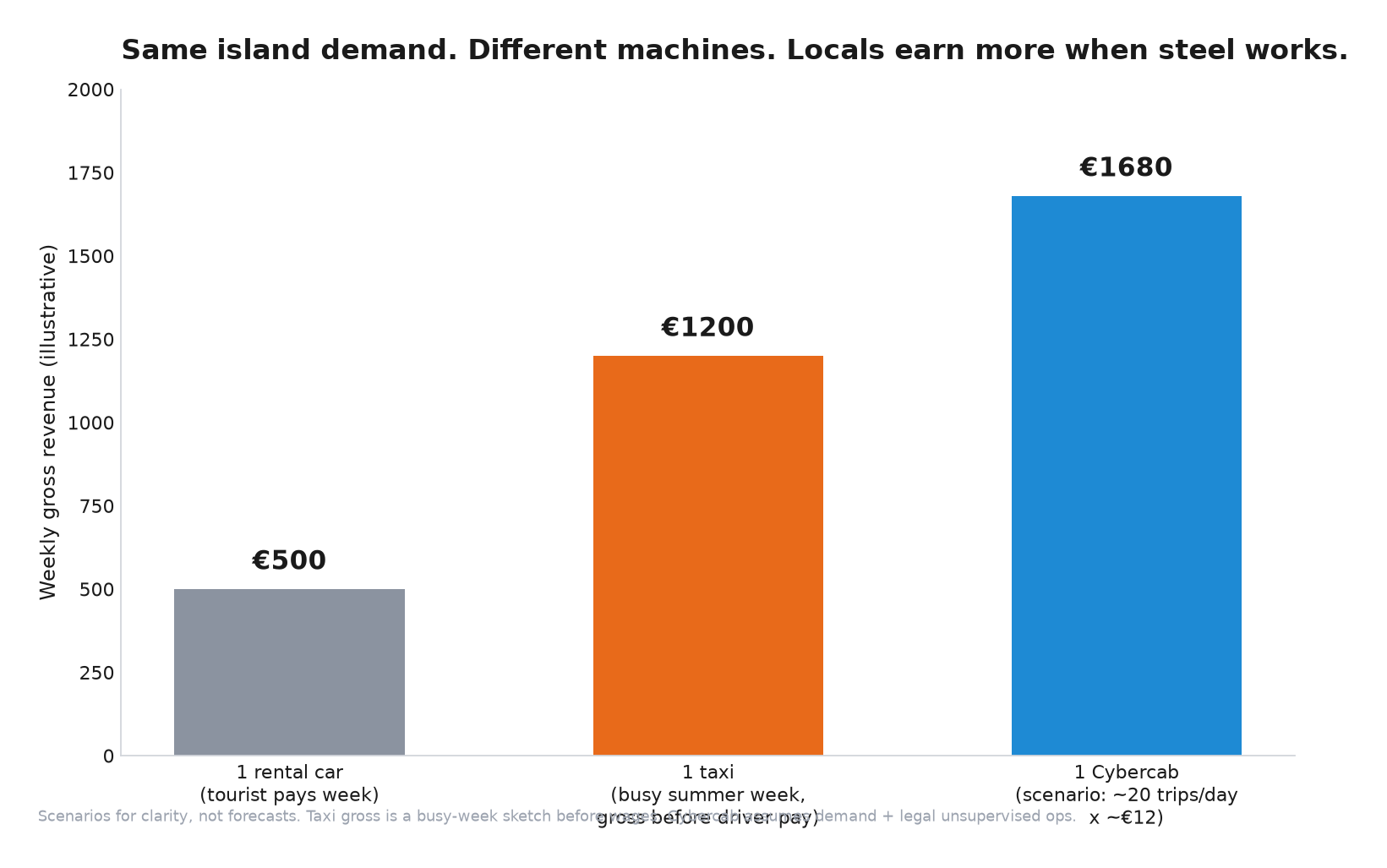
For the local owner, sketch a busy summer week the same way: one rental car near €500 gross for one customer who parks most hours; one busy taxi week near €1,200 gross before driver pay; one Cybercab scenario of about 20 trips a day at about €12, near €1,680 a week if law and demand allow. The point is blunt. Steel that works earns more than steel that parks.
The municipality’s job is thin and adult. A small fee per mile or per trip - a sliver - funds the story, helps retire bus routes that never made sense for thin demand, keeps enough working cars available, and supports lease or loan programs so more locals can buy in. Charge and clean stations, with solar and batteries, become local jobs, not imported wallpaper.
Then the flywheel. More local rental companies shift from parked fleets to Cybercabs - or to European or Chinese autonomous cars if those get licensed FSD-class software. Competition stays local. The island learns in public.
Quieter nights. Cheaper movement. The luxury of getting from A to B without owning a week of metal. An island that becomes interesting for how it moves, not only for how it parties.
Then the cab drivers
Drivers are the next group, not the only group, and not the enemy.
A fixed taxi licence near €180,000 is capital with a face. Flooding the island with robotaxis that pay those families nothing is a war. Folding that capital into the same local companies is a stake.
Trade the licence into shares in the entrepreneur Cybercab companies. The municipality helps with loans and structure so the swap is honest, not a speech. Former drivers get first right to charge-and-clean depot work, dispatch, safety checks, winter runs when the clubs go dark. Solar and battery work at the depots is more local employment on top.
Licence capital rides the flywheel instead of fighting it. The entrepreneur path comes first. Drivers join it with equity, not with a farewell.
Bring it home
Go back to Sant Antoni at 03:40.
Same couple. Same bed in Santa Eulària. This time a clean car is already there - bought by people who live here, paid with a fare the visitor can stand, watched by a town that takes a thin fee and sleeps through the night.
The rental ceiling was a stop sign. The demand kept walking.
You cannot make the good night work by delivering more parked steel, or by hoping the tourist will suddenly become a local driver. You can let people who stayed own the cars that work.
That is not a compromise between tourism and the street.
It is how a finite island answers without burning the people who live on it.