The Inevitable Ignition: Why the Age of Scarcity is Dead
We are currently living through the most significant transition in human history since the invention of agriculture. For ten thousand years, the human experience has been defined by the struggle for resources. Our wars, our political systems, and even our deepest psychological archetypes—the hunter, the hoarder, the competitor—were forged in the fires of “not enough.”
But the script has changed. The era we are entering is not a choice; it is an Inevitability. We are witnessing a “Stellar Ignition,” where the three pillars of civilization—Energy, Food, and Transportation—are hitting a point of self-sustaining superabundance.
1. The Geopolitical Mirage: Why Leaders Don’t Lead
We often look to our presidents and prime ministers as the drivers of history. But as George Friedman argues in The Next Hundred Years, leaders do not steer the ship; they are merely the actors chosen by geography and necessity to react to forces they cannot control. Geopolitics is a game of inevitable outcomes.
The current friction we see in the world—the tensions in the Middle East, the collapse of old industrial powers, the chaos in South America—are not signs of a “broken” future. They are the death rattles of an extractive system that has reached its biological limit. A leader can try to be a Luddite, they can try to protect the coal mine or the cattle ranch, but they cannot vote against a cost curve. The laws of economics are eventually more powerful than the laws of men.
2. Energy: The End of Extractive Entropy
For the first time since the Industrial Revolution, we have a path to a “Stellar” energy system—one that does not rely on burning anything. Tony Seba’s research through RethinkX proves that the combination of Solar, Wind, and Batteries (SWB) is not just an “alternative”; it is a superior economic engine that renders fossil fuels obsolete by 2030–2035.
+1
The math is simple and unavoidable:
- The Cost Curve: In the last 15 years, the investment cost for solar has dropped 80%, and for batteries, a staggering 90%.
- The Battery Buffer: Elon Musk recently noted that the U.S. grid currently has a peak capacity of 1.1 terawatts, but an average usage of only 0.5 terawatts. By using industrial battery storage (like the Tesla Megapack) to buffer energy at night and discharge during the day, we can double the annual energy output of the United States without building a single new power plant.+1
- Super Power: Because SWB systems must be built to meet demand on the “worst” weather days, they will produce a massive surplus of energy for 90% of the year. This “Super Power” will have a near-zero marginal cost, making energy effectively free, much like the marginal cost of information on the internet.+1
3. Food: The Software Revolution
The cow is the next horse. In 1900, the horse was the backbone of transport; by 1920, it was a hobby. Precision Fermentation (PF) and Cellular Agriculture are doing the same to industrial livestock.
We are shifting from an “Extractive” model of food to a “Stellar” model—what Seba calls Food-as-Software.
- The Efficiency Gap: Producing milk via a cow takes 24–28 months and is incredibly wasteful. Producing the same proteins via fermentation takes 48–72 hours.+1
- The Cost Collapse: The cost of producing animal-free dairy proteins has already dropped nearly 70% between 2021 and 2023. By 2030, these proteins will be 5 times cheaper than animal proteins, and 10 times cheaper by 2035.+1
- The Land Liberation: This shift will free up to 80% of global agricultural land—an area the size of the U.S., China, and Australia combined.
4. The Human Crisis: Survival of the Softest?
This brings us to the real disruption: The human spirit. For thousands of years, our competitive mindset was our greatest asset. We fought because there wasn’t enough to go around. Now, we are entering a world where the “External Problem” is effectively solved.
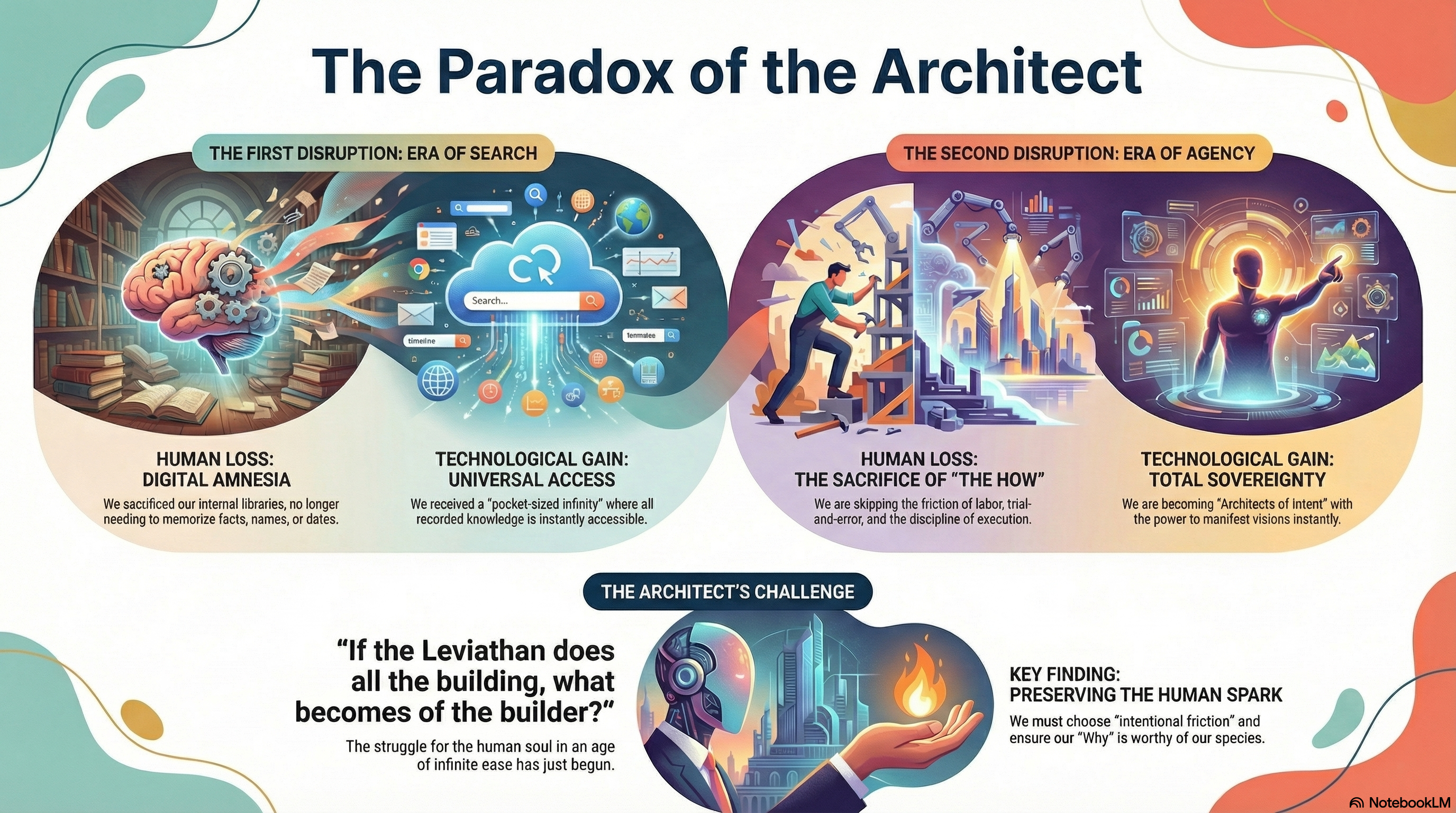
If we do not consciously transition, we will fall into what I call the “Architect’s Paradox.” We have designed a world that makes us redundant. If you continue to use a “Scarcity Mind” in an “Abundance Reality,” you will find yourself in a state of perpetual anxiety. You will manufacture “fake” scarcity—clinging to status, digital clout, or political rage just to feel the dopamine of the “hunt.”
5. The Transition: Choosing New Hardship
Abundance is inevitable. Our reaction to it is not. In my latest essay, The Paradox of the Architect, I proposed that we must learn to life like kings while choosing the path of the warrior. We must intentionally choose “Hardship” to remain conscious.
- From Scarcity to Presence: When you no longer need to fight for calories or kilowatts, the only struggle left is against your own distraction.
- The Sovereign Soul: We must use our abundance not to sleep, but to wake up. We use the time saved by the machine to “Be Aware of Being Aware.”
The future is not something that might happen. It is an ignition that has already started. The noise you hear in the media is just the friction of the old system burning away. Don’t look at the fire. Look at the light.