The Headset We Forgot We're Wearing
Two things are happening right now that almost nobody has connected.
First: AGI is arriving faster than the conversation about it. Systems that think, decide, produce, and execute — better than humans, cheaper than humans, tireless. The dominant response is either fear or compensation. The fear says we'll be replaced. The compensation says: protect your creativity, nurture your soul, be more human. Both responses sound different. They're the same mistake.
Second: at the edge of physics, something quiet is unraveling. A hundred mathematicians and theoretical physicists — funded by the European Research Council, working at institutions like Princeton and Caltech — are solving problems that require them to abandon spacetime entirely. Not metaphorically. Mathematically. David Gross, Nobel laureate: "Spacetime is doomed. It cannot be fundamental."
Most people haven't heard this. It hasn't reached the TED Talk circuit yet. But it changes everything about how we should think about the first thing.
Donald Hoffman is the bridge.
Part I — The Interface
Here is the central claim, stated plainly: your perception has nothing to do with truth.
Not slightly distorted. Not approximately accurate. Fundamentally, mathematically, categorically not designed to show you reality.
Hoffman proves this using evolutionary game theory. In simulation after simulation, organisms that perceive the world accurately — that see things as they really are — lose. Every time. They go extinct. The organisms that win are the ones tuned not to truth but to fitness: simplified signals about what to approach and what to avoid, compressed into a usable interface.
Evolution doesn't select for truth. It selects for survival. And survival is cheap — you don't need to see the full complexity of reality. You need a dashboard that tells you: eat this, run from that, mate with this.
That dashboard is what you call reality.
The table in front of you is not a table. It's an icon — a perceptual rendering that tells you "stable surface, can place objects here." Open the icon. You won't find a table. You'll find quantum fields, probability distributions, spacetime curvature. The icon is useful. But it is not the thing itself.
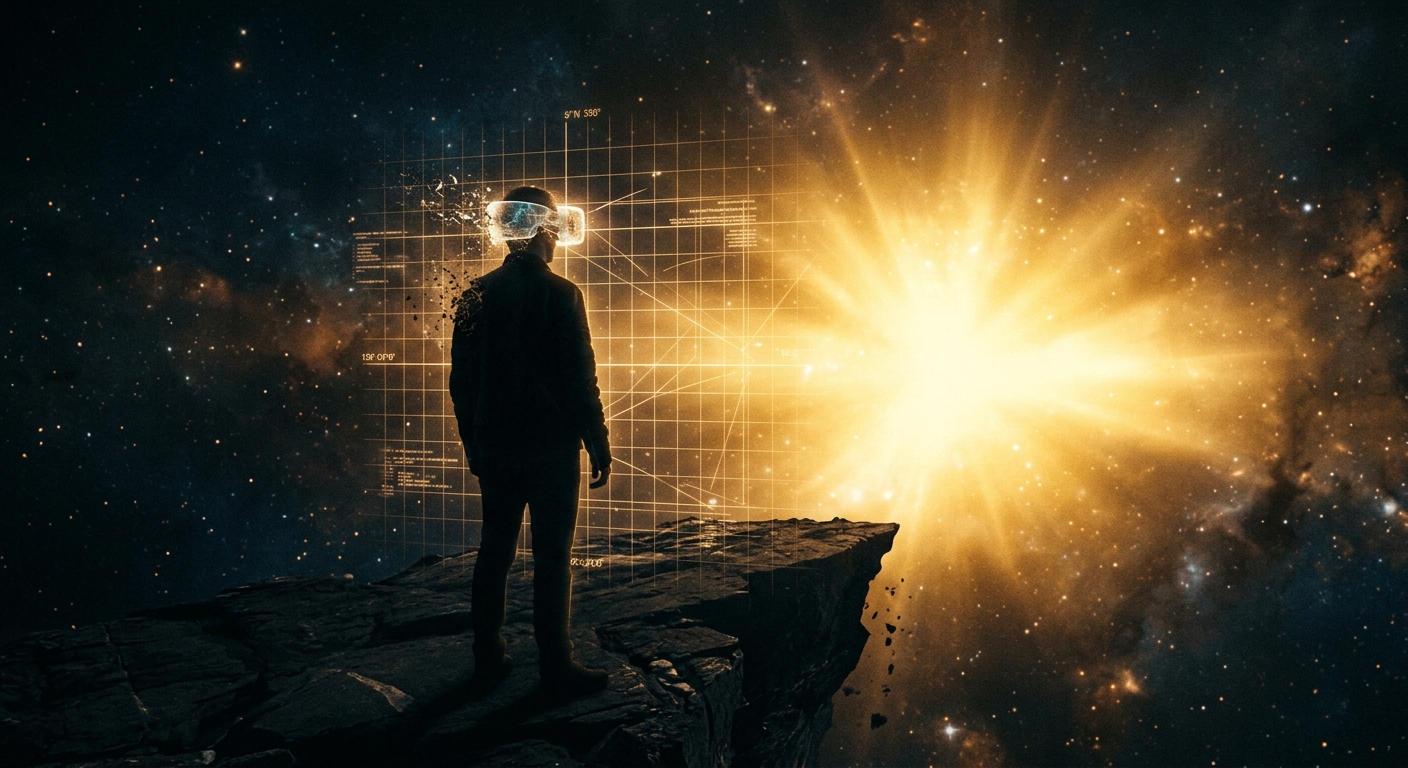
Hoffman calls this the Interface Theory of Perception. And here's where it connects to the physicists: the interface runs on spacetime. Spacetime — three dimensions of space, one of time — is the format of the human headset. Our species-specific rendering engine.
And that rendering engine, it turns out, breaks down.
At the Planck scale — 10⁻³³ centimeters — spacetime has no operational meaning. It simply stops working as a description. This isn't a gap in our measurement tools. It's a structural limit of the framework itself. Spacetime is not fundamental. It's a projection from something deeper.
The physicists working beyond spacetime have found strange objects — "positive geometries," structures like the amplituhedron — that exist outside of space and time entirely. These objects encode the behavior of particles inside spacetime, but they themselves have no location, no duration. They are not in the universe. They are prior to it.
Hoffman has spent decades building a formal mathematical theory of what might be prior. His answer: conscious agents. Networks of consciousness whose interactions, over time, project the interface we experience as physical reality.
Spacetime is not the stage. It's the rendering. Consciousness is not the audience. It's the source.
Part II — What This Means for AGI
Now the question becomes urgent.
AGI operates entirely within the interface. It processes language, patterns, logic, decisions — all spacetime-level phenomena. It navigates the dashboard with superhuman precision. It will, within a few years, navigate it better than any human in almost every domain.
If you believe the interface is all there is — if you believe that what you are is the sum of your interface functions — then AGI is an existential threat. Not metaphorically. Ontologically. If thinking, deciding, producing are what you are, and machines do those better, then you are obsolete.
This is why the fear response and the compensation response are the same mistake. Fear accepts the premise. Compensation tries to carve out a niche within the premise — "but my soul, my creativity, my human touch." It's a rearguard action on a battlefield that was lost before the fighting started.
The premise is wrong.
You are not your interface functions. You are the conscious agent for whom the interface exists.
Part III — The Ordinary Human
What do you actually do with this?
Not as a philosopher. Not as a meditator on a retreat. As someone with a job, a family, a phone full of notifications, trying to figure out what to do with the next ten years.
Here is the honest answer: most of what you spend your mental energy on is interface maintenance. Managing tasks, processing information, making decisions, producing output. These are real and necessary. But they are not you. They are what you do inside the headset.
AGI is going to take over most of that. Not all of it, not immediately, but the trajectory is clear.
The question is what happens when it does.
If you've identified yourself with the interface functions: the transition will feel like erasure. Your sense of value, contribution, meaning — all tied to what you produce. When production becomes cheap, you become cheap. This is the crisis most people are walking toward without knowing it.
If you understand what you are beneath the interface: the transition is different. You don't lose anything fundamental. You gain back time and attention that was consumed by interface navigation. The question that monks have always asked — who am I when I'm not doing anything? — becomes not a spiritual luxury but a practical necessity.
This is not about meditation as a productivity hack. It's about a genuine reorientation.
The deepest thing Vipassana trains is the disentanglement of consciousness from its content. Thoughts arise. You are not the thoughts. Sensations arise. You are not the sensations. The interface runs. You are not the interface.
That disentanglement is not a spiritual achievement. It's a description of what you actually are. Hoffman's mathematics points at the same thing from the outside. The meditative traditions point at it from the inside. They're describing the same object.
Part IV — The Cascade
Here is what changes when this understanding spreads.
For decades, the conversation about consciousness and spirituality has run in parallel to mainstream science — adjacent, tolerated, occasionally interesting, never integrated. The standard scientific story is: matter is fundamental, consciousness is what happens when matter gets complicated enough. Brain → consciousness. End of story.
That story is not just incomplete. It is mathematically incoherent. The "hard problem of consciousness" — why there is any subjective experience at all — has no solution within the materialist frame. Researchers have been working on it for fifty years. Nothing. Because you cannot get experience from non-experience by adding complexity.
Hoffman's work is beginning to change the conversation. Not by abandoning rigor — he is scrupulously mathematical — but by shifting the foundation. Start with consciousness. Derive spacetime. Derive matter. Derive physics. Show the math.
As this work gets traction — as it moves from the philosophy of mind into physics journals, into conversations between Hoffman and Karl Friston (whose Free Energy Principle is one of the most cited frameworks in neuroscience) — something shifts culturally.
The wall between "hard science" and "consciousness studies" starts to dissolve. Not because science becomes less rigorous. Because the rigorous science catches up to what the contemplative traditions have been pointing at for millennia.
When that happens — when it becomes scientifically respectable to say "consciousness is fundamental, spacetime is a variable" — a vast middle group of people becomes newly receptive. Not the committed materialists. Not the already-convinced spiritual seekers. The large, skeptical, intellectually honest middle who wanted the two stories to be the same story and couldn't make them fit.
They will fit. They already do. We just haven't found the common language yet.
Hoffman is building it.
Part V — The Synthesis
Koe says: protect your creativity from AI. Be more human.
JP Morgan says: your soul is your last competitive advantage.
Both are trying to put something against AI. Both are reacting from within a frame that AI has already won.
The synthesis is different.
AI is not the problem. AI is a clarification.
For the first time in history, we have a mirror that reflects back our interface functions with perfect fidelity. Everything we can do within the headset — reason, produce, execute, optimize — AI does better. The mirror is merciless.
But a mirror that shows you your clothes does not show you who you are.
The synthesis is not "humans plus AI." It's the recognition that what you are is prior to both. Consciousness — yours, mine, ours — is not a product of the interface. It is the source of it. AGI, however powerful, operates within the rendering. You are the renderer.
This matters at the level of civilizational orientation. If the human collective defines itself by interface function as AGI arrives, the transition will be traumatic — a species discovering it is obsolete in the role it thought was its essence. If the human collective understands what it is beneath the interface, the transition is different. AGI becomes the greatest liberation technology in history — freeing human consciousness from the burden of interface maintenance to do what consciousness actually does.
Nobody knows yet what that is at scale. History has never had the opportunity to find out.
We're about to.
I spent 30 days in silence. Not to escape. Not to relax. To find out what was left when the interface went quiet.
The answer was surprising in its simplicity. Not emptiness. Not bliss. Just awareness, prior to the content of awareness. The thing that knows it's thinking without being the thought. The observer who isn't located in the brain, isn't made of neurons, isn't threatened by the noise or the silence.
Hoffman would call this the conscious agent. The traditions call it by many names. The physicists are building mathematics that points in the same direction.
This is not a spiritual claim against science. It's a synthesis that science is beginning to reach from its own direction.
If we understand this before AGI transitions from tool to architecture — before it becomes the fabric of how civilization operates — we navigate with clarity. If we miss it, we defend our interface functions against a tide that has already turned.
The headset is not the eye that wears it.
The question AGI is forcing us to answer is the oldest question there is:
Who is wearing the headset?