How Falling Costs Will Usher in a New Energy Era and Reshape Our World
Elon Musk, ever the visionary, recently linked the future of energy to humanity's cosmic ambitions, stating that "essentially all energy generation will be solar" once you grasp the Kardashev Scale1. This scale, proposed by Soviet astronomer Nikolai Kardashev in 1964, measures a civilization's technological advancement based on its ability to harness energy2.
- A Type I civilization commands all of its planet's energy,
- Type II its star's, and
- Type III its entire galaxy's.
We, still a Type 0.73 civilization, heavily reliant on fossil fuels, have a long way to go3. But Musk's prediction, bold as it may seem, is grounded in the rapidly falling costs of solar power and battery storage, a trend poised to disrupt the energy landscape and redefine our future.
The Plummeting Price of Sunshine
Imagine a world where electricity is practically free. This isn't science fiction; it's the logical conclusion of the "Seba Curve," a phenomenon identified by clean energy expert Tony Seba4. This curve illustrates the exponential decline in the cost of solar photovoltaic (PV) and battery technologies.
Consider this: in the 1970s, solar PV modules cost over $76 per watt. Today, that price has plummeted to less than $15. Similarly, lithium-ion battery pack prices, crucial for storing solar energy, have fallen by nearly 90% in the last decade, from around $1,000 per kilowatt-hour (kWh) to roughly $100/kWh6. Seba projects that by 2030, solar could drop below $0.50 per watt, and batteries to under $50/kWh7.
The Cost Comparison: Solar Leaves Competitors in the Dust
To grasp the magnitude of this disruption, let's compare the cost trajectories of different energy sources:
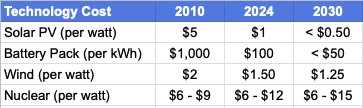
Source: Based on data from IRENA, BloombergNEF, Lazard, and expert analysis8.
While wind power has become more affordable, its cost decline is slowing. Nuclear, plagued by cost overruns and safety concerns, remains expensive9. Solar, coupled with increasingly cheap batteries to store energy for when the sun isn't shining, is on track to become the most economical energy source by far.
The Ripple Effects: A World Transformed by Cheap Energy
The consequences of this energy revolution are far-reaching:
Deflationary Impact: Imagine cheaper electric vehicles, lower heating bills, and reduced manufacturing costs. Abundant, affordable solar energy will cascade through the economy, potentially lowering the price of everything from groceries to gadgets.
The Fate of Wind and Nuclear: Giant wind farms, while vital today, may face an uncertain future as solar becomes increasingly competitive. New nuclear plants may become economically unviable, and existing ones may require significant subsidies to remain operational.
Land Use Considerations: While solar farms require land, the amount needed is often overstated. Europe could meet its 2035 electricity needs with solar panels covering an area roughly the size of Belgium10. Rooftop solar, especially in densely populated areas like the Netherlands, will be key.
Embracing the Solar Age
This transition is not just about cheaper electricity; it's about a fundamental shift in how we power our civilization. Solar energy, abundant and clean, allows us to:
- Combat climate change: Reduce our reliance on fossil fuels and mitigate the impacts of global warming.
- Enhance energy security: Decentralize energy production and reduce dependence on foreign energy sources.
- Drive economic growth: Create jobs and stimulate innovation in the clean energy sector.
Conclusion
Musk's vision, though ambitious, is within reach. The sun, our star, offers an inexhaustible source of energy. As we approach a Type II civilization on the Kardashev Scale, solar power, coupled with affordable battery storage, will be the key to unlocking a brighter, more sustainable, and more prosperous future. This isn't just an energy revolution; it's a turning point in human history.
Elon Musk [@elonmusk], "Once you understand the Kardashev Scale, it becomes utterly obvious that essentially all energy generation will be solar," X, 28 August 2024, tesla ceo elon musk essentially all energy generation will be solar x platform. ↩
Kardashev, Nikolai. "Transmission of Information by Extraterrestrial Civilizations." Soviet Astronomy, vol. 8, 1964, pp. 217-221. ↩
Carl Sagan, "Cosmos" (1980). ↩
Tony Seba, Clean Disruption of Energy and Transportation (2014). ↩
Our World in Data, "Solar Photovoltaics," solar photovoltaics our world in data [invalid URL removed]. ↩
loombergNEF, "Battery Price Survey" (2023). ↩
Seba, Clean Disruption of Energy and Transportation. ↩
See, for example, International Renewable Energy Agency (IRENA), "Renewable Power Generation Costs in 2021" (2022); BloombergNEF, "Battery Price Survey" (2023); Lazard, "Levelized Cost of Energy Analysis" (2023). ↩
World Nuclear Association, "The Economics of Nuclear Power" (2024). ↩
European Commission, "Study on the potential of solar energy in the EU Member States" (2020). ↩