The AI Reckoning: How SMEs Can Shatter Inertia Before a Garage Trio Devours Their Market
Summary
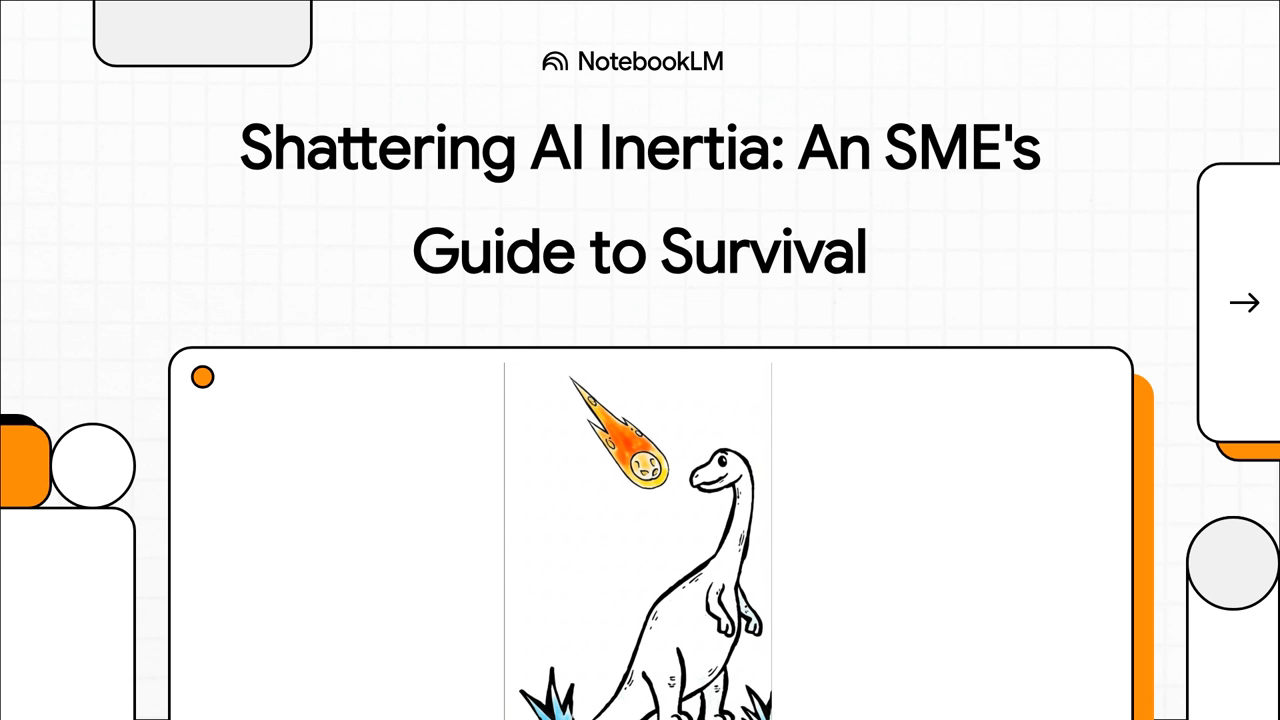
Imagine your small business humming along, only to get blindsided by three tech nerds in a garage who’ve cobbled together an AI that’s stealing your customers faster than you can say "chatbot." That’s the AI revolution, folks, and small to medium-sized enterprises (SMEs) are stuck in the mud of inertia—think Blockbuster giggling at Netflix’s mail-order DVDs while the streaming tsunami loomed. Big shots like Amazon and Spotify dodge this with their slick, nimble setups, but most SMEs? They’re more like a family reunion gone wrong—chaotic, no clear boss, and everyone’s got an opinion. So, how do you, the scrappy SME, avoid becoming dinosaur chow? Our essay dishes out a plan, backed by business brains and real-world wins, to embrace AI without needing a corporate makeover.
Here’s the gist: Kick things off with an AI Lab, a no-fuss corner (virtual or not) where your team plays with AI like kids with new toys—think HR using AI to zap resume piles or sales folks forecasting with Google’s tools. Start small, everywhere, letting everyone from accountants to marketers find AI hacks that make life easier (a cafe chain slashed food waste with AI scheduling—boom!). Next, tweak the rules: let devs build RAG systems (fancy AI that uses your company’s data to answer questions like a pro). Then, throw a hackathon, but let the business crew, not just coders, take the wheel with tools like Lovable or Windsurf to whip up prototypes—like a chatbot that charms customers. Devs just check the homework. Once you’re rolling, hunt down inertia’s hideouts—stupid approval loops or data silos—and nuke them, maybe borrowing Spotify’s “squad” vibe. Compliance? Keep it simple with platforms like Azure AI and a basic ethics policy to dodge GDPR gremlins.
The punchline? You don’t need Jeff Bezos’ budget to outrun the garage gang. Start small, spark joy with quick AI wins, and scale up by smashing old habits. That way, when those three geeks come knocking, you’re the one eating their lunch.

Inertia is the real enemy
Inertia is the stubborn resistance of an organization to change, rooted in entrenched habits, outdated processes, and fear of the unknown, which slows or stalls the adoption of transformative technologies like AI.
Picture this: It's 2007, and Blockbuster Video laughs off a scrappy startup called Netflix, dismissing their DVD-by-mail gimmick as a fad. Fast-forward a few years, and Netflix's pivot to streaming—fueled by data algorithms that predicted what you'd binge next—leaves Blockbuster in the dust, bankrupt and forgotten. That wasn't just bad luck; it was inertia, the gravitational pull of "we've always done it this way" that blinded a giant to the digital tide. Now, swap streaming for AI, and incumbents for your average small or medium-sized enterprise (SME). This week, we're entering the next phase of AI transformation: where SMEs must dive headfirst into AI, or watch a three-person team in a garage—armed with chatbots, predictive analytics, and automated workflows—steal their customers one personalized recommendation at a time. The real villain? Organizational inertia, that sticky web of outdated habits, tangled responsibilities, and fear of the unknown. Big players like Booking.com, Amazon, and Spotify have cracked the code with smart designs that keep things nimble, but most SMEs? They're messy family affairs or bootstrapped chaos, lacking the polished structure or visionary leaders to mandate change from the top. So, how do you spark transformation from within, in the trenches? Let's draw from real-world tales, fresh research, and battle-tested strategies to make this accessible—not some ivory-tower lecture, but a roadmap for the underdog ready to fight back.
Studies find inertia is everywhere
Organizational inertia isn't abstract; it's the daily grind that kills innovation. Remember Kodak? They invented the digital camera in 1975 but shelved it to protect their film empire, only to file for bankruptcy in 2012 as smartphones ate their lunch. Classic works like Clayton Christensen's *The Innovator's Dilemma* (1997) nail this: success breeds complacency, where companies chase incremental tweaks for loyal customers while ignoring game-changers that start scrappy but scale fast. Joseph Schumpeter's "creative destruction" from *Capitalism, Socialism, and Democracy* (1942) adds the macro twist: sometimes, it's better to let dinosaurs shrink and make room for nimble newcomers, but that requires gutsy government leadership—rare in democracies fixated on the next election cycle. Recent papers echo this for AI: A 2024 review by Ammar Masood et al. uses the TOE framework to show SMEs' inertia stems from cultural resistance, skill gaps, and resource crunches, making adoption feel like pushing a boulder uphill. Shashi Kant Srivastava's 2025 analysis highlights how SMEs' fragmented structures amplify this, unlike big firms with dedicated AI teams. Popular books like Ajay Agrawal's *Prediction Machines* (2018) frame AI as a cheap prediction tool, urging businesses to rethink workflows, while Kai-Fu Lee's *AI Superpowers* (2018) spotlights how SMEs can leapfrog with niche AI wins—if they overcome the mess.
Giants show Inertia can be bend
But here's the hope: Giants like Booking.com, Amazon, and Spotify have org designs that smash inertia, and SMEs can borrow sparks without a full overhaul. Booking.com thrives on a culture of relentless experimentation—think A/B testing everything from trip recommendations to chatbots, powered by GenAI for hyper-personalized travel plans. Their CEO Glenn Fogel calls AI a "revolution," and they've rolled out tools like an AI trip planner that feels like chatting with a savvy friend, boosting bookings by up to 25% in some cases. Amazon's secret sauce? "Two-pizza teams"—small, autonomous groups that own end-to-end projects, minimizing bureaucracy. CEO Andy Jassy pushes AI hard, warning that it will shrink workforces but create smarter roles; they've embedded AI in everything from warehouse robots to predictive inventory, turning data into gold. Spotify's squad model is the rebel yell: Cross-functional "squads" (like mini-startups) focus on features, grouped into "tribes" for alignment, with "chapters" sharing expertise across squads. This decentralizes decisions, letting them adopt AI for playlist curation or fraud detection without endless approvals—keeping the vibe innovative, not inert.
Not that easy to bend for SME, but bottom up
For SMEs—often a whirlwind of interlocking roles, no clear hierarchy, and leaders juggling hats—top-down mandates rarely stick. Instead, embrace the mess with bottom-up ignition. Start where the pain is real: the business side. A small retailer I know began AI transformation not in the IT closet, but with sales folks frustrated by stockouts. They piloted a simple tool like Google's AI for inventory forecasting, spotting trends from sales data—cutting waste by 20% in months. Why business devs first? They feel the customer pulse, identifying quick wins like AI chatbots for queries or personalized emails that boost conversions. Loop in software people next for integration, but don't wait for perfection. As a 2025 SBA guide advises, start small: Free tools like ChatGPT for content or Canva's AI for designs, scaling to key projects once momentum builds. Versus big swings? Pilots win—test AI on non-core tasks like automating invoices before tackling supply chains. A cafe chain anecdote: They started with AI scheduling staff shifts (via tools like When I Work's AI), freeing owners from spreadsheets, then expanded to predictive ordering, dodging food waste amid inflation.
Overcome the hidden dragon
Compliance? It's the hidden dragon, but SMEs can tame it without lawyers on retainer. EU's AI Act offers SME-friendly simplifications, like lighter rules for low-risk tools. Pick compliant platforms (e.g., Microsoft's Azure AI with built-in GDPR checks), draft a simple AI policy outlining ethical use, and monitor with audits—starting small avoids big fines. One marketing firm dodged trouble by using AI for ad targeting but anonymizing data upfront, staying ahead of privacy regs.
Turn inertia into velocity with AI Labs
To truly accelerate, though, you need a structured yet flexible playbook—backed by business science—that turns inertia into velocity. Drawing from resource orchestration theory in a 2024 ScienceDirect study on AI in manufacturing SMEs, the key is bundling resources into learning capabilities, starting with an "AI Lab": a lightweight, cross-departmental hub (even virtual) where a handful of enthusiasts experiment without red tape. This mirrors Singapore's AI readiness frameworks, adapted for Italian SMEs in a 2025 arXiv paper, emphasizing self-assessment tools to spot gaps and pilot projects. Inspire adoption by seeding small wins across departments: Encourage teams to hack their daily grind with AI, like HR using tools for resume screening or finance for expense predictions. A 2025 MDPI study on AI in SMEs found this bottom-up approach boosts knowledge and reduces resistance, aligning with the TOE framework's organizational readiness pillar. Real case: A Swedish packaging SME orchestrated AI resources this way, starting small to build governance capabilities, yielding 15-20% efficiency gains.
Business people hackathons
Next, tweak the rules: Loosen hierarchies for agile experiments and have devs establish Retrieval-Augmented Generation (RAG) systems—custom AI that pulls from your company's knowledge base for accurate, context-rich answers. Per a 2025 bibliometric review, this addresses data requirements and skills gaps in SMEs, turning fragmented info into a competitive edge. Then, flip the script: Let business developers lead hackathons, not just coders. Arm them with no-code/low-code tools like Lovable (an AI-powered app builder for quick prototypes) or Windsurf (an AI code editor that accelerates development), to whip up MVPs—like a customer chatbot or demand forecaster. Devs review for feasibility, ensuring polish without gatekeeping. This echoes IBM's 2025 insights on gen AI pilots, where hackathons overcame adoption hurdles by quantifying ROI early, and a French SME case where similar events spiked innovation by 30% in marketing.
Remove inertia hotspots
Once rolling, audit for inertia hotspots—like rigid approval chains or siloed data—and surgically remove them, perhaps by adopting Spotify-like squads. A 2025 ScienceDirect paper on AI in NPD for Irish SMEs showed this pinpointing led to 27% KPI improvements, proving that sustained momentum comes from iterative destruction of barriers. One Italian manufacturing SME, per arXiv research, used such a phased roadmap to bridge digital gaps, turning AI from buzzword to bottom-line booster.
Inertia is a choice SMEs can't afford
In this AI storm, inertia is a choice SMEs can't afford. Borrow from the bigs: Form "pseudo-squads" for experiments, celebrate small wins to build culture. Start business-first, pilot humbly, scale boldly, and weave compliance in early. Follow this lab-to-hackathon flow, and that garage trio? Make them chase you. As Schumpeter knew, destruction births creation—disrupt your own world, or watch it crumble. The tools await; your move.