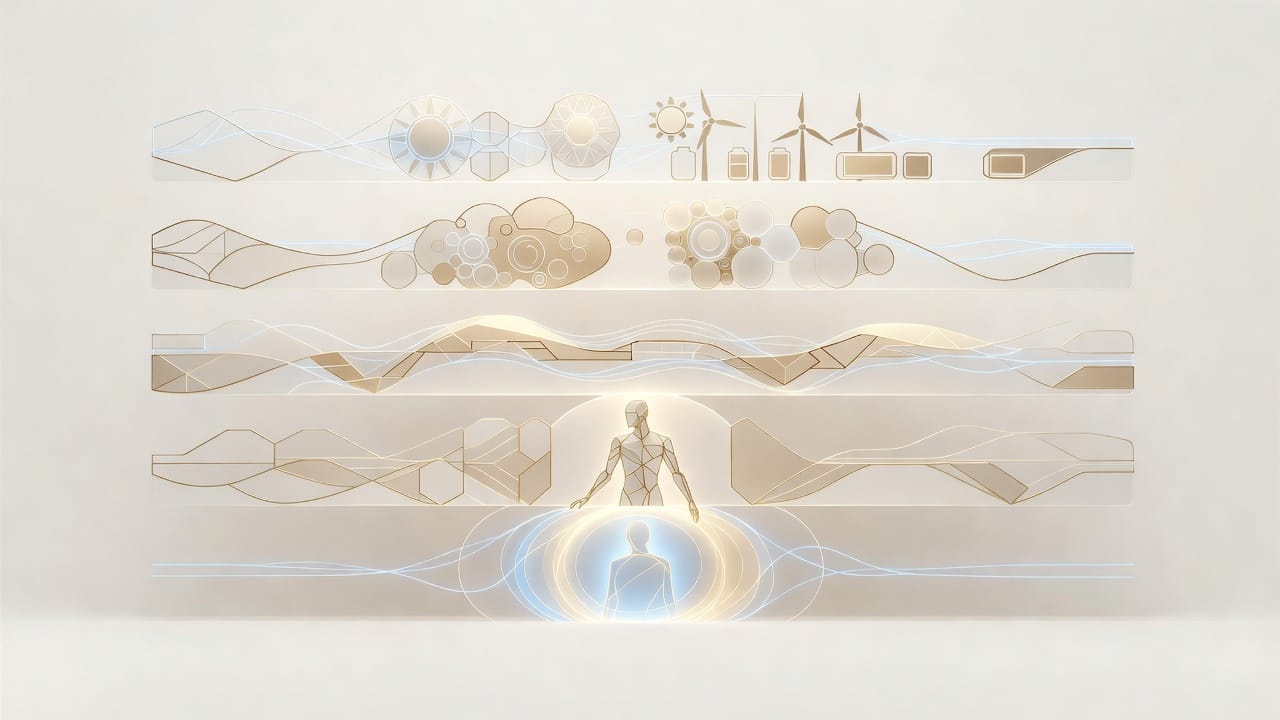
Energy, food, transport, labor, and health are not separate trends. Together they expose the real scarcity: presence, love, trust, and spiritual maturity.
Energy, Food, Transport, Labor, Health
RethinkX is often read sector by sector.
Energy. Transportation. Food. Labor. Health.
That is understandable, but it misses the deeper pattern. The work of Tony Seba, James Arbib, Adam Dorr, and the RethinkX team is not a pile of industry reports. It is a map of the dismantling of scarcity infrastructure.
Each sector is a layer. Each layer removes an old constraint. Together they form something much larger than technological progress.
They form an abundance stack.
Energy makes power abundant.
Food makes nutrition programmable.
Transport makes mobility electric, autonomous, and service-based.
Labor makes useful action scalable.
Health makes human vitality more maintainable and resilient.
When these are viewed separately, they look like trends. When viewed together, they look like a new operating system for civilization.
That is the real RethinkX story.
Not “solar panels are cheap.”
Not “robots are coming.”
Not “Ozempic is popular.”
Those are headlines. The deeper story is that the cost structure of civilization is changing.
Energy: the end of extractive power
Energy is the base layer.
For most of industrial history, power came from extraction and combustion. Coal, oil, gas, uranium, pipelines, shipping routes, mines, refineries, grids, geopolitical alliances, wars, and utility monopolies all formed around a simple fact: energy was scarce, fuel-based, and geographically uneven.
Solar, wind, and batteries change the logic.
Not because they are morally superior, although cleaner air and lower emissions matter. They change the logic because they move energy toward technology economics. Fuel extraction gives way to manufacturing. Burning gives way to harvesting. Marginal fuel cost gives way to near-zero marginal production once the system is built.
This is why RethinkX’s solar-wind-battery work is so important. It argues that a clean energy system is not merely feasible. In many contexts, it becomes economically superior to the legacy system. Overbuilding renewable generation can be rational. Curtailment is not necessarily waste. Surplus electricity becomes a new industrial raw material.
A scarcity mind sees excess generation and asks, “Why build more than demand?”
An abundance mind asks, “What becomes possible when clean energy is cheap most of the time?”
Hydrogen. Desalination. Synthetic fuels. Direct air capture. Flexible manufacturing. Data centers. Local resilience. Electrified transport. Heat. Robotics. Food production. New forms of industry that were previously too energy-expensive to consider.
Energy abundance is not just lower bills.
It is the opening of the possibility space.
Food: the cow is the next horse
Food is the second layer.
Industrial agriculture looks eternal because it is physically massive. Fields, barns, slaughterhouses, subsidies, trucks, brands, supermarkets, cultures, recipes, rituals, and rural identities create a feeling of permanence.
But permanence is often a psychological effect of infrastructure.
RethinkX’s food and agriculture work argues that precision fermentation and cellular agriculture can disrupt livestock because they attack the system at the level of efficiency. A cow is a biological machine that turns plants, water, land, time, antibiotics, and methane into protein. It is beautiful as an animal. It is astonishingly inefficient as industrial infrastructure.
Microorganisms do not need the whole cow.
They can produce proteins directly.
That is why the line matters: the cow is the next horse.
Not gone. Not hated. Not meaningless. But economically displaced where a superior production system takes over.
This becomes even more interesting when connected to health. RethinkX’s health work suggests that Health Optimizer Therapies may reduce calorie consumption while increasing demand for high-quality protein, especially if future therapies support muscle gain or preservation. A population eating fewer empty calories and requiring more protein-dense nutrition creates pressure on the existing food system.
Precision fermentation may not just replace old food.
It may become the protein infrastructure of optimized health.
This is how the stack works. One disruption activates another.
Energy makes fermentation cheaper. AI accelerates biological design. Health changes demand. Food production becomes more programmable. Land and water are freed. Agriculture shifts from extraction to precision.
Again: not a trend.
A layer.
Transport: mobility becomes software
Transportation is the third layer.
The internal-combustion car is not merely a vehicle. It is a civilization pattern: oil, roads, parking lots, suburbs, dealerships, repair networks, insurance, traffic deaths, pollution, commuting, logistics, and the psychological identity of ownership.
Electric vehicles already disrupt part of that pattern. Autonomous vehicles may disrupt the deeper structure.
RethinkX’s transportation work has long argued that transport-as-a-service could collapse the economics of private car ownership in many contexts. Whether every date lands perfectly is less important than the core logic: when a vehicle becomes electric, software-defined, autonomous, and fleet-managed, mobility is no longer the same product.
A combustion car sits unused most of the time. It carries debt, insurance, maintenance, parking, fuel, and depreciation. It is an expensive private asset with low utilization.
An autonomous electric fleet vehicle is a moving service machine. Higher utilization changes cost. Electric drivetrains reduce maintenance. Software improves capability. Fleets learn. Cities reorganize. Parking demand falls. Logistics changes.
The point is not that every person stops owning a car tomorrow.
The point is that mobility shifts from scarce personal hardware toward abundant service access.
And when transport connects to energy, the stack deepens. Solar-wind-battery systems power electric fleets. Vehicle batteries interact with grids. Autonomous logistics lowers the cost of moving goods. Food and manufacturing supply chains shift. Labor inside transport changes.
The old world sees a car.
The new world sees a node in an energy-data-mobility system.
Labor: action becomes scalable
Labor is the fourth layer, and it may be the most psychologically disruptive.
Energy gives us power. Food gives us nutrition. Transport gives us movement. Labor gives us action.
Human civilization has always been constrained by available labor: hands, backs, attention, skill, training, patience, care, risk, coordination, fatigue, and time. Wealth has often meant command over other people’s labor. Poverty has often meant selling one’s own labor under pressure.
Humanoid robotics changes this at the root.
RethinkX forecasts that humanoid robot labor may enter below $10 per hour, fall below $1 per hour before 2035, and continue toward near-zero marginal cost. The relevant unit is tasks per hour per dollar. Robots perform tasks, not jobs. As the task library grows, the labor system changes.
This should not be reduced to “robots take jobs.”
That frame is too small.
The larger frame is: what happens when useful physical action becomes abundant?
Construction, elder care, agriculture, maintenance, cleaning, logistics, disaster response, manufacturing, household support, small business operations, repair, personal assistance, education, and medicine all contain suppressed demand for labor. Much that should be done is not done because human labor is too expensive, scarce, tired, unsafe, or unavailable.
Artificial labor may reveal a hidden civilization: all the care, maintenance, beauty, repair, and craft we wanted but could not afford.
But ownership matters. If the labor layer is owned by a handful of platforms, abundance becomes dependency. If communities, firms, families, and nations have real access, control, repairability, and sovereignty, artificial labor can become a liberation engine.
Same technology.
Different civilization.
Health: vitality becomes maintainable
Health is the fifth layer, and the most intimate.
RethinkX’s 2026 report on Health Optimizer Therapies argues that medicine is shifting from damage control toward continuous optimization. GLP-1s are the first visible wave. Future combinations with myostatin and activin blockers may support fat loss and muscle gain. Broader therapies may target bone, cardiovascular, immune, metabolic, skin, and cognitive health.
The report predicts that by 2040, at least one billion adults may use personalized HOTs under medical guidance.
Whether that number is exactly right is less important than the category shift.
Health becomes infrastructure.
A healthier population is not only a lower-cost population. It is a more capable population. More resilient older adults. Less chronic disease. Less pain. Less addiction. Less compulsive consumption. More mobility. More energy. More years of useful strength. More agency.
This changes demand across the stack.
People eat differently. Food systems shift. Healthcare demand changes. Insurance changes. Labor participation changes. Sports and recreation change. Aviation changes. Military readiness changes. Relationships change. Aging changes.
Most importantly, the person’s relationship to the body changes.
The body is no longer only a fragile organism to be rescued after failure. It becomes a platform of vitality to be maintained, strengthened, and guided.
That sentence can become dystopian if handled badly. A body is not a corporate dashboard. A person is not a performance metric. Optimization without wisdom becomes anxiety with better tools.
But optimization in service of agency is different.
A body with more vitality can meet truth more directly. It can act with less friction. It can explore, love, build, repair, protect, and create.
Health abundance should not make us narcissists.
It should make us more available to life.
The real scarcity after abundance
If RethinkX is even broadly right, then many of the old scarcities are already solved in principle. Energy is solved directionally. Food is solved directionally. Transport is solved directionally. Labor is being solved directionally. Health is being solved directionally. Climate is not emotionally solved, politically solved, or atmospherically repaired, but the technological path out of fossil dependence has already appeared.
So what remains scarce?
Not stuff. Not calories. Not information. Not even, eventually, labor.
What remains scarce is presence. Love. Trust. Great friendship. Deep inspiration. Beauty that is not content. Spiritual maturity. The ability to sit in the present moment without immediately trying to optimize it, monetize it, manifest it, or escape it.
Abundance will make this more obvious, not less. When the material struggle softens, the inner struggle becomes visible. We will have to do the work now to become human, because technology can remove many constraints but it cannot meditate for us, love for us, forgive for us, or stand in wonder for us.
The stack compounds
The real power of the abundance stack is that each layer reinforces the others.
Cheap clean energy supports AI, robotics, drug discovery, precision fermentation, transport electrification, desalination, and manufacturing.
AI accelerates robotics, biological design, drug discovery, logistics, energy management, and autonomous systems.
Precision food supports better health with less land and fewer ecological costs.
Healthier people can work, learn, care, and adapt better.
Artificial labor builds, maintains, and deploys the physical infrastructure faster.
Autonomous transport lowers logistics costs across every sector.
Solar-wind-battery systems reduce the marginal cost of the whole stack.
This is why the word “abundance” should not be treated as motivational language. It is an economic architecture.
Scarcity civilization was built around expensive energy, inefficient food, costly movement, scarce labor, and fragile health. Institutions formed around those constraints. So did politics. So did culture. So did religion, status, family structure, empire, class, and identity.
When the constraints move, everything built on top of them begins to shake.
That is why the transition feels chaotic. It is not just innovation. It is an ontological insult to the old order. The old system does not merely lose market share. It loses its claim to inevitability.
Abundance is not sovereignty
There is one trap here.
Abundance does not automatically create sovereignty.
A country can live inside technological abundance while owning none of the crucial layers. It can enjoy cheap devices, clean energy, AI services, robotic labor, precision foods, and health technologies while depending on foreign platforms, foreign chips, foreign drugs, foreign cloud, foreign capital, foreign operating systems, and foreign security.
That is not sovereignty.
That is comfort.
Europe is especially vulnerable to this confusion. It has a wealthy consumer base, strong institutions, high education, and beautiful social systems. But if it does not own enough of the engines — energy infrastructure, AI compute, robotics, batteries, biotech, manufacturing, capital formation, and software platforms — it will experience abundance as a customer.
A comfortable customer, perhaps.
But still a customer.
You are not sovereign because you benefit from the future.
You are sovereign when you can build, govern, repair, finance, and defend the systems that make the future unavoidable.
What abundance is for
The abundance stack forces a question that is both practical and spiritual.
What is abundance for?
If the answer is only consumption, the future will become decadent. More comfort, more entertainment, more optimization, more passive luxury, more dependency, more distraction.
If the answer is control, the future will become technocratic. Bodies managed. Labor automated. Food engineered. Energy optimized. Movement tracked. Life smoothed into compliance.
But if the answer is agency, the future becomes interesting.
Energy abundance can power exploration.
Food abundance can restore land and reduce suffering.
Transport abundance can reconnect people and place.
Labor abundance can free human time for care, craft, science, art, learning, and beauty.
Health abundance can give people the vitality to actually use their freedom.
That is the optimistic version. Not naive. Not guaranteed. But worthy.
RethinkX gives us the material map. The curves, the sectors, the costs, the convergence, the system dynamics.
The human task is different.
We must decide what kind of people we become when scarcity stops disciplining us from the outside.
The abundance stack is coming into view.
The question is whether we will build sovereign humans on top of it — or merely comfortable consumers inside it.
Sources: RethinkX, Rethinking Humanity; RethinkX, Rethinking Energy and solar-wind-battery work; RethinkX, Rethinking Food and Agriculture; RethinkX, Rethinking Transportation 2020–2030; RethinkX Labor research; RethinkX, Rethinking Health: The Health Optimizer Therapy Disruption (2026).