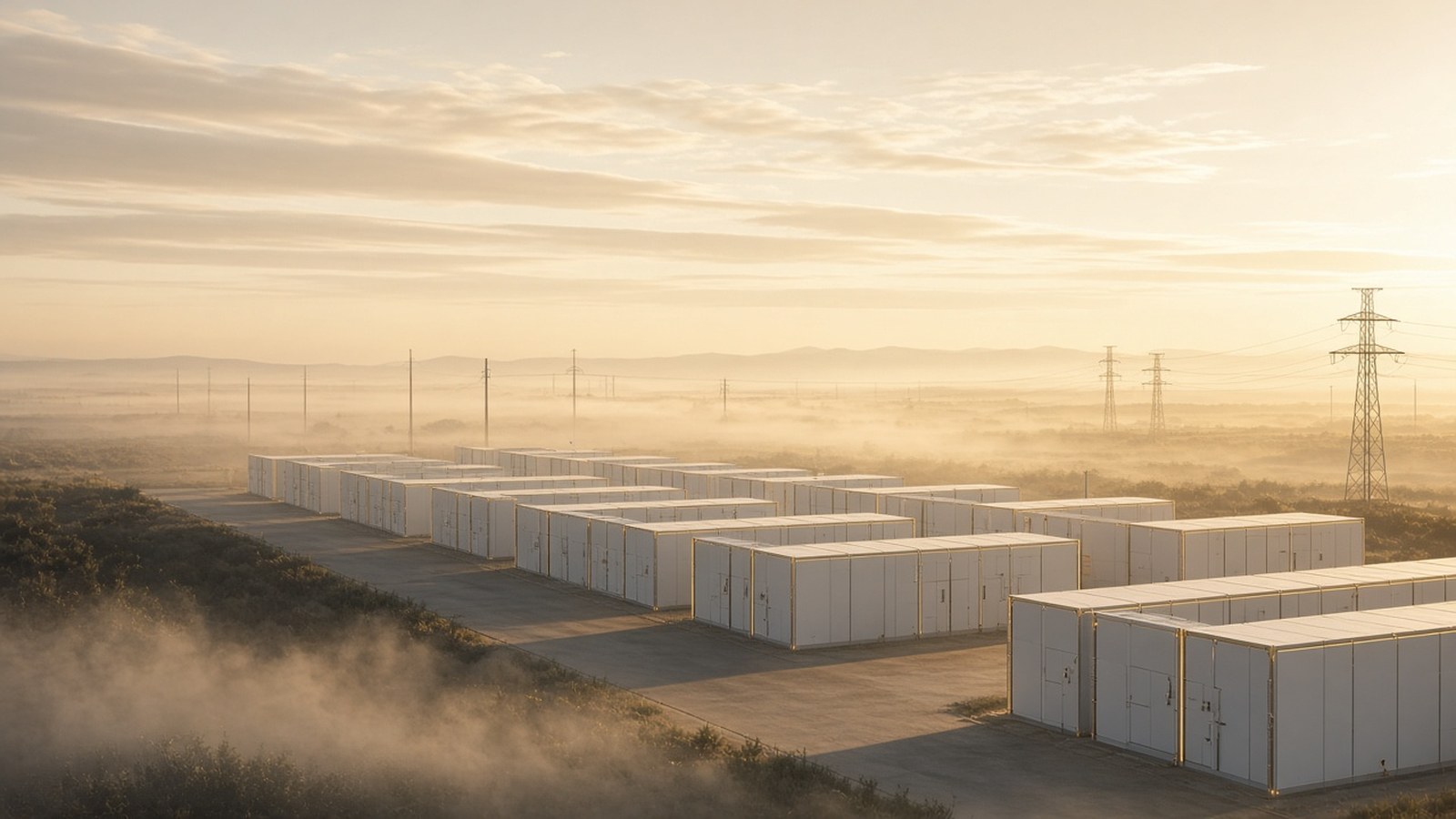
Across the border in Belgium, crews have started a battery park that can, at peak, move as much power as roughly three hundred and eighty-five thousand homes use in a day. In the Netherlands, builders filed grid requests for about six hundred thousand new homes — and the cabinet still aims for a hundred thousand a year. The technology that breaks the shortage story is already pouring concrete. The politics of scarcity is still deciding how little we are allowed to build.
On a former industrial strip near the Dutch border, the story stops being abstract.
Belgium is building Green Turtle: hundreds of Tesla Megapacks, about seven hundred megawatts and nearly three gigawatt-hours of storage, a project on the order of six hundred and fifty million dollars. At peak it can supply electricity on the scale of the daily use of some three hundred and eighty-five thousand households. Construction has started. Commissioning is aimed for early 2028. It is not a housing estate. It is a machine for time — soaking up surplus wind and sun, giving it back when the wire is hungry — so the grid stops being an excuse to freeze the future.
Drive a short way north and the language changes.
Dutch grid operators say that between January and the first of July this year, applications came in for electricity connections for roughly six hundred thousand new homes over the coming three years — more than twice a normal three-year build. Developers rushed the door before the rules tightened. Almost half of those requests have no immediate room on the wire. More than half, the operators say, can still be connected in that window — which they place neatly beside the cabinet’s ambition under Prime Minister Rob Jetten: one hundred thousand homes a year.
Six hundred thousand asks. One hundred thousand as the official horizon. A neighbor pouring steel for storage that treats shortage as an engineering problem. That is not a spreadsheet. That is a picture of two minds.
One mind manages scarcity. The other builds past it.
The soft story that hardens into law
Scarcity feels like weather. Rents climb. Waiting lists lengthen. Someone serious explains that the grid is full, that nitrogen rules bind, that Europe must be careful, that we must share what little there is. The story sounds moral. It sounds adult.
It is also a choice.
Socialism, in the generous version, wants to fix a wound: too many people left behind. The method is to treat the pie as fixed and fight over slices. Cap this. Queue that. License the rest. The wound does not close. The dilemma thickens. Shortage becomes the operating system — and the people who run the operating system need shortage to stay employed as its managers.
Disruptive technology and market scale do something else. They raise the floor. Poor and rich both get more absolute capacity — light, heat, miles, compute, square meters — even when the gap between them stays ugly. Capitalism with real innovators is not a sermon about virtue. It is a machine for more. Abundance is not the same as wealth for a few. Abundance is when the constraint that used to define a life stops being binding.
Tony Seba’s curves are blunt about the direction: once the S-curve bends, there is no polite off switch. Batteries, electric miles, solar, intelligence as a service — the stack is already moving. Delay is not neutrality. Delay is a policy.
What well-meaning hands actually achieve
Look at the first jump in prosperity and you will see the same reflex. Output rises. Fear rises with it. Someone writes a rule to make the jump “fair,” “safe,” “orderly.” Sometimes the rule prevents a real harm. Often it protects the old scarcity model — the utilities, the permits, the ministries whose dignity is rationing.
Yuval Harari is right that disruption leaves wreckage and people behind. Pretending otherwise is propaganda. The answer is not to smash the curve. The answer is to refuse the lie that braking the curve is compassion. Slowing abundance has victims too: the couple who will not get a key this decade, the factory that will not electrify, the kid whose attention will be eaten by scarcity politics instead of freed by cheap power and cheap intelligence.
Belgium’s park does not abolish injustice. It makes one hard constraint softer. That is how abundance usually arrives — not as a speech, as a substation and a row of cabinets humming in the rain.
The Dutch mirror
So why not meet the six hundred thousand where they are — clear the path, build storage like the neighbor, let entrepreneurs who already filed the paperwork move?
Because the dominant frame is still distribution. There must be a plan. There must be a fair share of a shortfall. The grid is “full,” as if capacity were a lake with a fixed shoreline instead of a system you can buffer, price, and expand. The official ambition settles at a round hundred thousand a year, and the machinery congratulates itself for aligning with that number while nearly half the connection asks sit outside the wire.
Scarcity thinking does not ask: what would make six hundred thousand possible? It asks: how do we allocate one hundred thousand without a riot?
That is the mismatch. The product that dissolves it is not a prettier waiting list. It is capacity — storage, generation, faster wires, by-right building where the maps allow — owned and driven by people who ship, not by people who manage the shortage.
No off switch
You can dislike billionaires and still need the physics. You can want a floor under the losers of disruption and still refuse to worship delay. The curve does not wait for a European caste to feel ready. It waits for concrete, capital, and permission.
Across the border, permission looks like a battery field sized for hundreds of thousands of homes’ worth of daily power. At home, permission looks like a target that fits the congestion story.
Scarcity is what we rehearse. Abundance is what we build when we stop rehearsing.
The exit is not a fairer division of emptiness. The exit is plenty — then the freedom to spend a life on something other than fighting over the scraps.