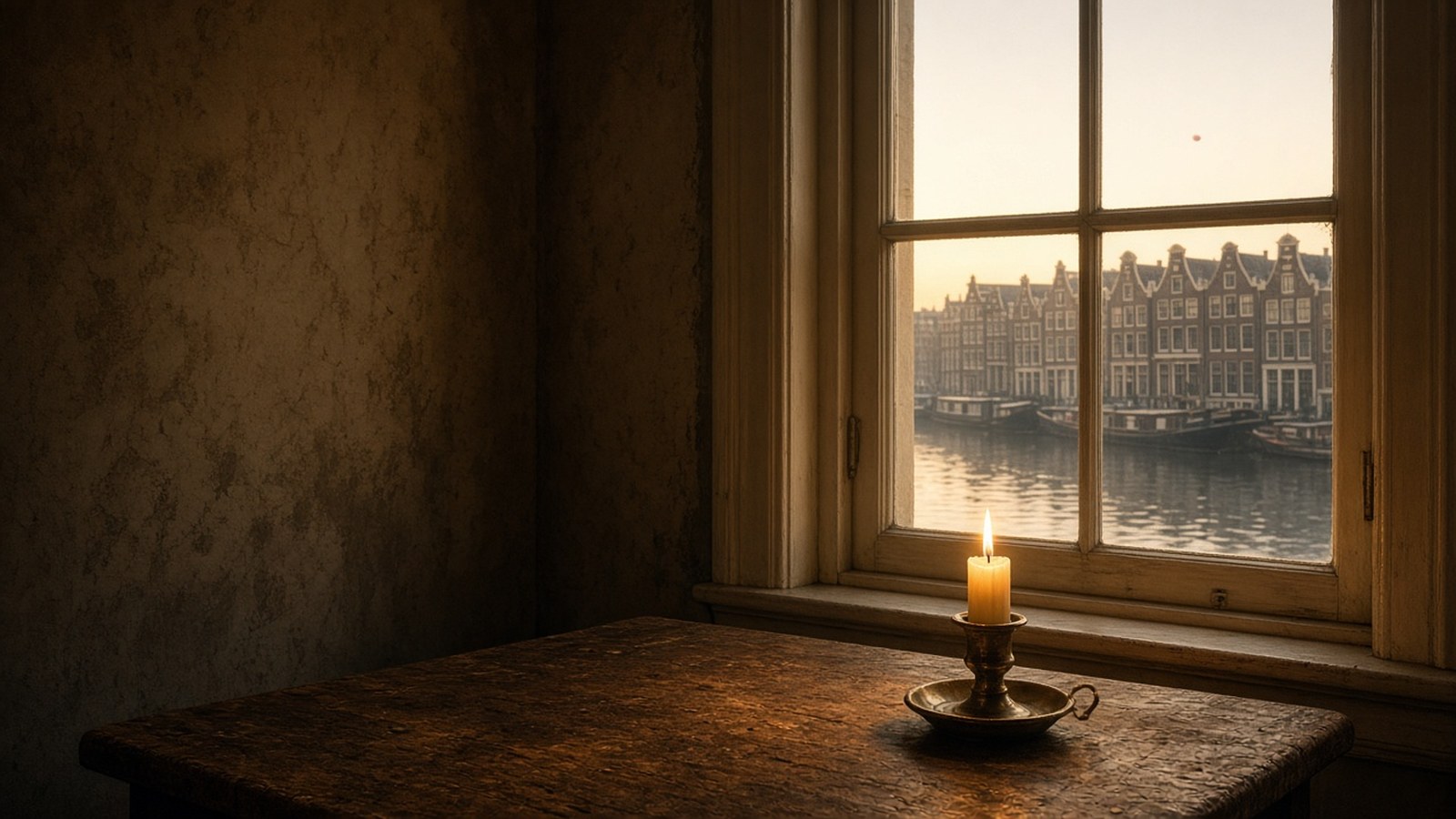
From Amsterdam I watch America build an abundance stack in public: robotaxis, Grok in the car, Starlink, Optimus, and a promise of universal high income. Elon builds to keep the light of consciousness from going out. I want to know what we do with it once it is safe. Elon wants to preserve the light of consciousness. I want to explore enlightenment. Whatever that turns out to be.
It is early in Amsterdam and the light comes in low over the canal. A bike rattles across the bridge. On my phone, on the other side of the ocean, a car is driving itself while the man inside asks an AI to sort out his inbox.
This is how I watch America now. From a kitchen table, in an old trading city built on water, while the United States builds something in public that most people still read as a pile of separate headlines.
I have seen this pattern before.
I have used Apple since the early nineties, back when that was more a confession than a choice. I carried a Palm, then a Treo, years before the iPhone. Those devices were brilliant and half-finished. You could feel what they wanted to become. When the iPhone arrived I did not think: nice phone. I thought: this is the end of them. Apple had the whole stack, so Apple would take the whole thing. It did.
That is not a credential. I did not build any of it. It is a habit of seeing: recognizing the moment when separate gadgets turn out to be one machine.
It is happening again.
Put the news of the last few weeks in one frame.
In Austin, anyone can now hail a Cybercab. It is a two-seat car with no steering wheel and no pedals. There is nothing inside to drive with, because nobody is meant to.
In ordinary Teslas, Grok now rides along. Tesla put it plainly: FSD Supervised with Grok “is a lot like having your own Robotaxi.” You talk through your calendar and your email while the car handles the road. Elon says Grok’s usage is growing faster than anything they have ever seen.
Above it all runs Starlink, which Elon now calls “often more reliable than cable.” Within days of this writing, the first Starship to reach orbit is due to carry Starlink V3 satellites meant for real service.
And in the factories, Optimus: a humanoid robot, learning to do what hands do.
Taken one by one, these are gadgets. Taken together, they are something else. Movement without a driver. Labor without fatigue. Intelligence on call. Connection everywhere, and cheap power from sun and batteries underneath. That is not a product line. It is an abundance stack: one machine that takes the scarcities people organized their lives around and turns them, one after another, into infrastructure.
Why build it? Elon has answered that question for years, and the answer has hardly moved.
“Our collective light of consciousness is a tiny candle in a vast darkness,” he wrote. “Please do not let it go out.” Making life multiplanetary on Mars, he says, “really is about preserving the light of consciousness.”
I take that seriously. As far as we know, there is no life anywhere else. If consciousness is that rare, keeping it on one planet is a single point of failure. The rockets, the cars, the robots, and the money they earn all serve one purpose in his telling: keep the candle burning. That is a moral project, and a beautiful one.
The money part matters more than it seems. In a short reply this month, Elon wrote that the old tradeoffs change “when AI and robots are ubiquitous, as there will be universal high income.”
Read that sentence slowly. Not a basic income, a floor to survive on. High income. A world where machines do the work and people share the returns. Work becomes something you choose, not something you owe.
Now picture it across billions of lives. The commute, the shift, the forms, the overtime. All the hours people sold because they had to sell them. Handed back.
Down on the canal, a courier rides past with a crate strapped to the front of his bike. In the world being built across the ocean, that ride becomes optional.
This is where my half begins. Not against Elon. Next to him.
Preserving the light keeps it burning. It does not tell you what to look at by it.
Almost every story I read about the abundance future stops in the same place. The income arrives. Work is optional. Civilization has a backup on a second planet. The end. As if a preserved consciousness were automatically a fulfilled one. As if free hours turned into wisdom on their own.
They don’t. We have already seen the small version of this experiment. Machines gave us back time before, and much of it flowed straight into screens designed to keep it. The hours came home, and we handed them over again.
So the question I care about is the one that comes after the rocket.
I don’t know what enlightenment is. I have read the old traditions. I have sat in silence long enough to notice how rarely my mind is quiet. I have no method to sell and no teacher to recommend. What I have is a question that gets sharper every year the machines get better: once we no longer spend our consciousness on survival, what is it for?
Maybe presence. Maybe love, practiced on purpose instead of squeezed between obligations. Maybe something the contemplatives pointed at for thousands of years that we never had the free time, as a species, to test. For most of history, only a small group of monks and the idle rich had hours to spend looking inward. Abundance could make that search ordinary. Not a retreat for the few. A normal part of being alive.
Almost nobody builds for that. There are enormous plans for moving our bodies and doing our labor. For what a free mind does on a Tuesday morning with nothing it has to do, we have a meditation app and a feed.
The risk is not that the robots fail. The risk is that they succeed, and our attention gets captured again.
Freed attention will be the most valuable thing the abundance economy produces, and everything that wants power will want it. Platforms. Movements. Governments. Gurus. I wrote earlier that harder power is still the same power. A stronger hand does not free what a weaker hand held. Attention works the same way. Trade one master for a more persuasive one and you are not freer. That is not the flaw of one country or one ideology. It is a human trap, and the more free time we have, the wider it opens.
That is why exploring cannot mean a new doctrine. The moment enlightenment has a manual and a membership, it becomes one more thing competing for the hours abundance gave back. Exploring means keeping the question open, especially when someone kindly offers to close it for you.
The light over the canal is full now. Rembrandt worked in this city, chasing the way light falls on a face in a dark room. Elon wants to carry that light to another planet so it can never go out. Good. Someone has to, and he is actually doing it.
But a candle kept safe is where the story starts, not where it ends. The rocket keeps the light. The robots and the high income give us the hours to look at what it shows.
What we will see, I can’t tell you. That is the frontier, and almost nobody is building for it yet.
Elon wants to preserve the light of consciousness. I want to explore enlightenment.
Whatever that turns out to be.