Kill Your Uncles and Sleep Well: What the Bhagavad Gita Teaches About Necessary Action
The darkest moment in the Bhagavad Gita happens before the war begins.
Arjuna stands on the battlefield. Across from him: his teachers, his uncles, his cousins. People who raised him. People he loves.
Krishna tells him to kill them anyway.
This isn't metaphor. This isn't about "releasing limiting beliefs" or "letting go of the past." This is the actual instruction: do what must be done, even when the obstacle is someone you care about.
I've spent three decades building businesses, leading organizations, and dissolving what I built when it stopped serving. I've sat through 30-day Vipassana retreats and written code with AI in the same year. And here's what I've learned about the magician-monk synthesis Krishna teaches:
The obstacle is rarely abstract. It's often someone you love whose role in your life must transform or end.
The Neurobiology of Arjuna's Paralysis
Arjuna freezes on the battlefield because he's caught in what neuroscience calls "inaction crisis." He knows what must be done. He cannot do it.
Research on letting go reveals something critical: people can take decisive action while simultaneously releasing attachment to outcomes. But only when the motivation is autonomous—when you truly identify with the decision—rather than controlled, where you feel forced by external pressure.
Arjuna's paralysis comes from controlled motivation. He's thinking about what others expect, what his role demands, what tradition requires. That's why Krishna spends 18 chapters restructuring his entire framework before Arjuna can act.
The synthesis isn't "just do it" or "just let go." It's both, held simultaneously.
I learned this when I was 29, living in Amsterdam's vivid lifestyle. I had an urge for solitude. Not escape—I wasn't running from anything. I was ready. I discovered Vipassana meditation and its 10-day silence retreats.
The difference between earned retreat and spiritual bypassing is autonomous motivation. When you're genuinely ready, solitude feels like the natural next step. When you're bypassing, you're hoping meditation will fix something you haven't faced yet.
I met a guy after one retreat who said he was disappointed his disease hadn't gone away. He missed the point entirely. He came with attachment to an outcome, which is the opposite of what the practice teaches.
The Family You Must Outgrow
Here's what makes Krishna's instruction brutal: research shows that when you undergo significant personal growth, families unconsciously trigger homeostatic pressure to restore familiar dynamics.
Your growth literally threatens the system's stability.
The people who love you will pull you back toward who you were, not because they're malicious, but because your transformation destabilizes their world. One clinician notes that people "will tear themselves apart rather than comfortably end something that is not working for them."
I was fortunate. My parents never imposed expectations. My grandmother told me to go out into the world and do whatever I wanted. But that freedom created its own challenge: when you can let go easily, you have to dig deeper to find what's actually real beneath the constructions.
The magician builds ego. The monk dissolves ego. This is the process.
I've built businesses, created spreadsheets projecting wealth, assembled teams. What I call "being filthy rich at the end of the spreadsheet." That's always a lie. But the commitment to building is real. The work is real.
And then you let it go.
Not because it failed. Not because you lost interest. Because life moves in cycles, and what you built served its purpose. The instability of constant building and dissolving forces you to find what remains when the structures fall away.
Dharma Is Not What Others Expect
Krishna doesn't tell Arjuna to follow duty because society demands it. He tells him to follow his sva-dharma—the dharma belonging to him specifically as a warrior.
The Gita's teaching: "Better is one's own duty, though imperfect, than the duty of another, well performed."
The action required isn't what feels comfortable or what others expect. It's what structural reality demands of your specific position in the larger pattern.
I'm 55. I still have energy to create. I need money. And I want to test my insights through lived experience, not just theorize about them.
Theory without practice is philosophy cosplay.
So I build software with AI. I write about consciousness and technology. I hold the tension between progress and presence because they're not contradictory—they're the same investigation into what's real.
The magician phase always builds stress. The monk phase always brings relief.
Here's the dilemma: if letting go always feels better, why not skip the stress entirely and go straight to monk mode?
Because you earn the right to let go by first committing fully.
Be Committed Every Day, Not Attached to the Outcome
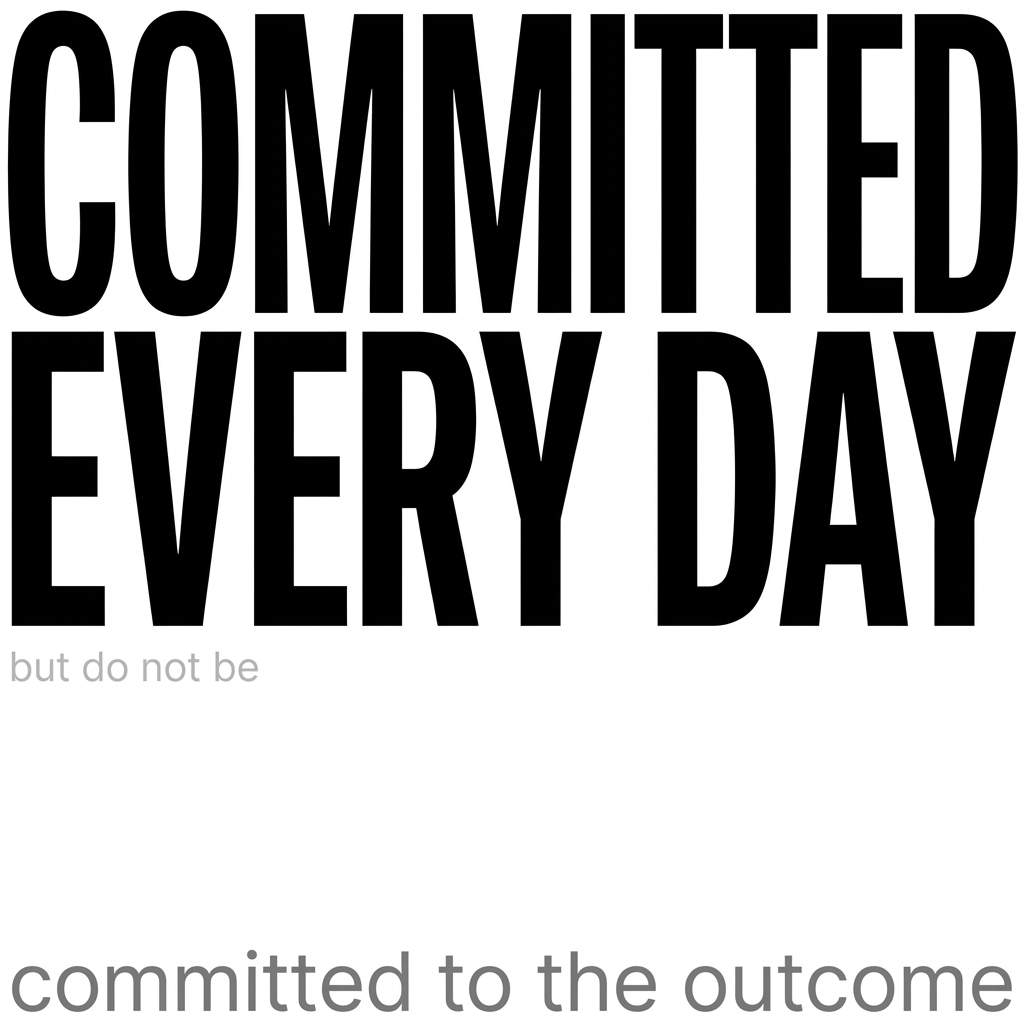
This is the synthesis in one sentence: be committed every day but do not be committed to the outcome.
Most people hear "act without attachment to outcome" and think it means not caring, or going through the motions. That's not what Krishna teaches. That's not what I've lived.
When you're genuinely holding both—committed to the daily work, released from outcome attachment—here's what it feels like:
The magician phase builds stress. Always. You're creating, assembling, pushing forward. The tension accumulates.
The monk phase brings relief. Always. You let go, and the pressure releases.
But you can't access the relief without first building something worth releasing. You can't dissolve ego you haven't constructed. You can't let go of outcomes you never committed to creating.
The people who try to jump straight to monk mode—who reach for meditation retreats or inner peace work before they've done their magician work—are bypassing. They're hoping to cure a disease through detachment when what they need is engagement.
I'm still not ready for full monk mode. I still have things to create in daily life. I still have insights to test. And that's fine.
The question isn't whether you're a magician or a monk. The question is whether you can hold both without clinging to either.
What You're Actually Killing
When Krishna tells Arjuna to kill his uncles, he's not asking him to become heartless. He's asking him to act from a level of consciousness where duty transcends the attachment-fear circuit.
The obstacle isn't always a person. Sometimes it's a mentor whose advice no longer fits. A family expectation that's crushing you. A version of yourself that served you once but now holds you back.
Sometimes it's the business you built. The identity you constructed. The spreadsheet you believed in.
You're not killing what's real. You're releasing what was always temporary.
The synthesis Krishna teaches isn't about achieving perfect security or permanent peace. It's about accessing both the approach system (magician) and the withdrawal system (monk) functionally, as the situation demands.
Do what must be done. Then let it go completely.
Neither alone is enough.
The magician without the monk becomes attached to outcomes and suffers when they don't arrive. The monk without the magician becomes detached from reality and mistakes passivity for wisdom.
You need both. You hold the tension. You build the stress and release it. You commit fully and let go completely.
And when the obstacle is someone you love, or a version of yourself you've outgrown, you do what Arjuna finally does after 18 chapters of instruction:
You act.
Not because you want to. Not because it feels good. But because structural reality demands it, and you've earned the clarity to see what must be done.
Then you sleep well.
---
Read the full article and explore more at roelsmelt.com.
Disrupt Consciousness examines the collision between exponential technologies and human awakening. Founded by Roel Smelt, it bridges three decades of business leadership, Vipassana practice, and AI-native creation to explore what becomes of human purpose when machines solve scarcity. This is the intellectual infrastructure for a world that realizes freedom only after the machines stop demanding our labor.