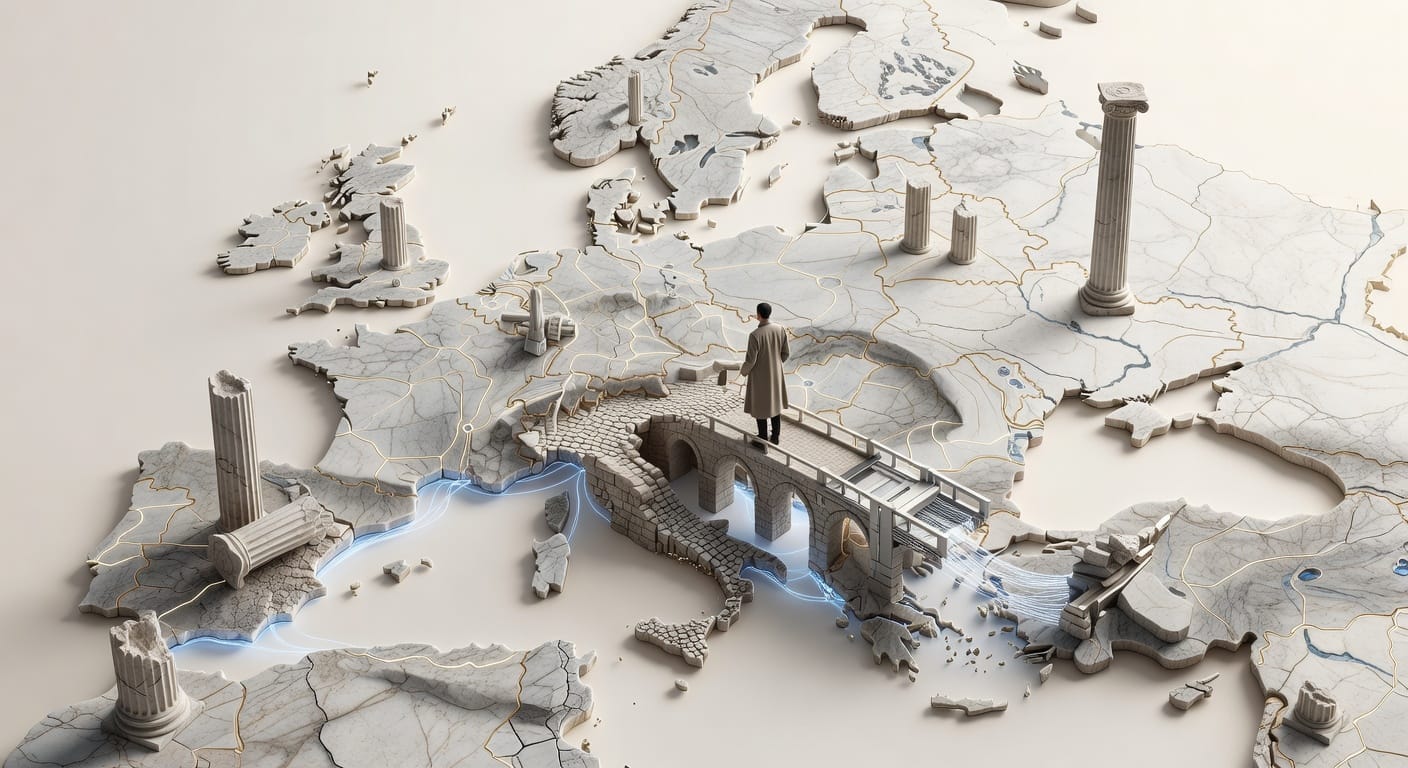
Yes. And this is exactly why the frequently heard call “Europe must reinvent itself” sounds so true, yet is institutionally so false. Europe has three deep structural brakes that make genuine frontier innovation almost impossible. These are not temporary policy mistakes. They are not budget shortfalls. They are not a lack of talent or capital. They are fundamental features of a continent that bought peace through compromise — and in doing so, lost the ability to make the great leap. First: the
Yes. And this is exactly why the frequently heard call “Europe must reinvent itself” sounds so true, yet is institutionally so false.
Europe has three deep structural brakes that make genuine frontier innovation almost impossible. These are not temporary policy mistakes. They are not budget shortfalls. They are not a lack of talent or capital. They are fundamental features of a continent that bought peace through compromise — and in doing so, lost the ability to make the great leap.
First: there is no demos.
There is no European people. What we have are peoples — each with their own languages, traumas, interests, and collective memories. European unity can therefore only be built through procedures, compromises, and legal constructs. That has delivered decades of peace, a historic achievement. But it does not create a frontier culture. There is no shared feeling of “we are building the future, whatever the cost.” Without that common fire, Europe remains a beautiful, well-functioning machine that never truly dares to dream.
Second: an overdeveloped trauma against power.
Europe is rightly afraid of kings, dictators, empires, and mass movements. That fear is justified by history. But it has overshot. It has become a fundamental distrust of any form of greatness: big capital, big companies, big energy projects, big personalities, big risks. Success here may only be celebrated after it has first been thoroughly morally laundered. Greatness is suspect. Ambition must apologise. And that is the exact opposite of what frontier technology demands.
Third: bureaucracy as a substitute for entrepreneurship.
Brussels is world champion at setting boundary conditions, opening markets, procuring defence, and establishing standards. That is valuable work. But Brussels cannot want a Mistral. It cannot want an ASML. It cannot want a Tesla, SpaceX, or xAI. Innovation does not emerge from policy notes or subsidy programmes. It emerges from concentrated energy: visionary founders, bold capital, exceptional talent, technical obsession, and above all — permission to move. Europe rarely grants that permission. And when it does, it attaches so many moral and administrative brakes that the spark is extinguished long before any fire can ignite.
The Draghi report was essentially the diagnosis document of a continent that is still just smart enough to recognise its own disease. But what follows is the pattern we have seen for decades: crisis absorbs strategy. Ukraine becomes defence. Energy becomes emergency measures. Migration becomes political theatre. Climate becomes regulation. And innovation? Once again, just another chapter in the next policy paper.
The harshest sentence is this:
Europe wants the fruits of abundance, but not the moral burden of the systems that produce that abundance.
So yes: we will use American AI, American cloud, American chips and accelerators, American platforms, American biotech, and American defence intelligence — while continuing to say that we do it in a more humane, sustainable, and sensible way.
That is becoming the European posture: dependence combined with moral superiority.
Not even hypocritical out of malice. More tragic. An old continent that purchased peace with compromise, but in doing so became steadily worse at the frontier aggression that AI, chips, energy, and space now demand.
America is messy, violent, unequal, sometimes insane — but it still possesses one thing Europe lacks:
Permission for disproportionate ambition.
And that is why capital and talent keep flowing to Austin and San Francisco. Not because everyone thinks America is “better.” But because the people who want to build something great have to explain themselves far less there about why they even dare to try.